Ali Banisadr and Gustave Moreau, two painters outside the mainstream Review of Ali Banisadr's exhibitions in Paris
The Iranian artist, who lives in New York, is exhibiting his works in Paris at the Musée Gustave Moreau, alongside paintings by the 19th-century artist, and at the Thaddaeus Ropac gallery.
By Philippe Dagen
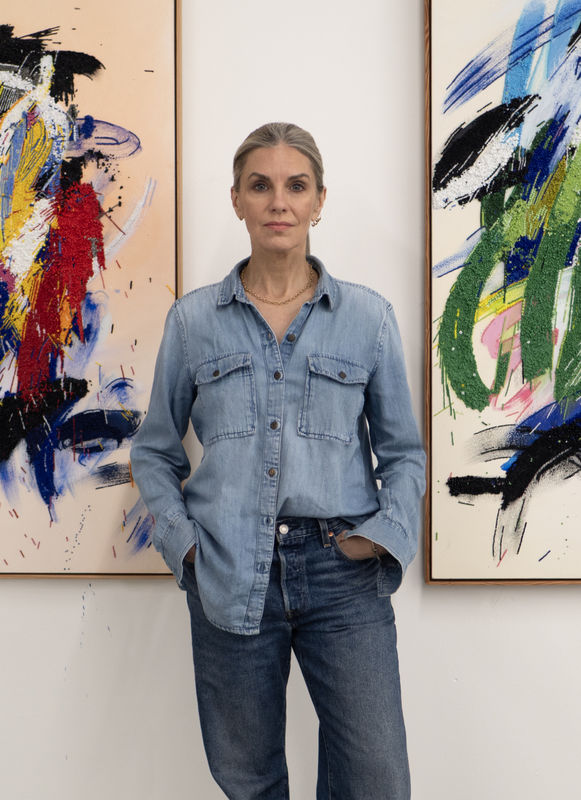
Ali Banisadr comes and goes in the house that was once Gustave Moreau's (1826-1898) studio, now his museum, on rue Catherine de La Rochefoucauld in Paris's 9th arrondissement. What is the painter, born in Tehran in 1976, living in New York since 2000, and whose studio is in Brooklyn, doing in these rooms from another era? He is checking the presentation of his works, which he has chosen to show alongside those of Moreau: paintings, pastels, drawings, and, a new addition to his work, sculptures. The museum invited him to participate in this project while simultaneously exhibiting at the Thaddaeus Ropac gallery in the 3rd arrondissement of Paris.
The two presentations are grouped under the same title, 'Talisman,' which is also the title of one of the canvases. It draws the eye from afar, yet it defies description. A being, human or divine, appears at the center, head down, surrounded by a white and green halo. There are other anthropomorphic creatures, in the form of specters or fragments, still others reminiscent of birds, and also all sorts of signs, curves, and vividly colored patches. The same is true for Smoke and Mirrors , another of the large canvases, but also for smaller ones, Terrible Beauty or Residue . The bronzes are named Cyclops , The Alchemist , or Gilgamesh , the legendary king of Mesopotamia whose epic is one of Banisadr's favorite readings. Many other mythologies are present, sometimes barely perceptible. [...]