Ali Banisadr: Ali Banisadr's first major monograph
€ 85.00
Talisman is an exhibition of new works by Tehran-born, New York-based artist Ali Banisadr. Spanning paintings, sculpture and pastels, the exhibition brings together the central languages of Banisadr’s practice: densely orchestrated pictorial worlds, archetypal figures, symbolic fragments and charged objects that seem to carry memory across time. Running concurrently with Banisadr’s exhibition at the Musée national Gustave Moreau, Paris, Talisman unfolds in dialogue with the French Symbolist master, whose work has become a key point of reference for this new body of work.

Talismans are loaded objects: vessels of protection, transformation and transmission. For Banisadr, imagery can operate in the same way. The enigmatic hieroglyphs and hybrids that hide among the artist’s gestural passages of paint are conceived and developed in the crucible of his sketchbook, through an intuitive process whereby he progressively distils ideas down to their most compact possible visual representation.

The Tower, 2026
Oil on linen
43.2 × 35.6 cm (17 × 14 in)
He then transfers these emblem-like figurations onto canvas, where they act as shorthand for a limitless network of thoughts and narratives, recalling Symbolist semiotics: living forms that move, mutate and gather meaning. In this sense, Talisman reflects Banisadr’s recent immersion in the work of Moreau, while extending his longstanding investigation into the migration of imagery across civilisations, from ancient Mesopotamian and Egyptian art and Persian miniatures to Renaissance painting and modern abstraction.

Banisadr is known for paintings in which figuration confronts abstraction, and maelstroms of gestural movement balance intricate storytelling. In this new body of works, he employs increasingly architectonic compositional structures. Oblique horizons, portals and elusive grid-like structures interrupt the picture plane, creating pressurised spaces in which multiple worlds appear to transpire at once.

Smoke & Mirrors, 2026
Oil on linen
167.6 × 223.5 cm (65.98 × 87.99 in)
Within the shifting lattice of forms in Smoke & Mirrors (2026), figures unfold, retreat or are absorbed in the ephemeral pattern of rising smoke, reflecting Banisadr’s fascination with illusion, distraction, disguise and concealment.


Above: Pages from Ali Banisadr’s sketchbook.
Below: Francisco de Goya, Fight with Cudgels, 1820–23. Museo del Prado, Madrid.
In Social Contract (2026), meanwhile, a diagonal rupture fractures the composition, suggesting an accord strained to its breaking point. Echoes of Thomas Hobbes’s 1651 work of social theory Leviathan and the suspended psychological struggle of Francisco de Goya’s Fight with Cudgels (1820–23) resonate in the diffuse conflict and atmospheric tension of the work.
In Talisman (2026), a winged, upside-down figure emerges from the centre of the composition, its fiery head surrounded by a halo. Banisadr was inspired by ‘The Hanged Man’ in tarot, which represents self-sacrifice. The cryptic creature also harks back to Moreau’s L’Apparition (1876; Musée d’Orsay, Paris), in which the hovering severed head of Saint John the Baptist materialises before Salome, beaming with light whilst dripping with blood.

The Alchemist, 2025
Bronze
Part 1: 40.6 × 17.8 × 22.9 cm (16 × 7 × 9 in)
Part 2: 10.2 × 17.8 × 8.9 cm (4 × 7 × 3.5 in)
The exhibition also features a group of Banisadr’s bronze sculptures, which function as talismanic presences in the gallery. Mythological beings summoned from the pictorial space into three dimensions, these sculptures nonetheless operate as independent archetypes: guardians, witnesses and intermediaries between material and imagined worlds.

Cyclopes, 2025
Bronze
38.1 × 15.2 × 12.7 cm (15 × 6 × 5 in)
Their modulated surfaces recall archaeological fragments and ritual objects. Banisadr approaches sculpture with the sensibility of a painter, working the surfaces of his bronzes with patina applied by brush.

Gilgamesh, 2025
Bronze
40.6 × 12.7 × 12.7 cm (16 × 5 × 5 in)
As curator Michelle Yun Mapplethorpe has written, their ‘weathered, quasi-figurative nature’ recalls the sculptures of Cy Twombly and Alberto Giacometti, while remaining deeply rooted in Banisadr’s own visual language of transformation and emergence.

Sky Boat, 2026
Pastel, charcoal and ink on paper
87 × 121.5 cm (34.25 × 47.83 in)
A significant development in Talisman is the presentation of Banisadr’s debut exploration of pastel as a complete and independent vehicle for his imaginarium. He has long engaged in drawing as a daily ritual, serving to bring subliminal images to the surface, but here, his pastels become fully realised works in their own right.

Mask of the Prophet, 2026
Pastel, charcoal and ink on paper
62.5 × 45.5 cm (24.61 × 17.91 in)
For the artist, the relationship between pastel and painting is reciprocal. This exchange is visible in canvases that incorporate pastel and oil stick atop oil paint, expanding the material vocabulary of the paintings themselves and allowing Banisadr to build and layer colour, texture and atmosphere.

Angle, 2026
Pastel, charcoal and ink on paper
87 × 121.5 cm (34.25 × 47.83 in)
The drier, more brittle pastel collides with the fluidity of the paint to bring certain forms to the fore. This untethering reinforces the artist’s conception of the canvas as a deep space set in motion, where structures can break down and come back together, figures advance and recede, and reference and history are woven together according to the logic of magic and dream.
Talisman at the Musée national Gustave Moreau, Paris, is open until 7 December 2026. The exhibition Ali Banisadr: Temple of the Mind is currently on view at Buffalo AKG Art Museum, NY until 8 November 2026. The museum’s first-ever artist collection intervention, it places works by Banisadr spanning the last 15 years among Surrealist and Abstract Expressionist works from the permanent collection. His work is also on view in the exhibition Tarot! Renaissance Symbols, Modern Visions at The Morgan Library & Museum, New York until 4 October 2026.

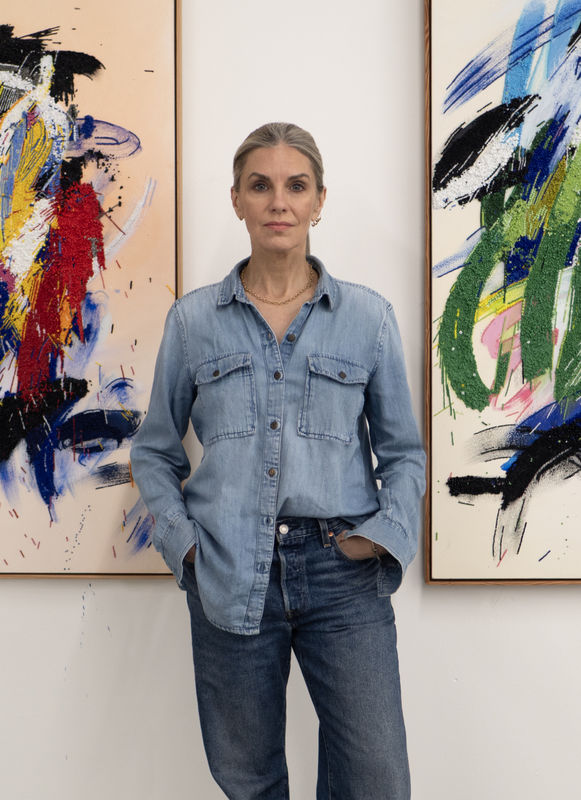
In his paintings, Ali Banisadr creates intangible worlds in which figuration and abstraction are delicately balanced, creating a rhythmic sense of motion in vibrant colours across the canvas. Influenced by the experience of synaesthesia, whereby his senses of colour and of sound are intertwined, he translates this internal state into visual terms.
Born in Tehran in 1976, Banisadr moved to California with his family when he was a child. While living in San Francisco, he studied psychology and became involved with graffiti art. He has lived and worked in New York since 2000, when he moved to the city to study at the School of Visual Arts and the New York Academy of Art. Since his first solo exhibition in 2008, his work has been shown at numerous museums, including S.M.A.K. Stedelijk Museum voor Actuele Kunst, Ghent (2010); Kunstmuseum Den Haag, The Hague (2011); The Metropolitan Museum of Art, New York (2012); Lehmbruck Musem, Duisburg, Germany (2013); Aga Khan Museum, Toronto (2017); The Museum of Fine Arts, Houston (2017); and a two-person show with Andrew Sendor at the Museum of Contemporary Art, Jacksonville, USA (2019). He was included in Love Me/Love Me Not: Contemporary Art from Azerbaijan and Its Neighbours at the 55th Venice Biennale in 2013. Recent solo exhibitions include at the Het Noordbrabants Museum, 's-Hertogenbosch, Netherlands (2019); Benaki Museum, Athens (2020); and Wadsworth Atheneum Museum of Art, Hartford, USA (2020). Ali Banisadr: The Alchemist, the first major US museum survey of Banisadr’s work, was on view at Katonah Museum of Art, NY in 2025, and the Museum of Fine Arts, St. Petersburg, FL in 2026, and will travel to Rose Art Museum, Waltham, MA and Bechtler Museum of Modern Art, Charlotte, NC in 2027.