Like Music in the Blood brings together the work of eight contemporary artists. Working across painting and sculpture, these artists figure the body through strategies of omission, displacement, projection and abstraction. Like a language privately known and felt, they explore selfhood as something carried beneath the skin, fractured in its translation from inner experience into material form. The title of the exhibition offers a connecting thread, its simile reminding us that systems of representation can only approximate a thing or an experience. Like Music in the Blood approaches its subject by way of analogy, describing one thing through another. These artists examine mediation as a necessary condition of representation.

Kira Freije (b. 1985; London, UK) transforms the gallery space into an immersive, atmospheric environment in which she stages sculpture, textiles, found materials and light. trudging, the sodden prelude (2023) is a grouping of three life-size figures, their torsos and limbs constructed from hollow stainless-steel armatures, while their hands, feet and faces are cast in solid aluminium from the bodies of the artist’s friends and family, as well as her own. Their mechanomorphic limbs are draped with found fabrics and off-cuts, and choreographed into dramatic poses reminiscent of history paintings or theatre scenography. Stripping the body back to its skeletal architecture, Freije explores ‘a possibility of embodiment – that you, as the viewer, might find yourself within it.’

Kira Freije
trudging, the sodden prelude, 2023
Stainless steel, cast aluminium, wool, suede and hide
170 x 75 x 243 cm (66.93 x 29.53 x 95.67 in)


The room also includes candle works and smaller-scale sculptures that the artist describes as gestures. With their unsanded joints, welding seams and heat marks, Freije’s sculptures bear the marks of their making. These remnants allow the artist to resist a point of fixity in her work, ensuring that presence is something that is ‘always emerging,’ as she explains. Her largest UK exhibition to date, Unspeak the Chorus, which travelled from The Hepworth Wakefield to Modern Art Oxford (2025–26), is shortlisted for the 2026 Turner Prize.
Kira Freije
Under evening, 2026
Stainless steel, 16th-century silk, cast aluminium and bronze
44 x 41 x 12 cm (17.32 x 16.14 x 4.72 in)

For Emil Sands (b. 1998; London, UK) selfhood comes to be known reflexively, through the very act of looking. In his paintings of partially nude figures – depicted alone or staged in groups – multiple lines of perception cross, triangulate and refract, creating complex matrices of looking. ‘I am always interested in the dynamics of who gets to see what, and when,’ he says.
Whereas his earlier paintings featured beaches, turquoise swimming pools and manicured gardens, his recent works shift towards interior spaces, foregrounding the more subtle, psychological undercurrents of observation and exposure that take place in private, versus public space. At times, the same figures appear multiple times across Sands’ compositions. Rather than establishing clear narratives, they function in his work like mirrors: bodies become surfaces against which the self can be measured and deciphered.


Emil Sands
The mightiest thing, 2026
Oil on linen
198.1 x 228.6 cm (78 x 90 in)

In Tanoa Sasraku’s (b. 1995; Plymouth, UK) new works, she exposes multiple sheets of newspaper to UV light from sunbeds, developing tanned camouflage patterns across their surfaces before cutting them into torso-like shapes and clamping their edges with coloured clips. At times, she strips away the uppermost, scarred and water-stained layers of newsprint to expose pale, naked surfaces beneath. ‘All presentations of power are fragile’, she says, ‘they collapse once you get close enough.’
Mounted on the walls or displayed in box frames, these torso works evoke the memorabilia of war veterans, athletes, or even Ken dolls. ‘I am very interested in looking at how masculine narratives shape our lives and how the feminine clads it, or protects it, or challenges it,’ Sasraku explains. Meanwhile, her materials and processes trace deeply personal narratives: the memories of the sunbeds used by her mother in Plymouth; or the pattern cuttings made by her father, the late Ghanaian fashion designer Kofi Ansah. Her work was the subject of a solo exhibition at the Institute of Contemporary Art, London (2025), for which she is shortlisted for the 2026 Turner Prize.


Tanoa Sasraku
Tropical Ken III, 2026
Newsprint UV printed using a sunbed, binder clips, studio water, rust, oil, custom wood frame and paint
336 x 84.5 x 51.8 cm (132.28 x 33.27 x 20.39 in)

Tiona Nekkia McClodden’s (b. 1981; Blytheville, AR, USA) works are grounded in what she calls ‘material accountability’ – the understanding that ‘the inanimate object, too, suffers bruising, welting, scarring and indentations under pressure, and retains the marks of this duress,’ as she explains – and a Foucauldian concept of power as relational, sustained through discipline rather than force. Her work is featured in Koyo Kouoh’s exhibition In Minor Keys at the Venice Biennale 2026.
Her ADVANCE | CUT series is a study of the physical and aesthetic value of cuts and scarring, in which she lacerates the surfaces of leather hides with an épée before working shoe polish into their skins like a balm. Meanwhile, in her NEVER LET ME GO series, each leather hide is tightly bound in intricate patterns of black jute rope, the lines of knots and ties leaving its own kind of mark-making on the skin of the hides. Straddling violence and care, McClodden’s gestures draw on durational aspects and formal specification of the Japanese BDSM rope-binding practice of kinbaku-bi, which she participates in as a ‘rigger’ or partner who restrains or binds another person using rope. Her own decade-long leatherworking practice serves as a foundation for both series.
![Tiona Nekkia McClodden NEVER LET ME GO | XLI. blue note [41], 2025 Black jute rope, Saint Laurent Masoil leather,...](https://static-assets.artlogic.net/w_1400,h_1400,c_limit,f_auto,fl_lossy,q_auto:good/ws-ropac/usr/images/feature_panels/image/10473/s1000.jpg)
Tiona Nekkia McClodden
NEVER LET ME GO | XLI. blue note [41], 2025
Black jute rope, Saint Laurent Masoil leather, leather dye, spit and Saphir shoe polish
122.6 x 61.9 cm (48.27 x 24.37 in)


In his sculptural practice, Benjamin Orlow (b. 1984; Turku, Finland) builds colossal, disfigured forms from clay, plaster, bronze and wood that hover between the heroic and grotesque. Often rooted in improvisation, his process embraces the raw, unpredictable qualities of his material. Misshapen anatomies emerge from coils of clay, their forms coaxed out instinctively by the artist rather than predetermined. As sculptor and curator Steven Claydon observes, Orlow’s work is ‘grounded in a conception of the body as something brought into being through strain, invocation, and material resistance rather than ideal form or symbolic resolution.’

Benjamin Orlow
Turning and turning / chest, leg, boot, 2026
Plaster, wood, steel, ceramic, walnut and shellac
269.5 x 202 x 100 cm (106.1 x 79.53 x 39.37 in)
Orlow’s figures evoke a profound sense of pathos with their monumental yet fragile materiality. Their supple, improvised forms are held by tiered scaffolds and slings, suspended between aspirations of greatness and the catharsis of total collapse. On their surfaces, abrasions, accretions and patinas accumulate, suggesting beings marked as much by time, memory and the environment as by the artist’s hand. Orlow’s installation Ritual City (2026), built on site from raw clay over multiple months, is on view in the Nordic Pavilion at the Venice Biennale 2026.


In their collaborative practice, Hannah Quinlan and Rosie Hastings (b. 1991; Newcastle/London, UK) reconstruct social worlds using miscellaneous archival imagery, reimagining the relationships between queer identity, public space, architecture and state infrastructure. In doing so, they reconfigure systems of power and the hierarchies inscribed within Britain’s built environment. In recent years, Quinlan and Hastings have turned to the traditional medium of fresco, drawn to the surprising, anachronistic quality it lends their compositions as well as its technical constraints. Fresco is executed section by section onto wet plaster, binding permanently as it dries. ‘The surface of the fresco has scars running through it where the plaster joins,’ they describe, ‘[...] We love how visible the process is on the surface of the painting – how the fresco has its own architecture, and how the plaster and pigment become one.’

Hannah Quinlan & Rosie Hastings
Day, 2026
Fresco on wooden panel
230 x 170 cm (90.55 x 66.93 in)
Their relationship to figuration is shaped by the politics of representation and the ethics of ‘replicating real-world power dynamics,’ they explain. Rather than working from a single source, they construct compositions through collage, bringing together found imagery from disparate contexts, including queer culture, the Italian Renaissance, mythology, drag, politics and protest. As such, uniforms often sit at odds with the attitudes and identities of their wearers, while costumes, settings and poses seem to belong to different times. This lends their work an uncanny quality, blurring the boundaries between fantasy, history and contemporary lived experience.


Hannah Quinlan & Rosie Hastings
Night, 2026
Fresco on wooden panel
230 x 170 cm (90.55 x 66.93 in)

The paintings of Galli (b. 1944; Berlin, Germany) examine the body through themes of vulnerability, disfigurement and mythological transformation. Emerging on the West Berlin art scene in the late 1970s and early 1980s, Galli is known for her starkly silhouetted figures that give visual form to untamed states of human desire, violence, ecstasy, joy and suffering.


Rendered with a striking economy of line and colour, her preternatural creations draw from a wide range of references. ‘I’ve always been interested in literary material that flows into the image, Dada poetry, ballads, the Old Testament,’ she says. They become vehicles of exuberant storytelling and metamorphosis, whereby limbs mutate into monstrous talons and hooves, are disembodied or rapidly multiply. Humour and surprise are central to her method of deconstruction, by which the structures of the self are constantly dismantled and unfixed.

GALLI
Zur Freude der PFoTTographen, 1989–96
Acrylic on calico
100 x 80 cm (39.37 x 31.5 in)


In his evocative, dreamlike paintings, Suleman Aqeel Khilji (b. 1985; Quetta, Pakistan), explores the shifting nature of images as they pass through memory, time and place. Working with distemper, oil and pigment, Khilji gradually builds compositions from translucent washes of pigment, beginning each surface with what he describes as ‘remembrances’ – memories of his native Quetta and the mountainous Balochistan landscape, old family photographs, Urdu calligraphy, sketches of strangers and stills from Pakistani films and television shows.
Using a reduced, earthy palette of lemon yellow, Lapis Lazuli, Lahore Indigo and Pozzuoli Earth, Khilji summons the mineral-rich terrain of his homeland while capturing what he perceives to be the intrinsic temperature of an image, memory or emotion. His pigments bleed and fuse into warm, sepia-toned surfaces or cool, blue-tinged atmospheres, lending each remembrance a distinct quality and climate. ‘I do want to see my work as something from the past,’ he says, ‘like you’re looking at the work as an excavated object, and [...] it’s been aged through time.’
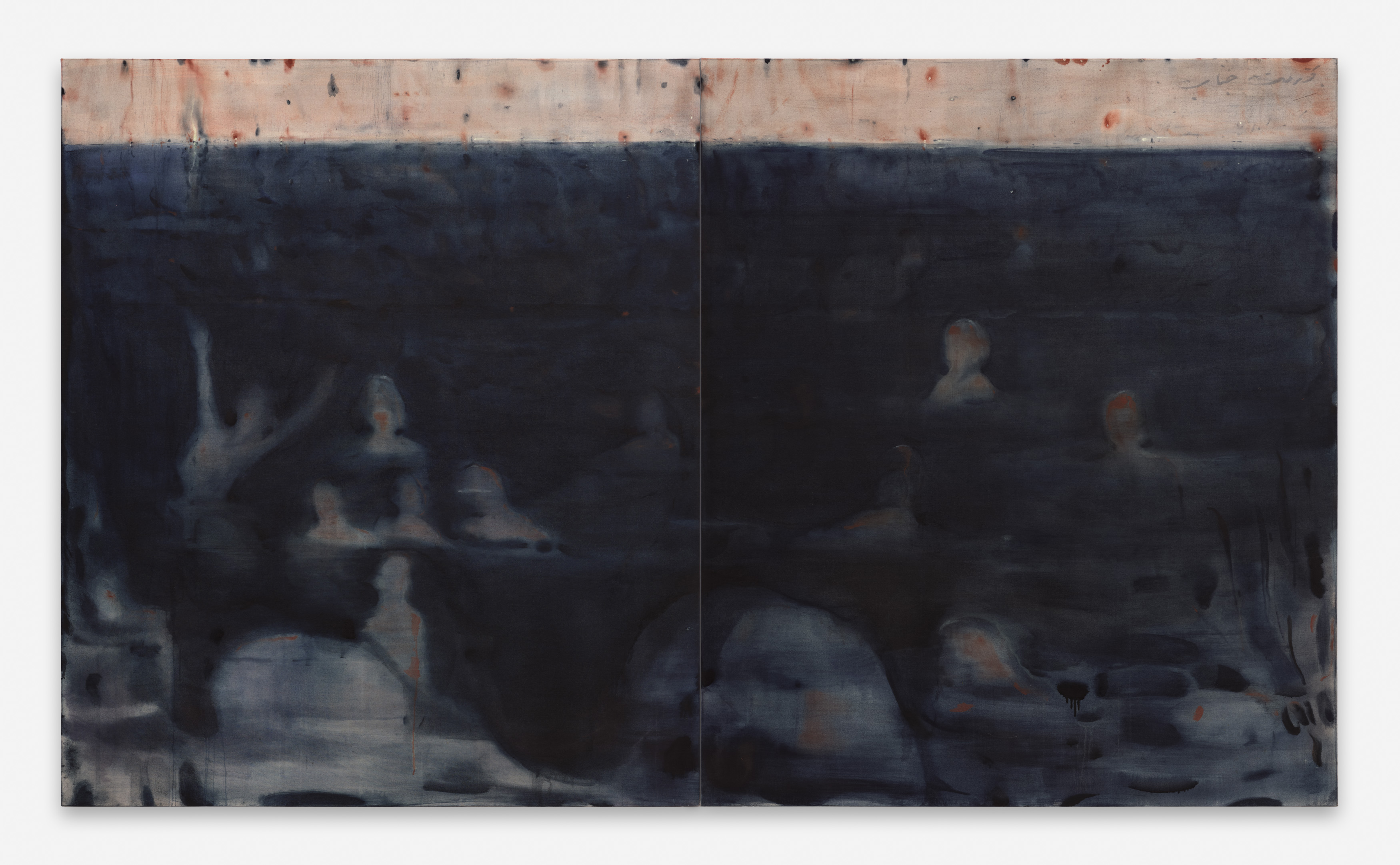
Suleman Aqeel Khilji
Back and forth II (diptych), 2024–26
Oil and distemper on linen
200 x 340 cm (78.74 x 133.86 in)

Suleman Aqeel Khilji
Teacher (Faith and Life), 2024–25
Oil and pigment on discarded book cover
18 x 25 cm (7.09 x 9.84 in)