Eva Helene Pade Paints the Thin Line Between Ecstasy and Violence This week, Pade will debut new works with Thaddaeus Ropac at TEFAF New York
By Katie White
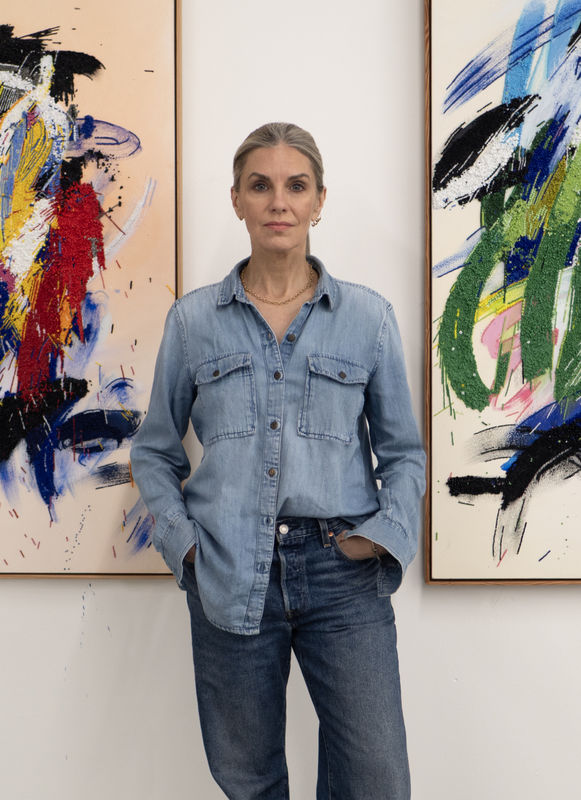
Pade welcomes the chance to paint on a grand scale. Over the past several years, she has become one of the art world’s buzziest young talents, known for her tempestuous scenes crowded with bodies moving through flickering, ambiguous terrains. But for close to a year now, Pade has been living in a semi-nomadic limbo, while her Paris home is undergoing renovations. The availability of a friend’s open studio brought her to London, where she set down to work. “I’ve just been working so much, I haven’t really had a chance to see people,” she said.
Three of these new paintings—Jagt (Hunt), Nærmere (Closer), and Opstand (Surge)—will debut with Thaddaeus Ropac at TEFAF New York this week, offering a coveted first glimpse of what Pade has been developing since opening her mark-making solo exhibition, “Søgelys” at Ropac’s London outpost, Ely House, last fall.
Success has come quickly for Pade. Born in 1997, the artist was raised in Odense, Denmark. Enrolling in the Danish Royal Academy of Fine Arts, she earned a BFA in 2021. By 2022, she had opened a solo exhibition at Galleri Nicolai Wallner in Copenhagen. In 2023, she moved to Paris, seeking a more dynamic contemporary art scene, while still completing an MFA with the Academy in 2024.
Her sinuous paintings, filled with crowds of naked female bodies, made in thin washes of color, are tied to a deep legacy of European art history, with Edvard Munch, James Ensor, and Gustav Klimt as particular influences.
More recently, however, those influences have been metabolized into a mood rather than direct allusions. “Just two years ago or so, I would look at those painters in terms of finding inspiration or finding a solution to something,” she said, “But with my past two shows, I’ve let go of them. I no longer need them like crutches.”