Overview
Thaddaeus Ropac Seoul is pleased to present That Inward Eye, a group exhibition bringing together a selection of works by Han Bing, Megan Rooney and Joan Snyder. Marking the first presentation of their work in Korea, the exhibition explores the artists’ distinct approaches to painting, and the various points at which these intersect and diverge. Working across different cultural, material and geographical contexts, the artists explore the picture plane not just as a surface to work onto, but into and against. Rather than a simple edge or support, it becomes a boundary that they actively negotiate and pass through. Painting, in turn, provides a kind of container – holding time, memory and feeling as much as colour, gesture and material.
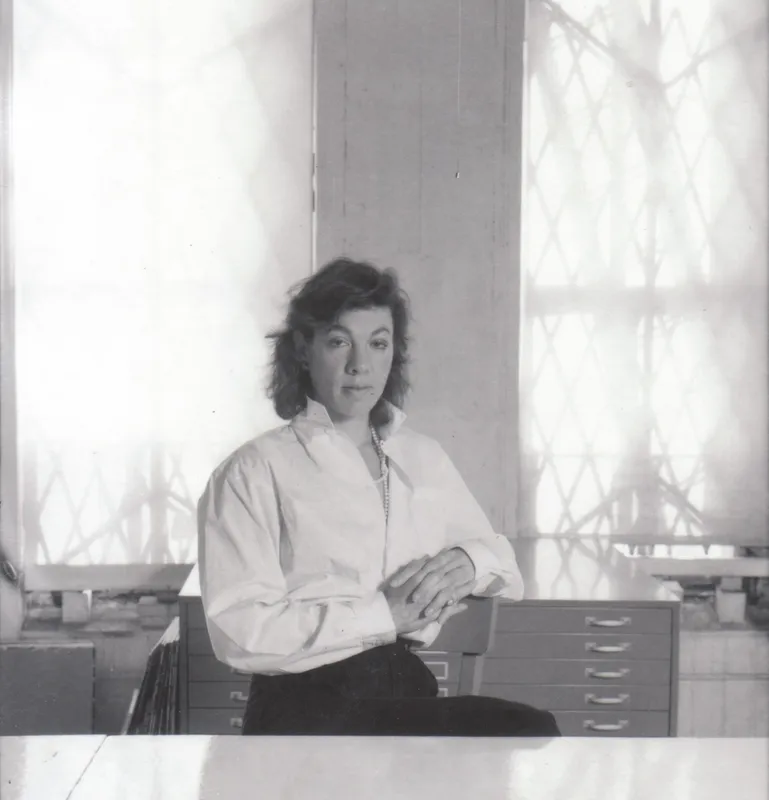
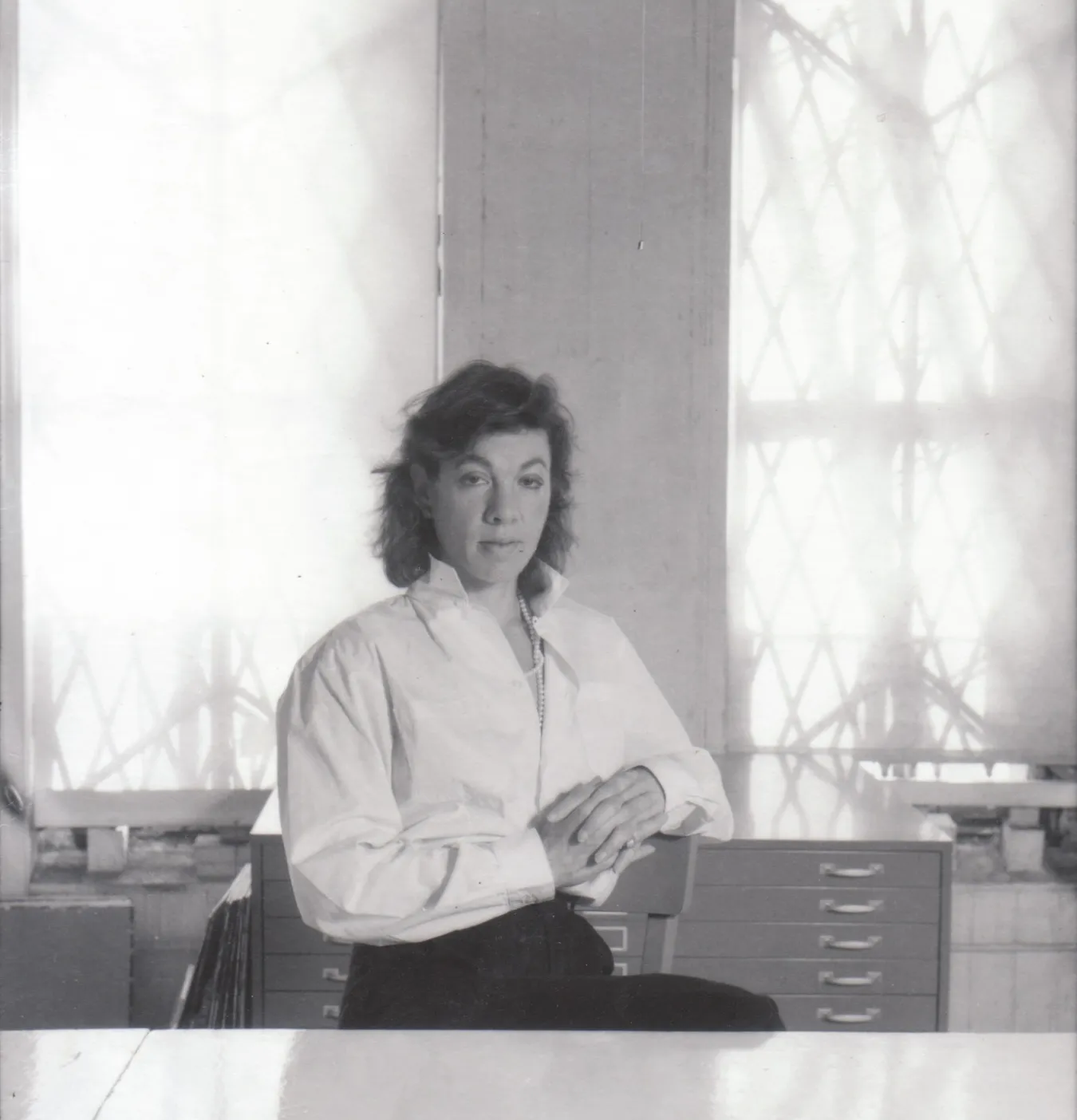
Born in New Jersey in 1940, Snyder is recognised for developing a distinctly embodied language of painting in American art. A selection of Snyder’s works reflect the interwoven relationship between autobiography, the natural world and painting itself. The paintings destabilise the fixity of the picture plane through evocations of liquidity: both literal, in their various depictions of water; and material, in their viscous, oozing surfaces. In Language of the Sea (1999), a yellow grid is painted over a turquoise sea that is studded with glass marbles. The preeminent, impervious structure of twentieth-century art – described by art critic Rosalind Krauss as the ‘emblem of modernity’ – appears to yield to the very substance of paint, its clean lines and defined edges dissolving into dribbles, streaks and smears. Snyder suggests that the language of the sea, like that of paint or the female sensibility, cannot be organised into neat geometry. As curator and art historian Jenni Sorkin writes, ‘Throughout Snyder’s entire oeuvre, the grid functions as a metronome, a device of precision, a tempo upon which to rely, or, conversely, to transgress.
Many of Snyder’s works amplify and dismantle the wet-dry, soft-hard, light-dark dichotomies that painting presents. In Because (2012), the painted surface melts into a vivid display of drips and impasto daubs, and in Studio Notes (2025), beneath a collection of personal artefacts – fabric cuttings, symbols, painted marks, a handprint and a handwritten inscription – a wooden hoop defines the contour of an oval pond. Ponds recur throughout Snyder’s oeuvre, forming part of a wider vocabulary of motifs that includes flowers, totems, bodies, fields and hearts. While evoking the landscape in which the artist lives and works and serving a diaristic function, its morphology also acts as an analogue for painting. The pond’s glittering, beguiling surface is at once a mirror and a depth, holding within as much as it reflects.
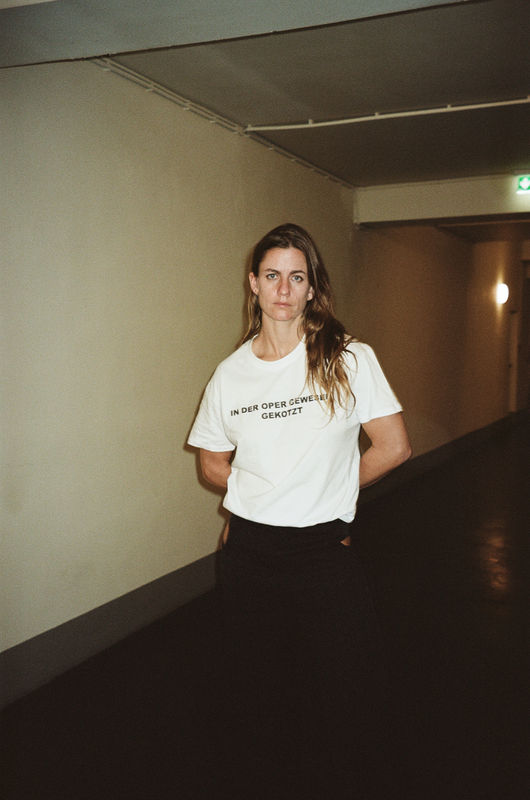
For Megan Rooney, painting is both a process of application and retrieval, part of an intensely physical exchange between artist and canvas in which forms are gently coaxed or wrestled into being. Created in cycles, her works – recently presented alongside those of Joan Mitchell in the exhibition Joan Mitchell / Megan Rooney: PAINTING FROM NATURE at the Espace Louis Vuitton Beijing in 2025 – develop through accumulated layers of paint, pastel and oil stick that are instinctively built up and sanded back. They become capsules of time, gradually absorbing traces of the environment as well as the artist’s internal landscape.
Resisting a purely superficial treatment of the canvas, Rooney alternates between paintbrush and power sander to work directly into the pictorial surface. As she explains, ‘I imagine myself in flight when I am painting, hovering above the surface and searching for places to land, touching down and lifting off. I do this again and again until the surface starts to collect information.’ Through this constant, often antagonistic process, she grapples with the very conditions of her medium, probing its flatness and the solidity of the painted stroke. Rooney’s titles are often based on something specific that emerges during the making of a work, particularly in its final stages; at other times, they draw on her observations, referencing lines of poetry or the changing seasons. They speak to the intimacy of her conversations with each painting, which unfold over many months and seem to echo in and out of her canvases, bristling against vibrant brushstrokes like another, invisible line of gesture. Several paintings in the exhibition take their titles from I Wandered Lonely as a Cloud (1807) by William Wordsworth, and the poet's description of imagination – ‘that inward eye’ – provides the exhibition’s title.
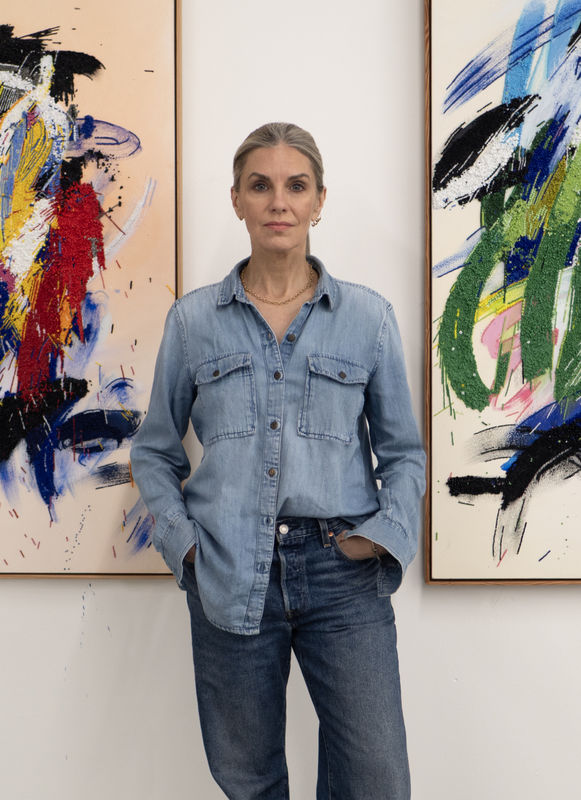
Recursive acts of layering and removal also shape Han Bing’s work, which was recently included in an exhibition at the National Art Museum of China in 2024. Having relocated to Paris after living in New York, Los Angeles and Shanghai, her work develops from an array of fragments and textures that she unconsciously gathers as she moves through cities. She is particularly drawn to the posters and advertisements she encounters pasted across subways and streets; the way these accumulate one atop the other like strata, or tear to reveal new, accidental compositions. ‘What interests her are the gaps between images,’ writes art historian Doris von Drathen. ‘Her attention is captured not by the tearing down itself, nor by the image fragments; rather by the ebb and flow of emergence and disappearance.’ In her paintings, images are exposed through layers of paint that are continuously applied and then scraped back to form jagged, overlapping edges. At times, familiar shapes and forms are disrupted by spontaneous, glitch-like brushstrokes, before resolving once again into a unified composition. The picture plane becomes a composite of multiple edges, rather than one.
A selection of works on paper accompanies Han’s paintings, created through a process of transfer that she likens to printmaking, in which paint is moved from one surface to another. ‘It’s a very delicate thing,’ she says, ‘[...] you never know what’s going to come out until you peel the paper off and it reveals itself to you.’ In these works, vibrant spatters of pigment come into contact with sheets of newspaper, partially obscuring the printed matter and generating chance, unexpected compositions. Like the accidental marks that emerge in urban environments, Han explores what happens when two pictorial edges meet.
Across their respective practices, physical processes of accumulation, burial and erasure allow each artist to interrogate the structures that comprise the painted surface and, ultimately, move between states of abstraction and figuration, observation and memory, solidity and fluidity, and past and present.
Installation views


Video