Overview
My process involves this improv where every stroke requires everything I have, my full attention. Every mark becomes this kind of violin-crescendo-holy-shit-experience.
— Liza Lou
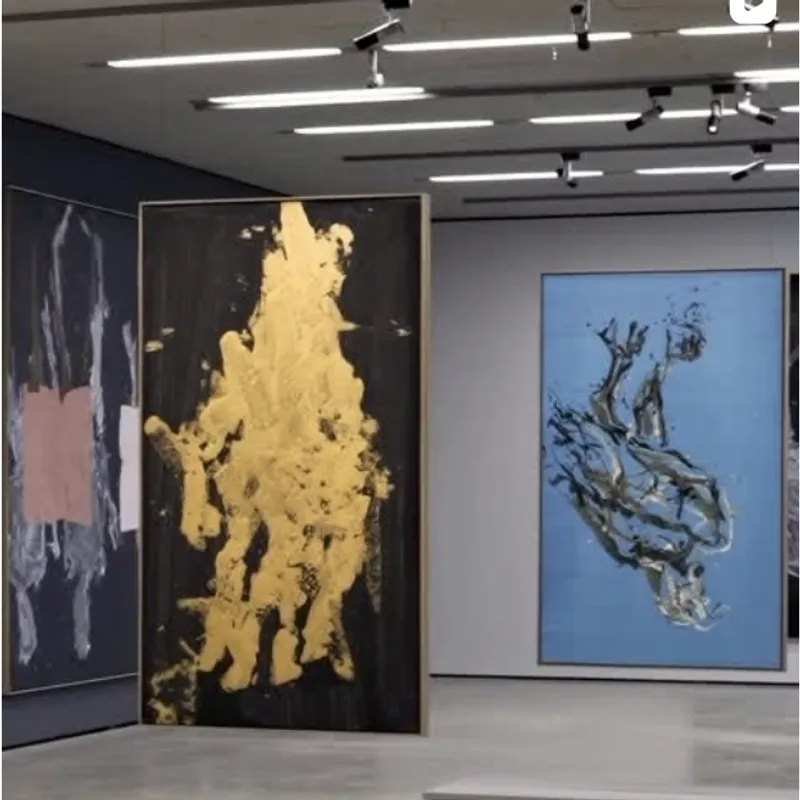
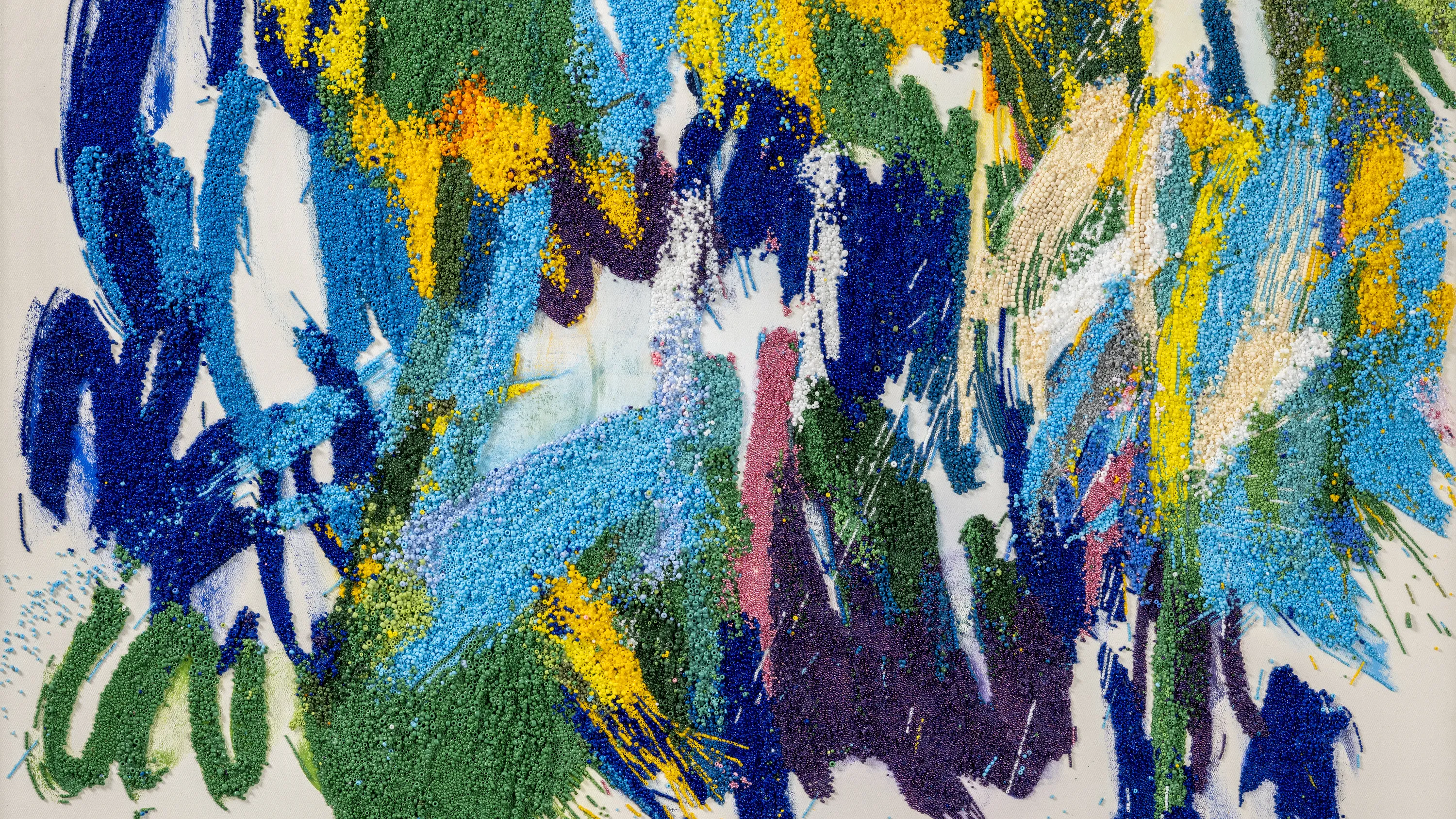
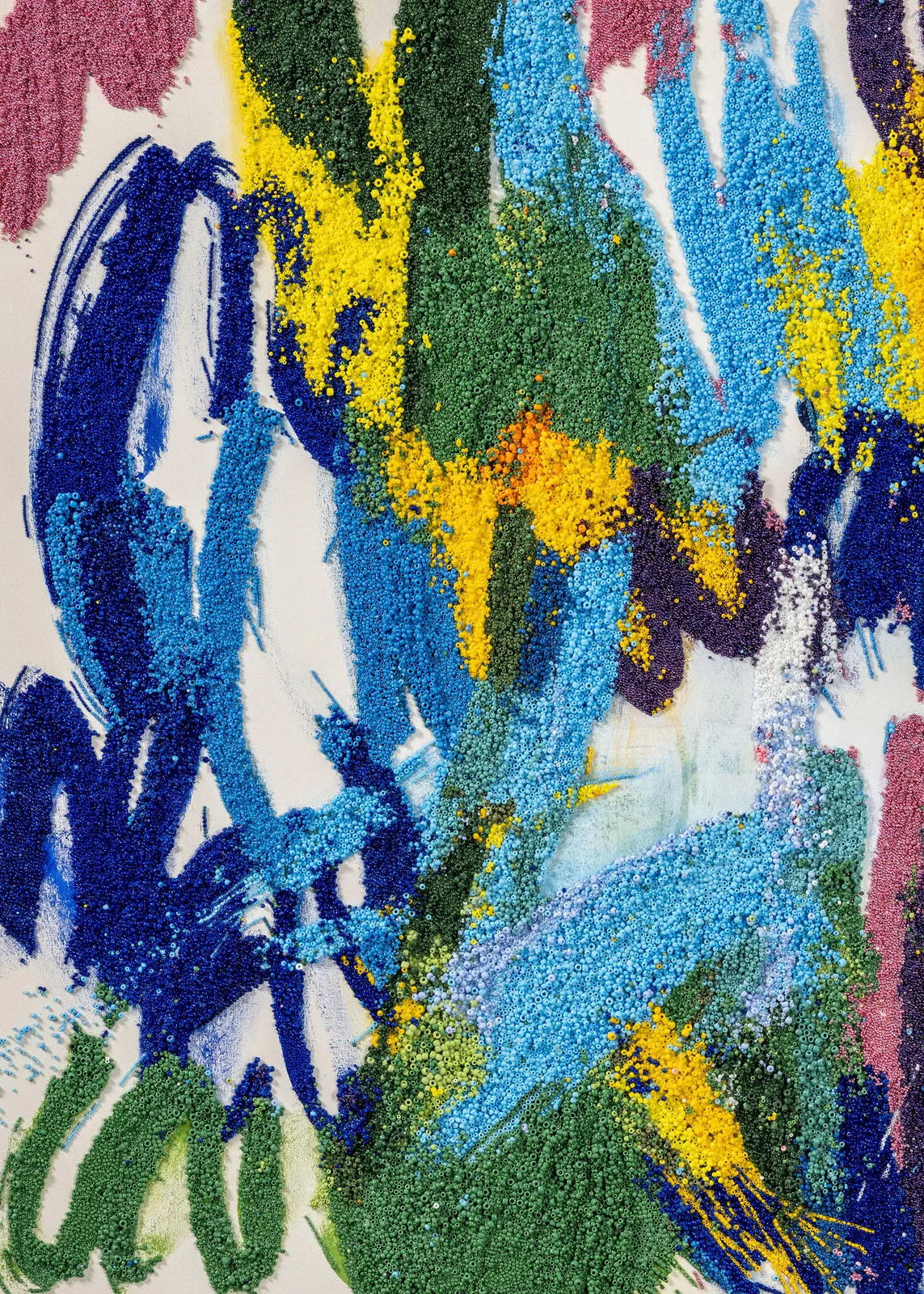
Liza Lou: FAQ presents a new body of work in which the artist combines glass beads and oil paint on canvas, layering two distinct temporalities on a single surface to examine the heroics of the painted gesture and mid-century abstraction. Lou uses her chosen material to denaturalise the spontaneity of the brushstroke, juxtaposing each painted drip and spatter with a process that demands painstaking care and precision. By translating fluid pigment into cell-like particles of colour, she forges a new experience of painting grounded in what she describes as the push and pull between ‘absolute control and total abandon.’
My process involves this improv where every stroke requires everything I have, my full attention. Every mark becomes this kind of violin-crescendo-holy-shit-experience.
— Liza Lou
Liza Lou: FAQ presents a new body of work in which the artist combines glass beads and oil paint on canvas, layering two distinct temporalities on a single surface to examine the heroics of the painted gesture and mid-century abstraction. Lou uses her chosen material to denaturalise the spontaneity of the brushstroke, juxtaposing each painted drip and spatter with a process that demands painstaking care and precision. By translating fluid pigment into cell-like particles of colour, she forges a new experience of painting grounded in what she describes as the push and pull between ‘absolute control and total abandon.’
Beneath the artist’s emphatic usage of beads – her signature unit of art making for more than three decades – lies an explicitly conceptual line of investigation. As the title of the exhibition indicates, FAQ proposes a series of fundamental questions about the nature of art that Lou has returned to across decades: When is a painting not a painting? What constitutes a paint body? Can a brushstroke be more than a brushstroke – and colour more colour than colour? ‘These works are about amplification, about making things more ideal,’ Lou explains. ‘There’s a poem by Fernando Pessoa where he writes about wanting flowers to be more flowers than flowers, and in this body of work I’m using my material as a way to make paint more paint than paint.’
The role of the artist is to ask questions, not answer them. — Anton Chekhov
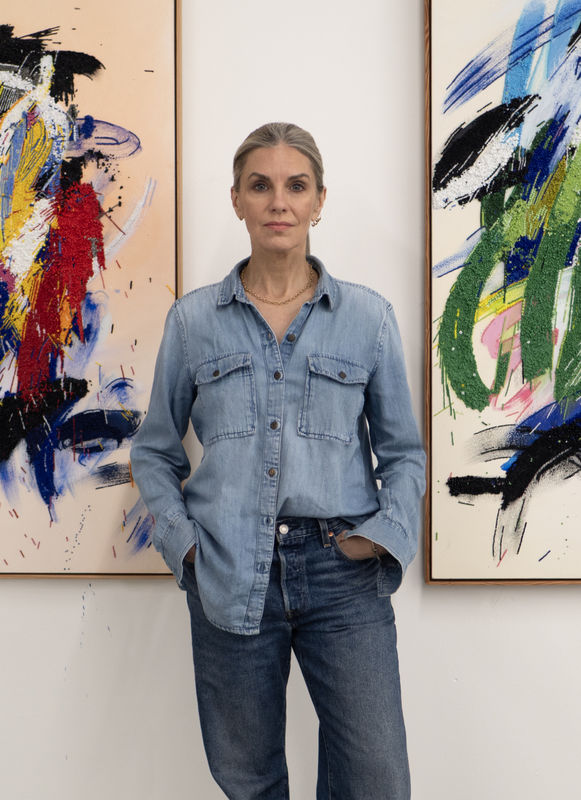
From her large-scale sculptures and installations of the 1990s – now held in major collections including the Whitney Museum of American Art, New York and National Gallery of Art, Washington D.C. – to the minimalist, community-based bead-woven works she created between 2005–20, an emphasis on concept and process has consistently defined Lou’s artistic language. Where these earlier works foregrounded intensive labour, duration and solidarity, this new series of highly gestural, abstract paintings explores her chosen material as a vehicle of unmediated personal expression. Clusters of yellow, indigo, blue, pink, red, green and lilac beads are applied over the sweeping, impasto lines of her paintbrush, amplifying each lyrical gesture with a shimmering chromatic chorus. Working alone and no longer threading the material stitch by stitch, accumulating meaning through repetition, Lou now appears to wield them like colours from a palette: ostensibly flinging them onto the canvas so they scatter like tiny iridescent droplets, or mixing them into the paint like a pigment – each glass granule seeming to magnify the very insolubility of her medium.
Unlike paint, beads cannot be blended, thinned or rinsed away. ‘They are pure chroma, carried in a glass body,’ she says, ‘which gives them a straight-out-of-the-tube quality.’ Shading emerges through carefully placed colour adjacencies that, once laid down, are difficult to rework or remove. From a distance, the strokes read as explosive, calligraphic lines; up close, they transform into vast, intricate landscapes, composed particle by particle, colour by colour. Lou asks what a world is if not an aggregation of single, indivisible units – a grain of sand, a seed, an atom, a pointillist dot. She cites the poet Rainer Maria Rilke, who wrote in his Letters to Cézanne: ‘Somehow I too must discover the smallest constituent element, the cell of my art, the tangible immaterial means of expressing everything.’
For Lou, the brushstroke is more than a mere element of a painting’s facture – it is a subject in its own right, loaded with the fetishistic notion that, through the artist's hand, we might obtain access to the artist’s consciousness. In these works, she treats the stroke as something not only to be enacted, but quoted, reinterpreted and reformed, recalling her own early Pop sensibility, while also evoking Roy Lichtenstein’s Brushstokes (1965–66), a series of enlarged, dripping brushstrokes made not with a loaded paintbrush but through layers of screenprinted Ben-Day dots. ‘Brushstrokes in a painting convey a sense of grand gesture,’ he once said, ‘but in my hands, the brushstroke becomes a depiction of a grand gesture.’ If Lichtenstein made replicable that which Abstract Expressionism and its painters had deemed the ultimate autographic gesture, Lou’s meticulously wrought facsimiles compete with the immediacy and fluency of paint itself, while simultaneously challenging art history’s long-standing valorisation of art forms associated with male expression and subjectivity over those tied to women’s work and craft.
The works in the exhibition are titled after figures of speech, highlighting the analogy Lou draws between visual art and language.For her, words and beads function similarly: we might string sentences together, follow narrative threads or watch plots unravel. Beads, like words, have a cumulative effect – laid down in a sequence, one by one, they develop structure, meaning and rhythm. Through their titles, Lou’s paintings invoke linguistic devices including Enjambment, the unpunctuated flow of a sentence from one line to the next; Chiasmus, a sentence shaped by symmetry; and Onomatopoeia,a word that phonetically resembles the thing it describes, such as splash, splat or fizz.
Accompanying the paintings is a selection of works on paper. Lou does not produce preparatory sketches for her canvases; drawing exists as an independent strand of her practice. Working with oil stick – another medium applied directly to the surface and resistant to blending – she builds each composition according to the same principle of adjacencies. Patches of pure colour accumulate side-by-side to form compact, mosaic-like abstractions, each richly textured scribble serving as a single unit within a larger scene or landscape.
Against the backdrop of her renewed solo practice and rigorous conceptual inquiry, Lou’s new works radiate a palpable sense of joy and freedom as she allows her medium to emote on its own terms, defining itself beyond the collective, labour-intensive modalities that shaped her earlier projects. Through processes of accumulation and care, Lou demonstrates how a material – as small, solid, inert as a glass bead – can amplify painting, breathe new life into its very surface and transform it into something capable of inspiring wonder.