Love from an Abstract Artist is an exhibition spanning over six decades of American artist Joan Snyder’s work on paper. Featuring nearly 50 new and historical works, dating from the mid-1960s to the present day, it bears witness to the important position drawing has always held in Snyder’s practice. Often diaristic and autobiographical, these varied works encompass Snyder’s grids, symbols, landscapes and strokes, and incorporate collaged materials including fabric, rope, berries, herbs and hand-pressed paper pulp, among others.
Watch a video of the exhibition


Snyder is recognised for developing a new, distinctly embodied language of abstract painting at a time when legacies of Abstract Expressionism loomed large and Minimalism espoused new conditions of sterility and mechanical facture in American art. In this male-dominated climate, she dissected the 'anatomy' of painting into its constituent parts and, in the mid-1970s, began adding personal motifs to her work such as bodies and breasts, vulvas and hearts, totems and fields of flowers. ‘It seemed to me that in order to go forward, I had to push back hard,’ she reflects. ‘To again embrace ideas that were at the very foundation of all my thinking about painting - about structure, about application, about meaning, about materials.’
Stripes/Mounds, 1968
Pastel and graphite on paper
22.86 x 30.48 cm (9 x 12 in)


Five important drawings from 1970 capture Snyder’s deepening interrogation of mark-making as a type of notation, as she begins to explore the dualities that now define her work: that of figuration and abstraction, logic and feeling, planning and impulse. In Marks and Strokes, scribbles and dashes of brightly coloured oil pastel, watercolour and graphite dance over graph paper, as though the grid – with its potent associations of Modernist art and its discourses – is a system against whose fixity she rebels.
Untitled (1970 series 1_2), 1970
Crayon, watercolour and graphite on paper
27.94 x 50.8 cm (11 x 20 in)

Similarly, in Untitled (1970 series 1_2), thick strokes of dark-pink watercolour are arranged in horizontal rows that smudge and bleed across pencilled lines. Organising structures recur throughout the exhibition as Snyder considers the autonomy of the gesture within a strict formal context, and how a painterly mark might animate a surface like the written words on a page or musical notes on a stave. ‘Throughout Snyder’s entire oeuvre, the grid functions as a metronome,’ the curator and art historian Jenni Sorkin writes, ‘a device of precision, a tempo upon which to rely, or, conversely, to transgress.’
Untitled (1970 series 1_1), 1970
Ink and graphite on paper
27.94 x 50.8 cm (11 x 20 in)

Summer 6/12, 1983
Watercolour, pastel, sand and graphite on paper
26.16 x 33.02 cm (10.3 x 13 in)

Untitled (nude w/black lines), 1989
Acrylic, charcoal and pastel on paper
56.52 x 55.88 cm (22.25 x 22 in)

Let Them Rest, 1996
Oil, ink, fabric and graphite on paper
35.56 x 45.72 cm (14 x 18 in)

Dream, 2001
Watercolor on paper
25.4 x 35.56 cm (10 x 14 in)

Lines & Seeds, 2007
Watercolour, ink and crayon on paper
21.59 x 27.94 cm (8.5 x 11 in)


Totem Dance, 2013
Paper pulp and berries on fabric
69.85 x 91.44 cm (27.5 x 36 in)

Throughout the exhibition, sprawling handwritten and painted words seem to capture fragments of the artist’s voice, which is at times poetic and at others confessional, grief-stricken, playful, deadpan or enraged. Dear Molly, Maggie, Mira (2015) is a visual letter addressed to the significant women in Snyder’s life that begins with emotionally written words and slowly blooms into four painted roses. In You Bastard (2016), disordered letters seem to scrabble and fight for coherence against a lattice of overlapping handprints.
Dear Molly, Maggie, Mira, 2015
Acrylic, watercolour, paper, ink and graphite on paper
67.31 x 101.6 cm (26.5 x 40 in)

By resisting legibility, Snyder invites us to consider language beyond its referential meaning, to see it instead as another graphic mark or embodied gesture. In Don’t Try to Read This (2025), one of the most recent works in the exhibition, Snyder playfully acknowledges this resistance, scrawling the titular words along the lower edge of the composition.
Don't Try to Read This, 2025
Watercolour, paper and ink on paper
57.15 x 76.84 cm (22.5 x 30.25 in)

The work which lends the exhibition its title, Love from an Abstract Artist (2025), is also ironic. Composed almost entirely out of words, it further complicates the idea of drawing as an exclusively pictorial mode of representation. The artist presents us with a list that is an inventory of personal motifs: buds, grapes, ponds, roses, herbs, faces, hands, bodies, trees, flowers, breasts, totems, strokes and moons. Her signature, ‘LOVE FROM AN ABSTRACT ARTIST’, serves as a valediction and nods to a semiotic game where list-making becomes mark-making, and mark-making, in turn, becomes abstraction. ‘It is the absolute congruence of formal and autobiographical discovery that distinguishes Snyder,’ writes the art historian Hayden Herrera. ‘Because the message is conveyed through abstract language as well as through images and words, self-exploration never becomes trivial self-display.’
Love from an Abstract Artist, 2025
Oil, watercolour, paper and ink on paper
57.15 x 76.84 cm (22.5 x 30.25 in)

You Bastard, 2016
Acrylic and fabric on paper
57.15 x 76.2 cm (22.5 x 30 in)

Old Demons, 2014
Acrylic, ink, pastel and pencil on paper
69.85 x 100.33 cm (27.5 x 39.5 in)

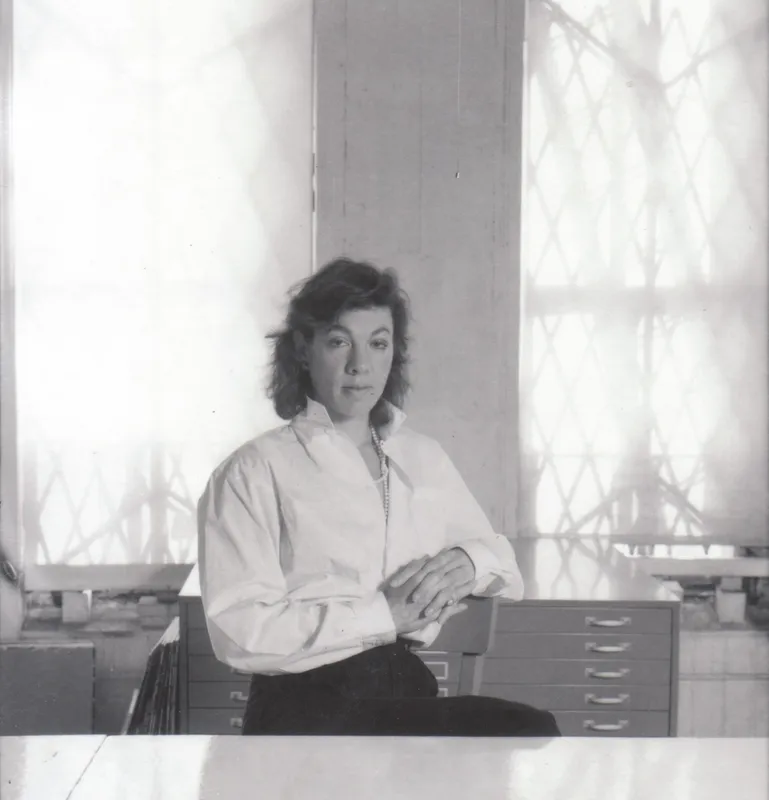
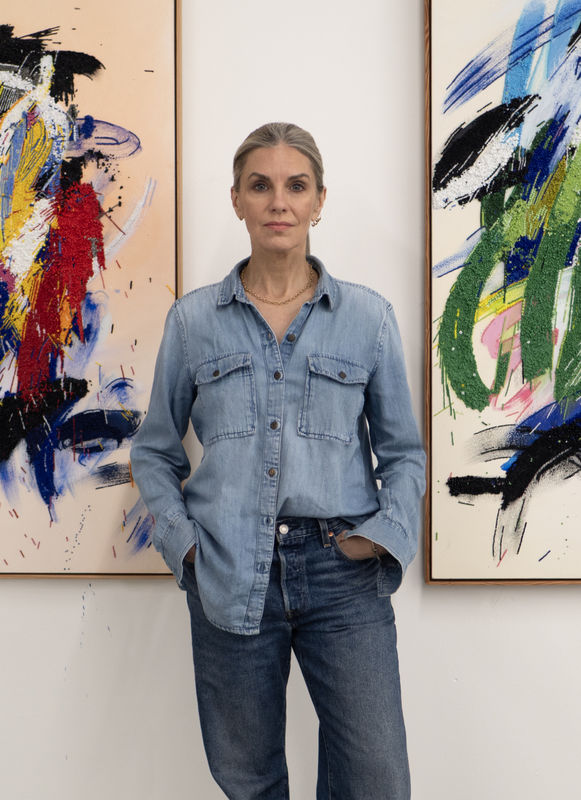
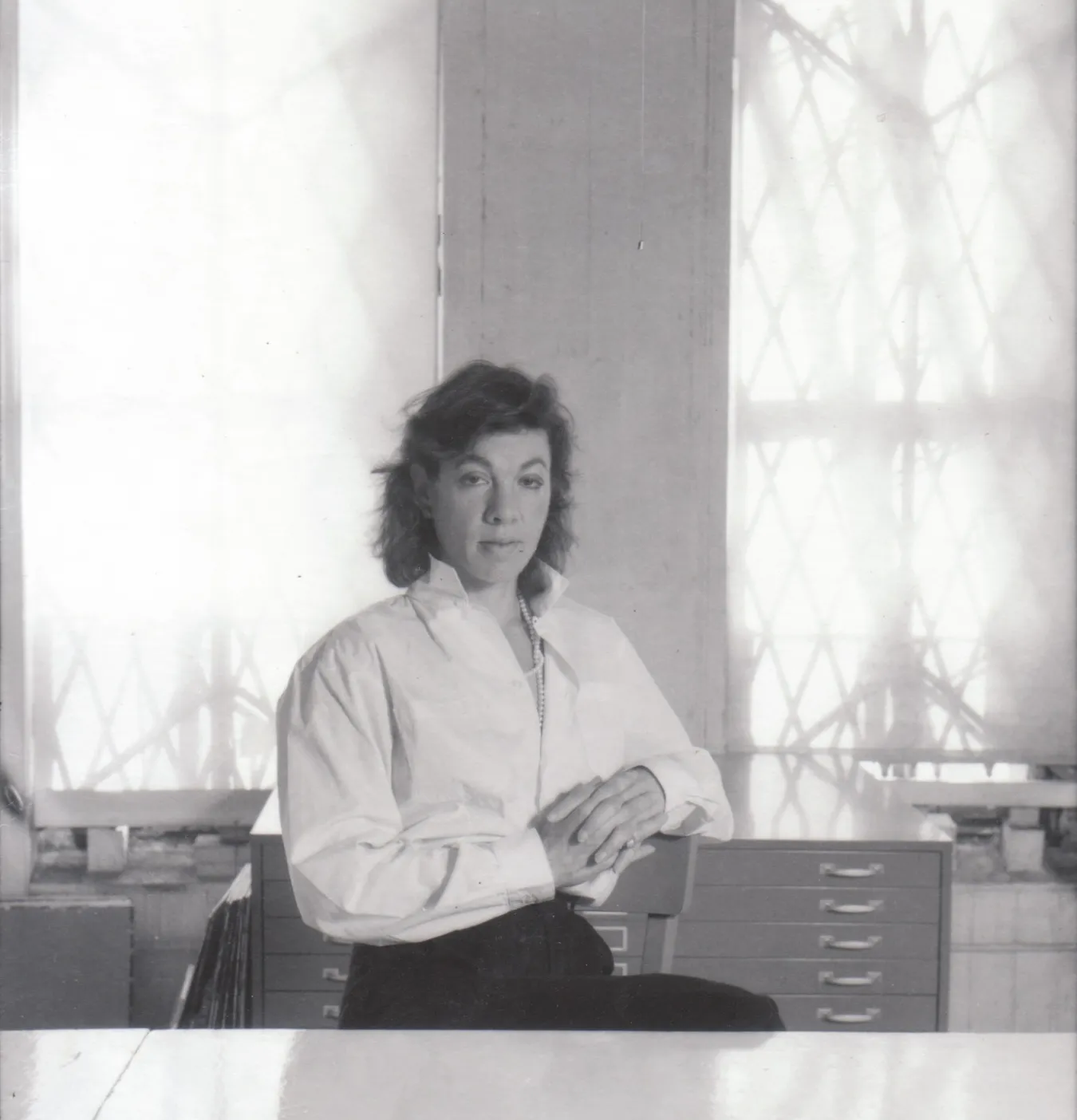
Joan Snyder was born in Highland Park, New Jersey, in 1940 and now lives and works in Brooklyn and Woodstock, New York. First exhibiting her Stroke paintings in the early 1970s, she has since shown work in numerous institutional exhibitions, including solo presentations at the Brooklyn Museum, Brooklyn, NY (1998); Jewish Museum, New York, NY (2005; travelling to Danforth Art Museum, Framingham, MA); and the Zimmerli Art Museum, Rutgers University, New Brunswick, NJ (2011). She participated in the Whitney Biennial in 1973 and 1981, and the 34th Biennial of Contemporary American Painting, Corcoran Gallery of Art, Washington, D.C. in 1975.
In recognition of her pioneering contribution to contemporary American art, Snyder was awarded the MacArthur Fellowship in 2007. Her works are held in the collections of the Guggenheim Museum, Whitney Museum of American Art, Jewish Museum, Metropolitan Museum of Art and Museum of Modern Art, New York, NY; Brooklyn Museum, Brooklyn, NY; Art Institute of Chicago, IL; Dallas Museum of Art, TX; Harvard Art Museums, Cambridge, MA; Museum of Fine Arts Boston, MA; National Gallery of Art and National Museum of Women in the Arts, Washington, D.C.; San Francisco Museum of Modern Art, CA; and Tate, London, among others.