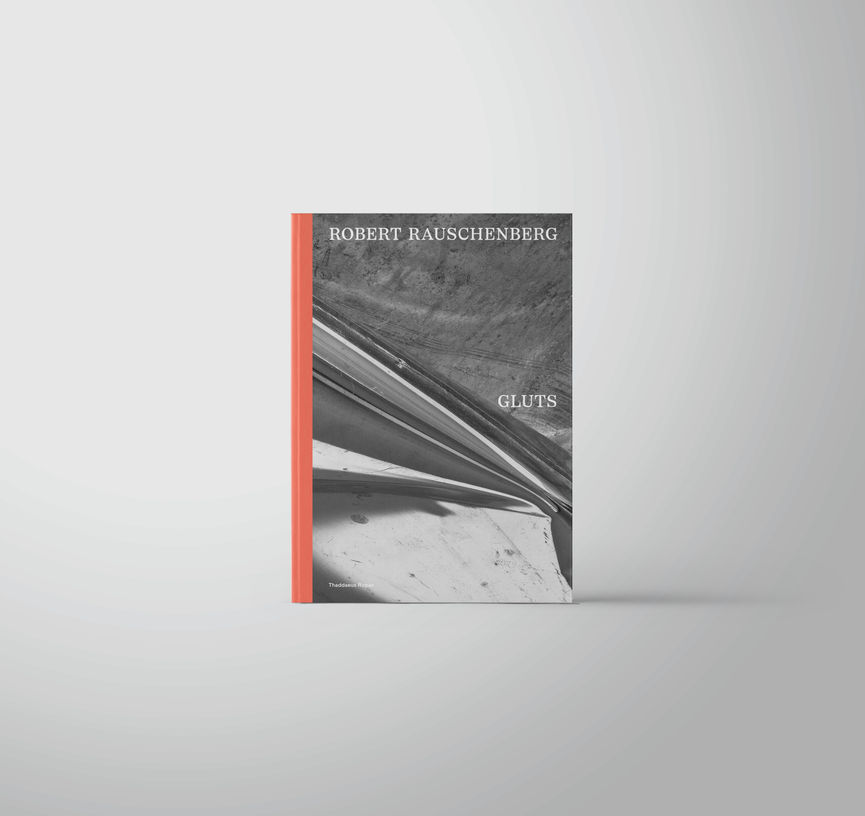
Robert Rauschenberg: Gluts
€ 50.00

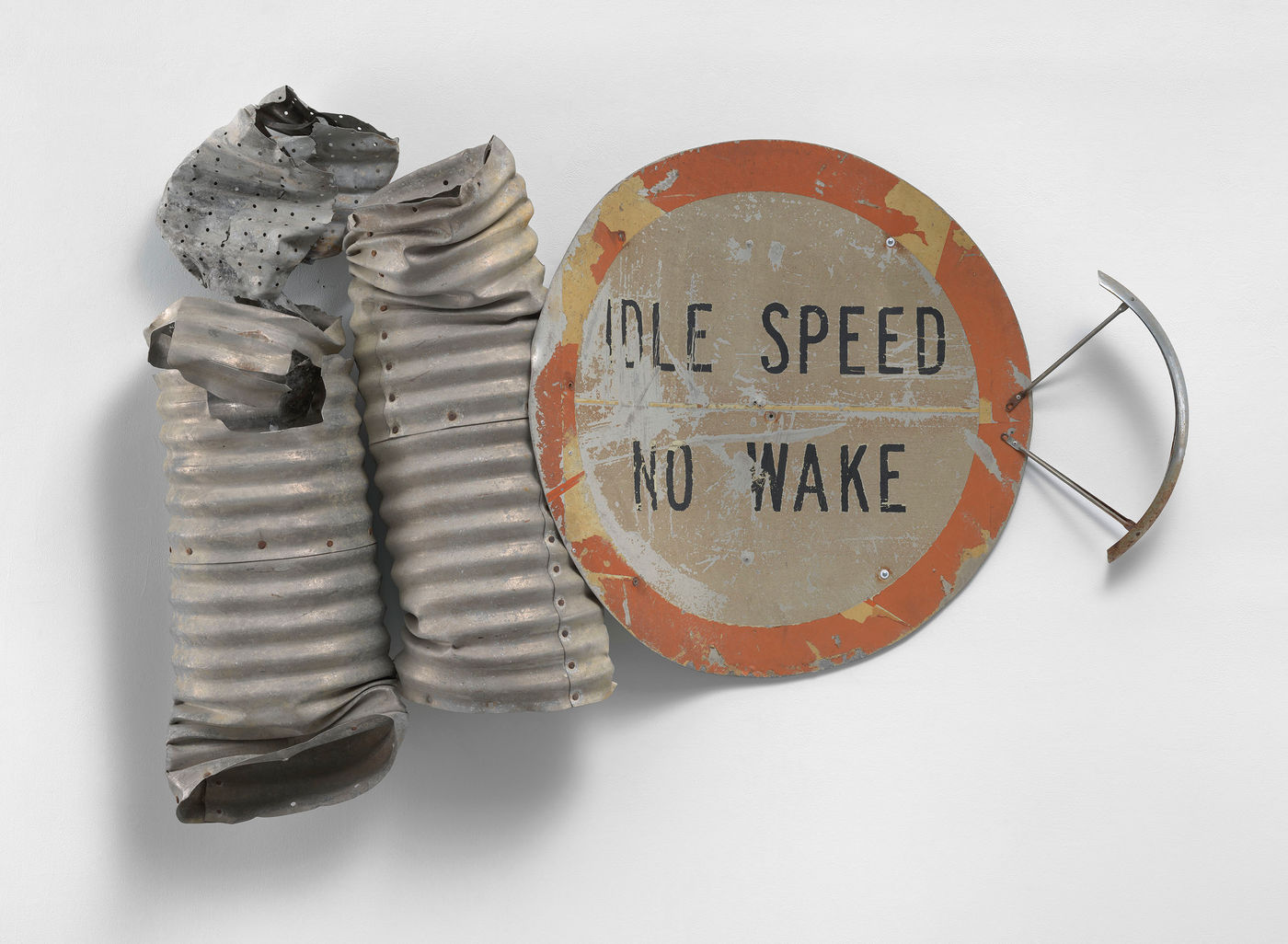
The Gluts represent one of Rauschenberg’s earliest forays into a new material – metal – in the form of found objects assembled and riveted together to create wall reliefs and freestanding sculptures. Unlike in the artist’s earlier Combines, however, the found elements in the Gluts are no longer affixed to canvas supports. Instead, they become entirely autonomous, placed directly on the wall or the ground in a wholehearted engagement with the poetics of recycling and reclamation.
No Wake Glut, 1986
Assembled metal
156.2 x 226.7 x 40.6 cm (61.5 x 89.25 x 16 in)

The series was inspired by the artist’s 1985 visit to his native Texas, which was in the midst of a recession due to a surplus, or ‘glut’, in the oil market, turning its landscape into a wasteland of abandoned vehicles and the rusting signs of failed petrol stations. Returning to his studio in Captiva Island, Florida, Rauschenberg, marked by what he had seen in Texas, sought out similar objects in the local scrapyard, salvaging discarded signs and automotive and industrial parts to create the first Gluts: a gesture that anticipated the environmental concerns that, decades later, have taken a central position in artistic thought and production.
Bumper Slip Late Summer Glut, 1987
Assembled metal
132.5 x 178.7 x 55.7 cm (52.17 x 70.35 x 21.93 in)
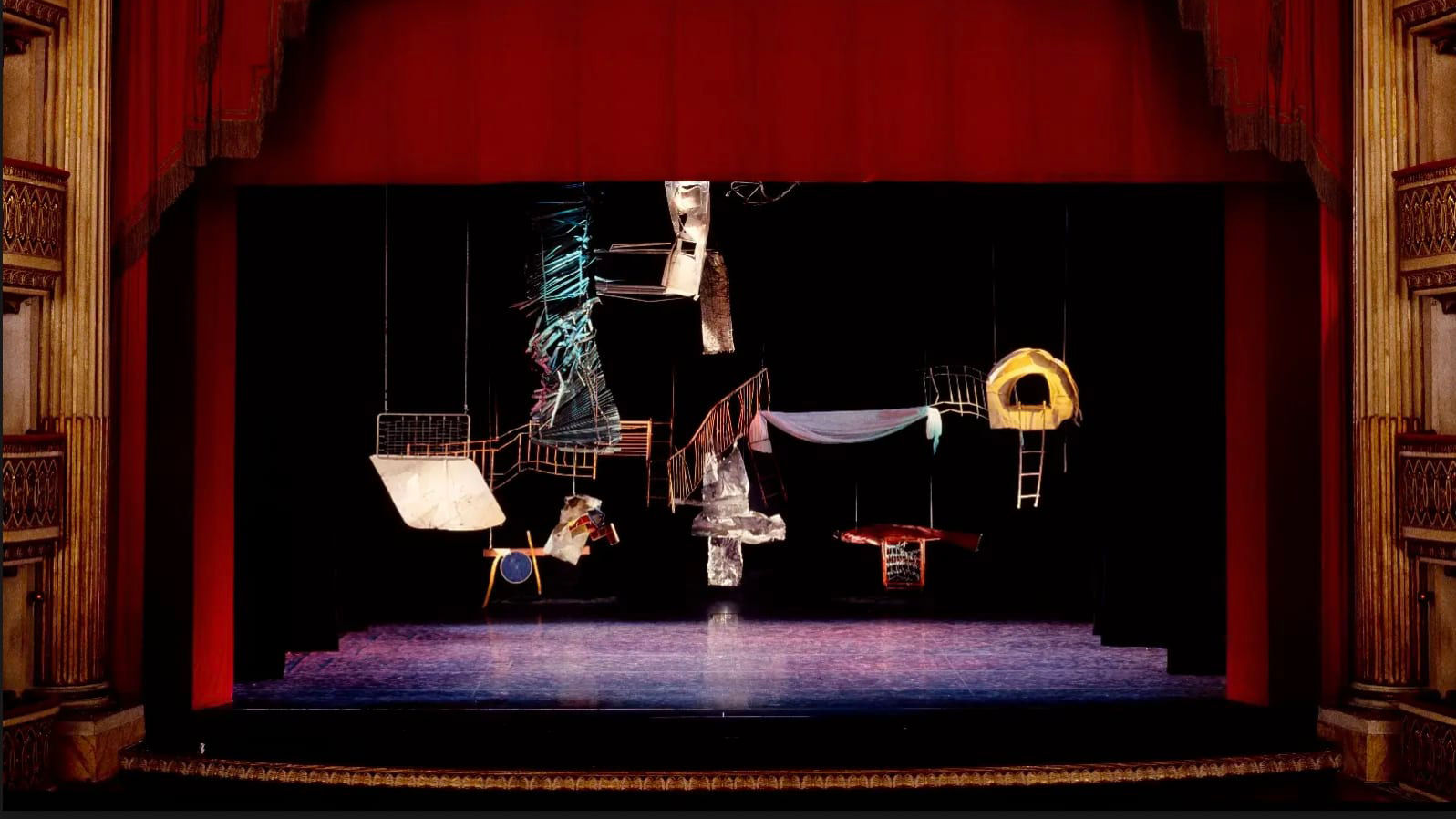
Robert Rauschenberg’s set design for Trisha Brown’s Lateral Pass (1985), Teatro di San Carlo, Naples, Italy, January 1987. Photo: Luciano Romano.


As Brown recalled: ‘Bob and his team dumped a truckload of junk backstage and proceeded to sort, stack, drill, and grommet into the night.’ He later incorporated pieces from this stage set into the Glut series, referring to them as the Neapolitan Gluts. This exhibition presents several examples of the Neapolitan Glut series alongside the Gluts made in Captiva Island.
Balcone Glut (Neapolitan), 1987
Assembled metal and insulated wire
241 x 140 x 42 cm (94.88 x 55.12 x 16.54 in)
Robert Rauschenberg, Villa Volpicelli, Naples, Italy, April 1987. Photo: Peppe Avallone.

At first glance the viewer finds in the Gluts an elegant formal abstraction; with a second look, what Mark Alizart calls ‘the appearance of function’ in his essay in the catalogue accompanying the exhibition. Rauschenberg enjoyed wordplay, and his titles often simultaneously indicate potential readings of his works and wittily exploit the ambiguities of the terms he uses. In Balcone Glut (Neapolitan) (1987), a ladder projects through the opening in a ventilation duct to imply the titular ‘balcony’; the alternating joist-like metal strands and transparences of Greenhouse Glut (Neapolitan) (1987) suggest the botanical structure.
Greenhouse Glut (Neapolitan), 1987
Assembled metal
165.1 x 194.3 x 54.6 cm (65 x 76.5 x 21.5 in)

But more than this, there is a sense of anthropomorphism across the Gluts, where the coldest, hardest of materials is animated with details that play on our pareidolia to suggest dangling legs or eyes. ‘The most striking thing’ writes Alizart of the Gluts, ‘is that they all seem to swarm with life. Rauschenberg doesn’t merely give his detritus a ‘second life’ in the sense of a ‘second chance’; he genuinely transforms it into an organism.’ For Alizart, Greek Toy Glut (Neopolitan), becomes a shield-wielding hero from The Iliad; it might also be read as a constructed Trojan horse with a bowed head.
Greek Toy Glut (Neapolitan), 1987
Assembled metal
207 x 254 x 39.4 cm (81.5 x 100 x 15.5 in)

When making the Gluts, Rauschenberg almost always left the painted finishes of his found metals untouched in the final work, instead giving prominence to each metal component’s inherent dents, markings, and colouration. Carnival (Glut) (1986) is a rare exception to this: he painted its inner face a shadowy pale pink, marking an unusual apparition of the artist’s own paintbrush in the Gluts.
Carnival (Glut), 1986
Assembled metal with acrylic and mirror
127 x 185.4 x 109.2 cm (50 x 73 x 43 in)


Photography lies at the heart of Rauschenberg’s artistic practice. For curator Walter Hopps, ‘The use of photography has long been an essential device for Rauschenberg’s melding of imagery. While photography is an inadequate metaphor for the complexity of retinal reception, it remains a vital means for Rauschenberg’s aesthetic investigations of how humans perceive, select, and combine visual information. Without photography, much of Rauschenberg’s oeuvre would scarcely exist.’

Rauschenberg’s photographs not only provided source material for his experimental multimedia works, but also constituted artworks per se. The photographs in the exhibition exemplify the ‘vernacular glance’ that art critic Brian O’Doherty discerned in Rauschenberg’s photographic oeuvre. The half-dismantled vehicles and industrial landscapes pictured, meanwhile, foretell the content of the sculptural Gluts.
Mexico, 1984, 1984
Gelatin silver print
33 x 48.3 cm (13 x 19 in)
![As Rosalind Krauss describes, Rauschenberg’s ‘fascination with two-dimensional “fronts” (billboards, torn posters, shop windows) stan[d] in for the deep space...](https://static-assets.artlogic.net/w_1400,h_1400,c_limit,f_auto,fl_lossy,q_auto:good/ws-ropac/usr/images/feature_panels/image/8699/rr_d.jpg)
As Rosalind Krauss describes, Rauschenberg’s ‘fascination with two-dimensional “fronts” (billboards, torn posters, shop windows) stan[d] in for the deep space of the “real”, which they effectively block.’ This same fascination is carried across into the artist’s painterly and sculptural work.
Los Angeles, California, 1981, 1981
Gelatin silver print
33 x 48.3 cm (13 x 19 in)