Joan Snyder: Earthsongs
€ 28.00

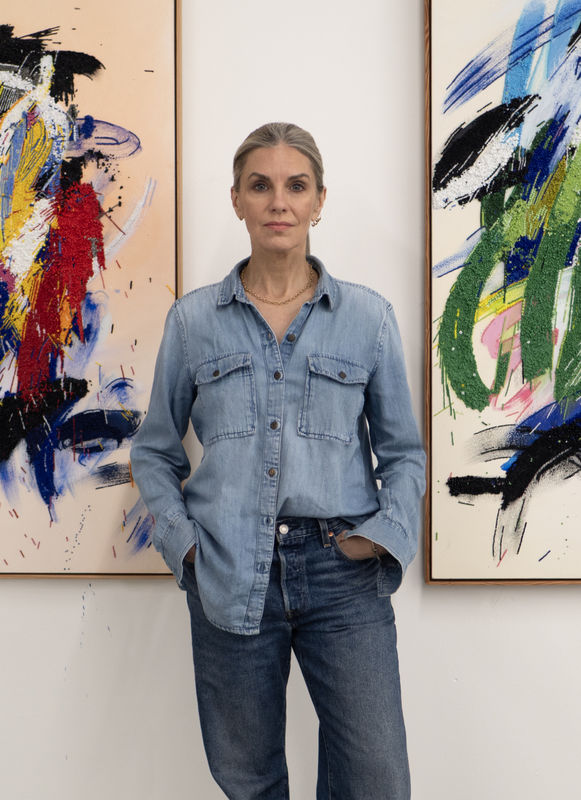
This new body of works is deeply rooted in the artist’s Field paintings, a series that emerged in the mid-1980s in response to the agricultural landscapes Snyder encountered upon relocating from New York City to more rural surroundings. Her all-over treatment of the canvas establishes a creative field in which she sows imagery, colour and gesture to fuse formal experimentation with ideas of mythical and personal cyclical renewal.

Earthsong II, 2025
Oil, acrylic, paper mache, mud, ink, paper on linen
142.2 × 248.9 cm (55.98 × 97.99 in)
In these meadows of blooming forms, the palette oscillates between livid, corporeal intensity in fuchsias and reds, and muted tones of mossy green and flaxen collaged straw: contrasts that suggest cycles of life and death, perishability and rebirth. The natural tan colour of the linen means it can be left unpainted, or at times lightly stained, giving it a generative, earthy presence.

Glitter Blues, 2025
Oil, acrylic, cheesecloth, straw, dried flowers, seeds, glitter, graphite on linen
137.2 × 182.9 cm (54.02 × 72.01 in)
Snyder nurtures a synergy between abstraction and autobiography, with each work forming a diaristic episode in which narrative guides formal investigation. Her practice has been overtly feminist since its inception, rooted in her role as a defining figure of the women’s art movement that flourished in the 1970s. She translates women’s lived experience into a complex and personal vocabulary of forms to which she constantly returns: roses and breasts, trees and totems, ponds and moons.


The Walls of My Mind, 2025
Oil, acrylic, paper mache, fabric, twigs, dried leaves, ink, paper, coloured pencil on linen
152.4 × 182.9 cm (60 × 72.01 in)
The artist has been inscribing words on her canvases since the 1970s, and insistent, clamouring handwriting features in several of the works on view. Snyder has a profound interest in literature. In The Walls of My Mind (2025), she spells out a citation from Virginia Woolf’s The Waves (1931): ‘when the walls of the mind grow thin’. The passage from Woolf’s novel describes a porosity between interior and exterior worlds – a feeling that is palpable in Snyder’s work, which casts nature as an expressive vehicle for the most fundamental of human experiences. As Cusk writes: ‘We belong to the world, these works seem to say.’

Dear Elijah, 2026
Oil, acrylic, paper mache, burlap, velvet, fabric, poppy pods, rosebuds,
plastic beads, straw, mud, ink, pastel, coloured pencil on linen in two parts
162.6 × 137.2 cm (64.02 × 54.02 in)
Patches of collaged burlap, fabric and papier mâché appear on the canvases, in places swelling into three-dimensional pouches. These forms act as vessels, collecting and cradling seeds, dried flowers and pools of paint.
In the large-scale paintings The Forest Becomes a Symphony (2025) and Elegy for Souls (2025), wooden shelves jut from the base of the canvases, recalling easels. Appearing in her work since the 1990s, these shelves serve as repositories for colour and matter, giving the paintings a shrine-like aspect as well as a sculptural presence.
Abstracted half-tree, half-crucifix forms recur across this latest body of works, as does the use of diptych and triptych formats, which evoke the traditions of early Christian altarpieces, framing painting as a devotional act. Snyder reflected in the late 1960s when writing for her MFA thesis: ‘My painting is my religion. It’s the altar that I go to and it’s where I face myself and find out who I am.’

Memories, 2026
Oil, acrylic, paper mache, fabric, rosebuds on linen
61 × 61 cm (24.02 × 24.02 in)
Brushstrokes have recurred as a central motif in Snyder’s work since she first began dissecting this most fundamental of painterly gestures in her celebrated Stroke paintings in the early 1970s. In Earthsongs, they manifest as vivid staccato daubs of paint on canvas and drawn-out, weaving lines of ink and watercolour on paper: gestures as tough as they are delicate.

Water Chant, 2025
Watercolour, paper and ink on paper
57.15 × 77.47 cm (22.5 × 30.5 in)
There is a delicate ambiguity in these traces, which at times seem to invite erasure and at others to insist that the human capacity for experiencing beauty and sorrow is truer and more lasting than our own concrete existence.
— Rachel Cusk
These strokes often function as fragmentary musical scores. They set the rhythm for our encounter with the works, which we read like hymns – at once despairing and ecstatic – to life itself. True to its title, Earthsongs kindles a sense of exultant joy in response to the bittersweet beauty of being alive: enacting what Cusk describes as ‘a commemoration of the self in the world’.
The exhibition is accompanied by a catalogue featuring a text by novelist Rachel Cusk, as well as Joan Snyder’s 2019 text ‘Femalish’. Cusk’s essay highlights Snyder’s ‘complete female oeuvre’, noting that in a history containing ‘few mothers and mainly daughters’, Snyder stands as an inspirational artistic figure for future generations.

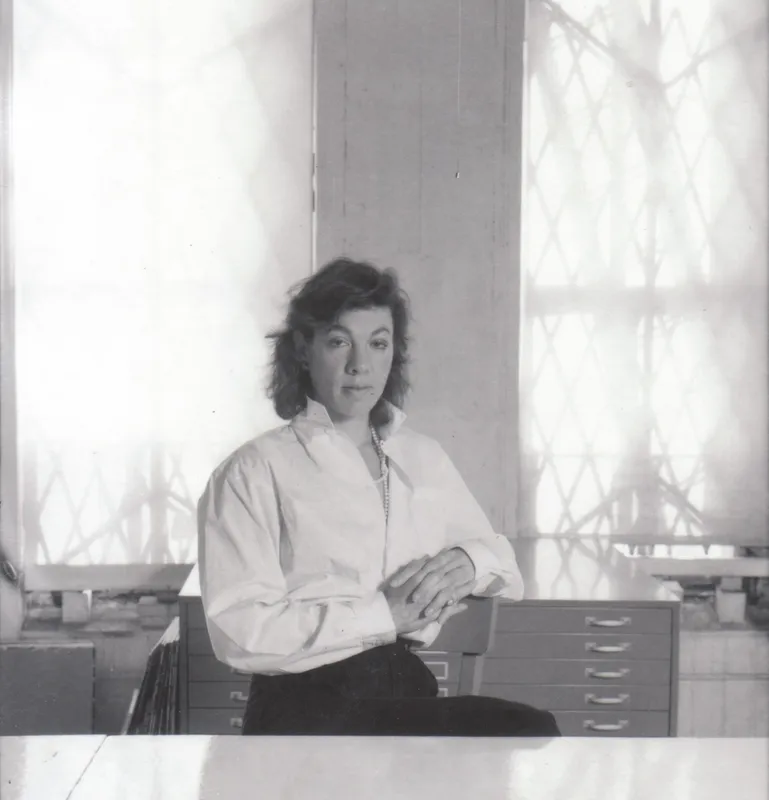
Working between Brooklyn and Woodstock, Snyder was born in New Jersey in 1940. She received her BA from Douglass College (1962) and an MFA from Rutgers University (1966), both in New Brunswick, NJ. As a graduate student at Rutgers she initiated the Mary H. Dana Women Artists Series (DWAS) at the Mabel Smith Douglass Library to increase the visibility of emerging and established contemporary women artists, asserting her life-long commitment to championing women’s participation in cultural spheres. In 2016, she was the recipient of an American Academy of Arts and Letters Award in Art which followed a MacArthur Foundation Fellowship (2007), John Simon Guggenheim Memorial Fellowship (1983) and National Endowment of the Arts Fellowship (1974). In 2026, she was elected to become a lifelong member of the American Academy of Arts and Letters.