Erwin Wurm Tomorrow: Yes Erwin Wurm Tomorrow: Yes

Erwin Wurm Tomorrow: Yes

Until 11 April 2026
Paris Pantin

Scroll down to learn more
/

The works on view in Tomorrow: Yes, the majority of which are exhibited here for the first time, encompass materials from marble to bronze to aluminium and span some of Erwin Wurm’s most celebrated series. Brought together, they form a sculptural vocabulary for the abstract and the intangible, testifying to the Austrian artist’s radical disruption of the limitations of sculpture.

Watch a video of the artist discussing the exhibition

Play
Pause
Watch a video of the artist discussing the exhibition

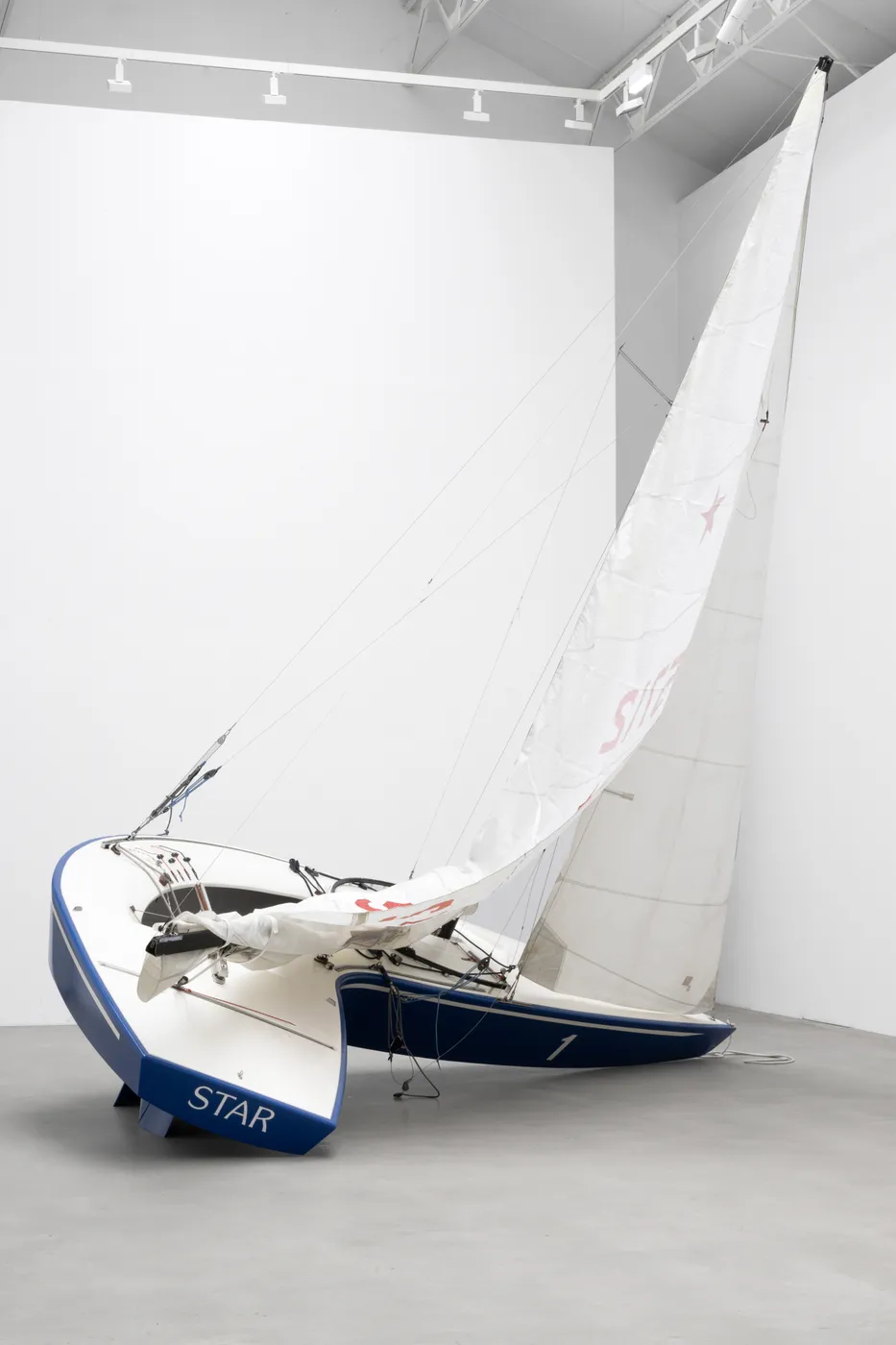
With its paradoxical and playful approaches to surface and material – solidity and fragility, volume and emptiness, history and ephemerality – Wurm’s work draws on the conventions and parameters of sculpture itself: what he calls ‘sculptural issues’. The exhibition unfolds around two monumental sculptural installations: a 6-metre-tall bent sailing boat, and a compressed schoolhouse. 

Erwin Wurm School, 2024 Mixed media 375 × 785 × 147 cm (147.64 × 309.06 × 57.87 in) Visitors are...
Erwin Wurm
School, 2024
Mixed media
375 × 785 × 147 cm (147.64 × 309.06 × 57.87 in)
 

Visitors are invited to step inside School (2024), which distorts the 19th-century silhouette of Wurm’s local village schoolhouse. In its narrow, low-ceilinged interior, the walls are plastered with vintage posters retracing some of the lessons once taught in French schools now considered outdated. The school’s cramped interior, complete with compacted chairs and a small blackboard, creates a sense of claustrophobia in the visitor who enters, mimicking the restrictiveness of teachings of the past, while encouraging us to reexamine the unquestioning beliefs we hold today.
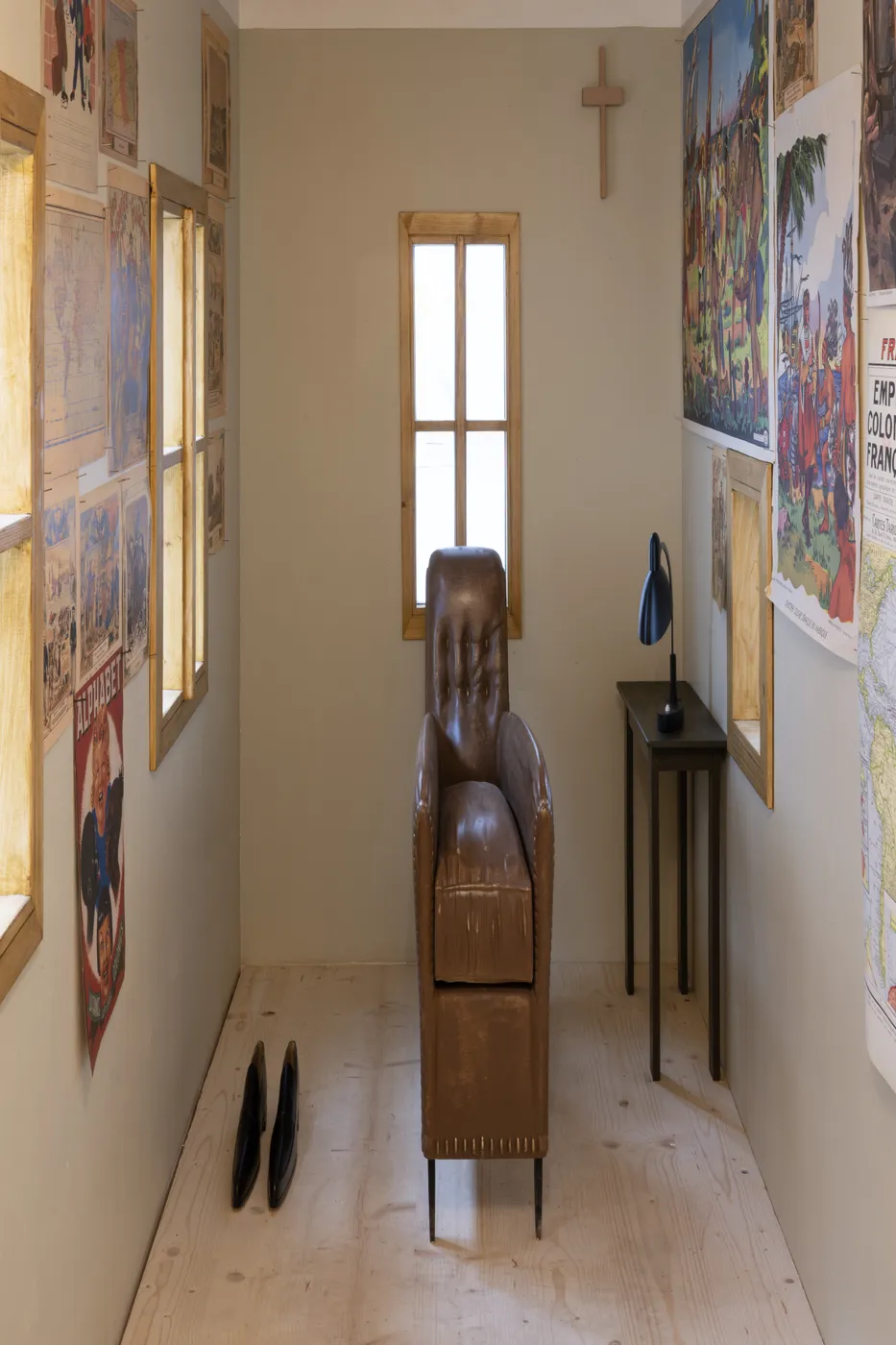
Erwin Wurm School, 2024 Mixed media 375 × 785 × 147 cm (147.64 × 309.06 × 57.87 in) ‘School is...
Erwin Wurm
School, 2024
Mixed media
375 × 785 × 147 cm (147.64 × 309.06 × 57.87 in)
 
School is about the sculptural mass of knowledge, and how it changes over the decades’, Wurm explains. ‘My intention is to suggest that if we cannot recognise our current distortions, perhaps we will see them clearly in 50 or 100 years’ time.’ The French version of School, made specially for Thaddaeus Ropac Paris Pantin, follows Austrian and Japanese versions presented in the artist’s retrospective at the Albertina Museum, Vienna (2024), Marmorschlössl Bad Ischl (2025), and Towada Art Center (2025).
Erwin Wurm Blurred Memory: Uncle Bazooka, 2025 Bronze, acrylic paint 160 × 80 × 45 cm (62.99 × 31.5 ×...
Erwin Wurm
Blurred Memory: Uncle Bazooka, 2025
Bronze, acrylic paint
160 × 80 × 45 cm (62.99 × 31.5 × 17.72 in)
 
Wurm finds in the shifting nature of ideas, perceptions and thoughts a sculptural plasticity. Just as School accords sculptural form to the received knowledge of an era, across the exhibition, Wurm gives shape to the immaterial. The Blurred Memories sculptures are anthropomorphisations of Wurm’s own school-age memories, beliefs and experiences.
Erwin Wurm Star, 2025 Mixed media 600 × 630 × 95 cm (236.22 × 248.03 × 37.4 in) Star (2025),...
Erwin Wurm
Star, 2025
Mixed media
600 × 630 × 95 cm (236.22 × 248.03 × 37.4 in)
 
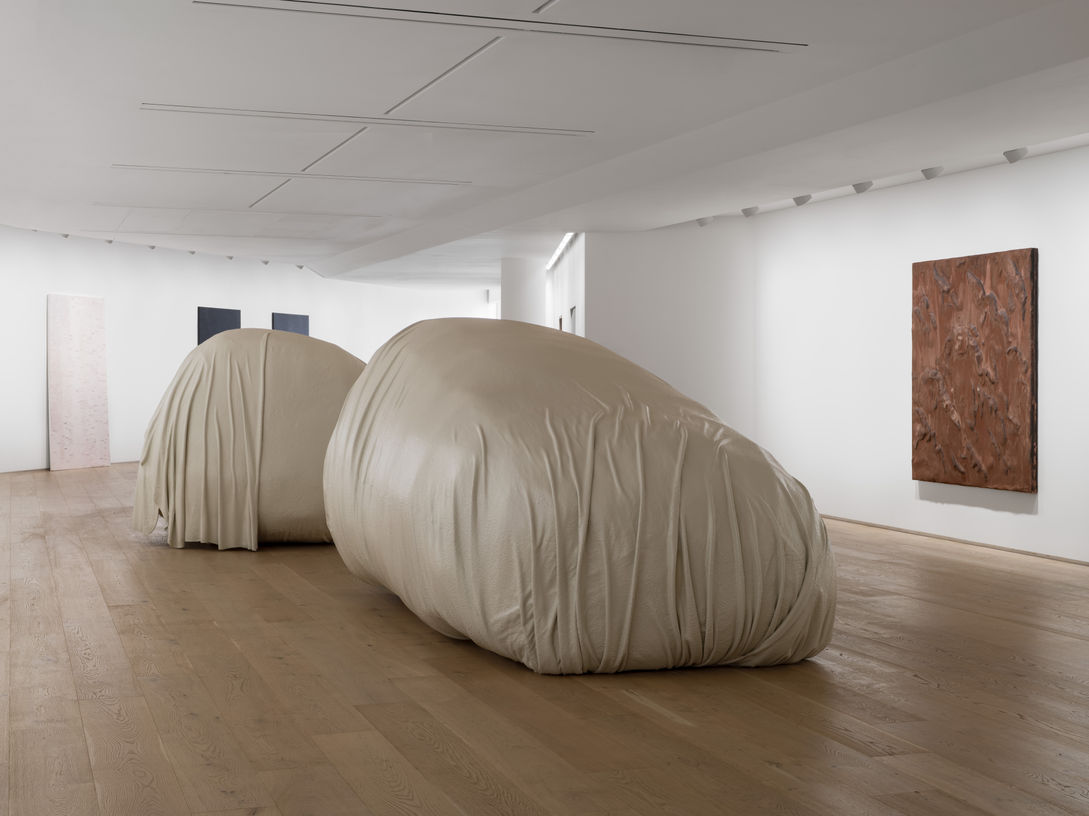
Star (2025), Wurm’s full-size sailing boat, is inspired by the Salzkammergut resort area in Austria, whose many lakes are popular with pleasure boaters. Curved in the middle, the fully-functioning vessel is designed for ‘going round corners’. Perfectly adapted to sailing in aimless circles around a lake, it epitomises the absurdities and futilities of modern life.
Erwin Wurm Star, 2025 Mixed media 600 × 630 × 95 cm (236.22 × 248.03 × 37.4 in) As Max...

Erwin Wurm
Star, 2025
Mixed media
600 × 630 × 95 cm (236.22 × 248.03 × 37.4 in)

 
As Max Hollein, art historian and director of The Metropolitan Museum of Art in New York, has said, Wurm ‘has succeeded in conveying to a large audience, in a hugely suggestive way, the tragedy of its own social condition.’ By giving it material form, Wurm positions Tomorrow: Yes as an investigation into how the philosophies we live by are built and bent, and an invitation to the visitor to question the ideas they take for granted.

Across the exhibition, the visitor encounters sculptures that, as Wurm put it, are ‘about human beings, but without human beings’. The Box People (2009–present) – cubic forms dressed in formal attire but lacking heads – interrogate the human condition and the role of the individual in the social, political and environmental conditions of the contemporary world.

The theme of clothing, which played an important role early in Wurm’s career, is once again at the heart of...

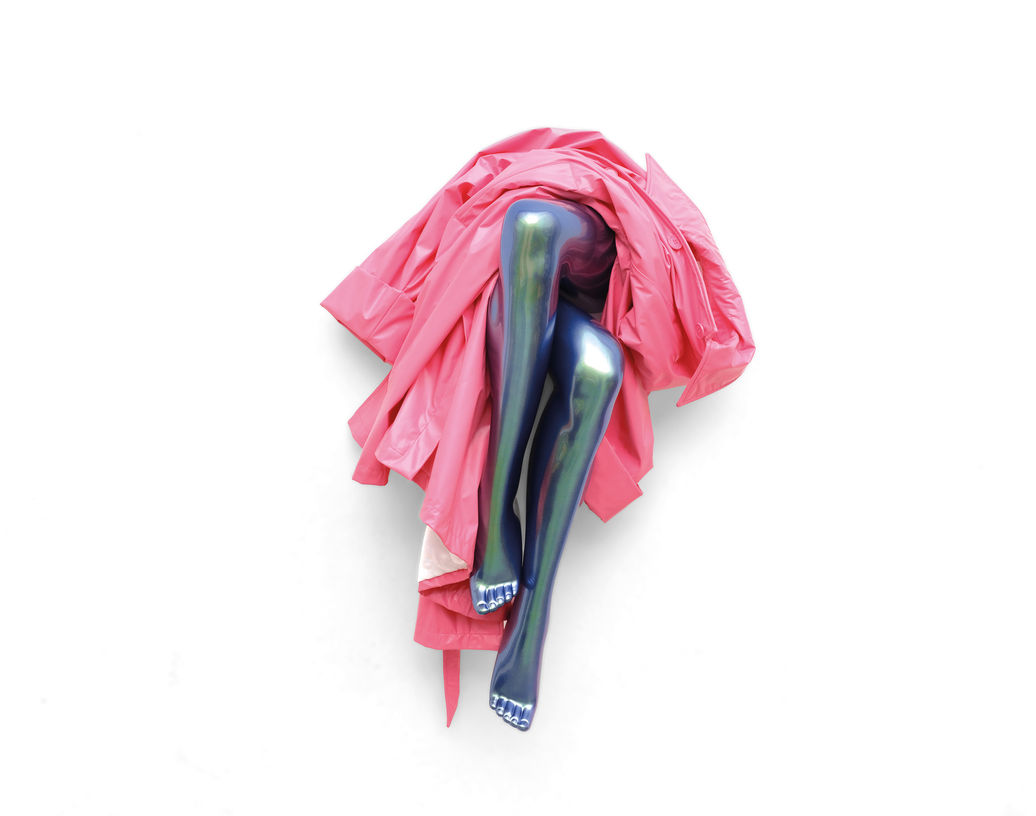
The theme of clothing, which played an important role early in Wurm’s career, is once again at the heart of his recent work. In new works from his Substitutes series (2022–present), clothing appears in the form of unworn, empty shells – as if suddenly vacated by their wearers – from which sculptural forms are cast.
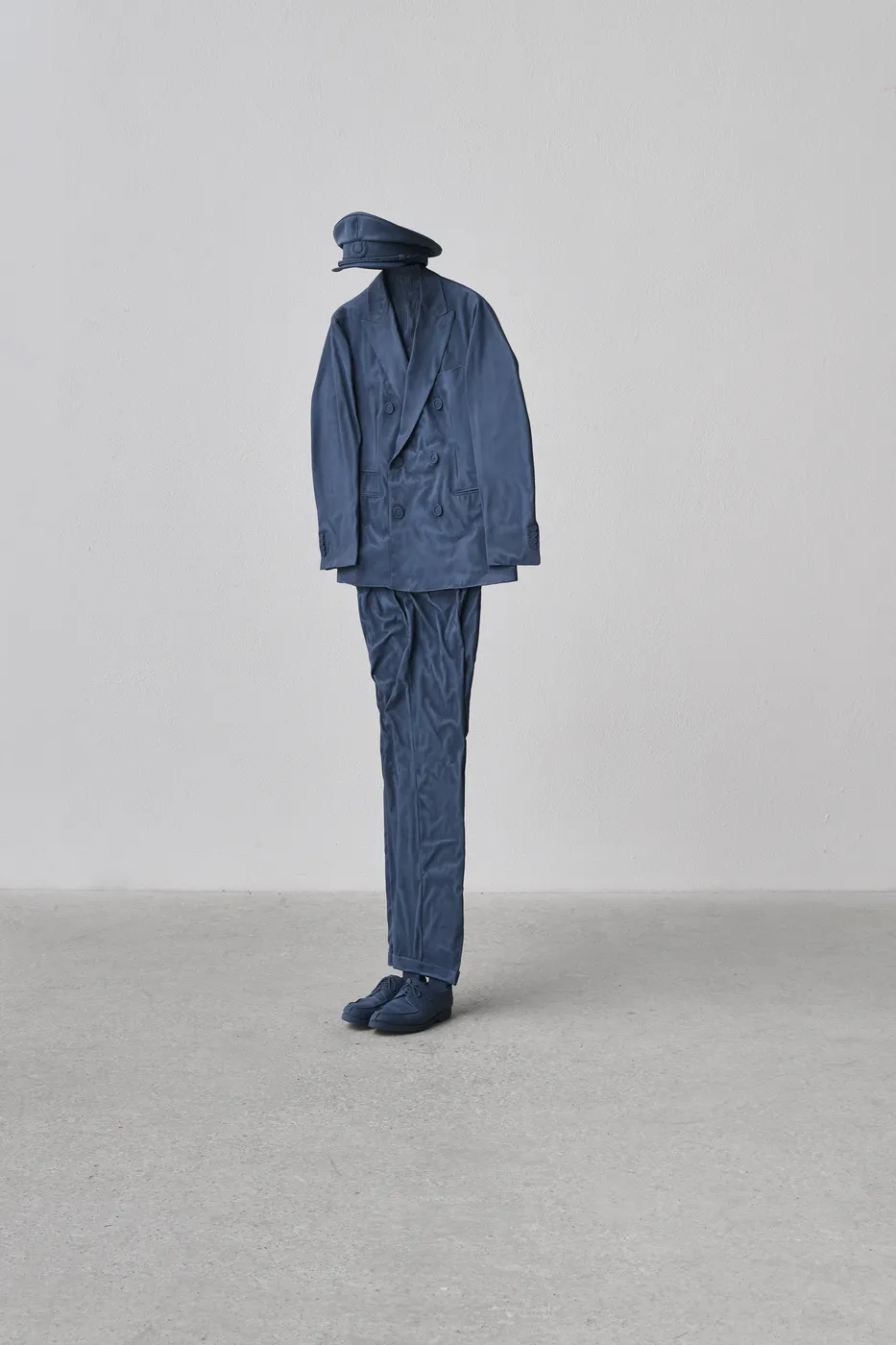
Erwin Wurm Regret (Substitutes), 2025 Aluminium, acrylic paint 188 × 62.5 × 30 cm (74.02 × 24.61 × 11.81 in)...
Erwin Wurm
Regret (Substitutes), 2025
Aluminium, acrylic paint
188 × 62.5 × 30 cm (74.02 × 24.61 × 11.81 in)
 
Most of the Substitutes on view are cast in aluminium coated with one or two vibrant tones of acrylic paint. Others are made in bronze or in marble: strong materials that contrast with the flimsiness of the ghostly garments. ‘As a sculptor, I’m interested in this idea of skin as a boundary,’ Wurm explained. ‘Clothes are our second skin, a shell that separates our bodies from the outside world’.
Erwin Wurm Bonjour Monsieur Courbet (Substitutes), 2025 Aluminium, acrylic paint 202 × 100 × 16.5 cm (79.53 × 39.37 ×...
Erwin Wurm
Bonjour Monsieur Courbet (Substitutes), 2025
Aluminium, acrylic paint
202 × 100 × 16.5 cm (79.53 × 39.37 × 6.5 in)
 
The deflated outfits – collars and hoods gaping open, stockings that pool on the floor or suits that hang flat against the wall as if the bodies that occupied them have simply slid away – are a reminder that clothes are a sculptural material in their own right, altering how we perceive what is within and even articulating new volumes.
Erwin Wurm Shadow (Substitutes), 2024 Bronze, patina 220 × 47 × 50 cm (86.61 × 18.5 × 19.69 in) Wurm’s...
Erwin Wurm
Shadow (Substitutes), 2024
Bronze, patina
220 × 47 × 50 cm (86.61 × 18.5 × 19.69 in)
 
Wurm’s investigation of skin and clothes as sculptural surfaces is rooted in art-historical tradition. Observing that classical sculptures in bronze are hollow, consisting only of a thin outer membrane of clothes and skin, in the Substitutes, Wurm takes this surface as his subject. Shadow (2024), one of the Substitutes on view, nods to this art-historical connection with the verdigris patina that coats its bronze surface, giving it a time-worn aspect.
 
 
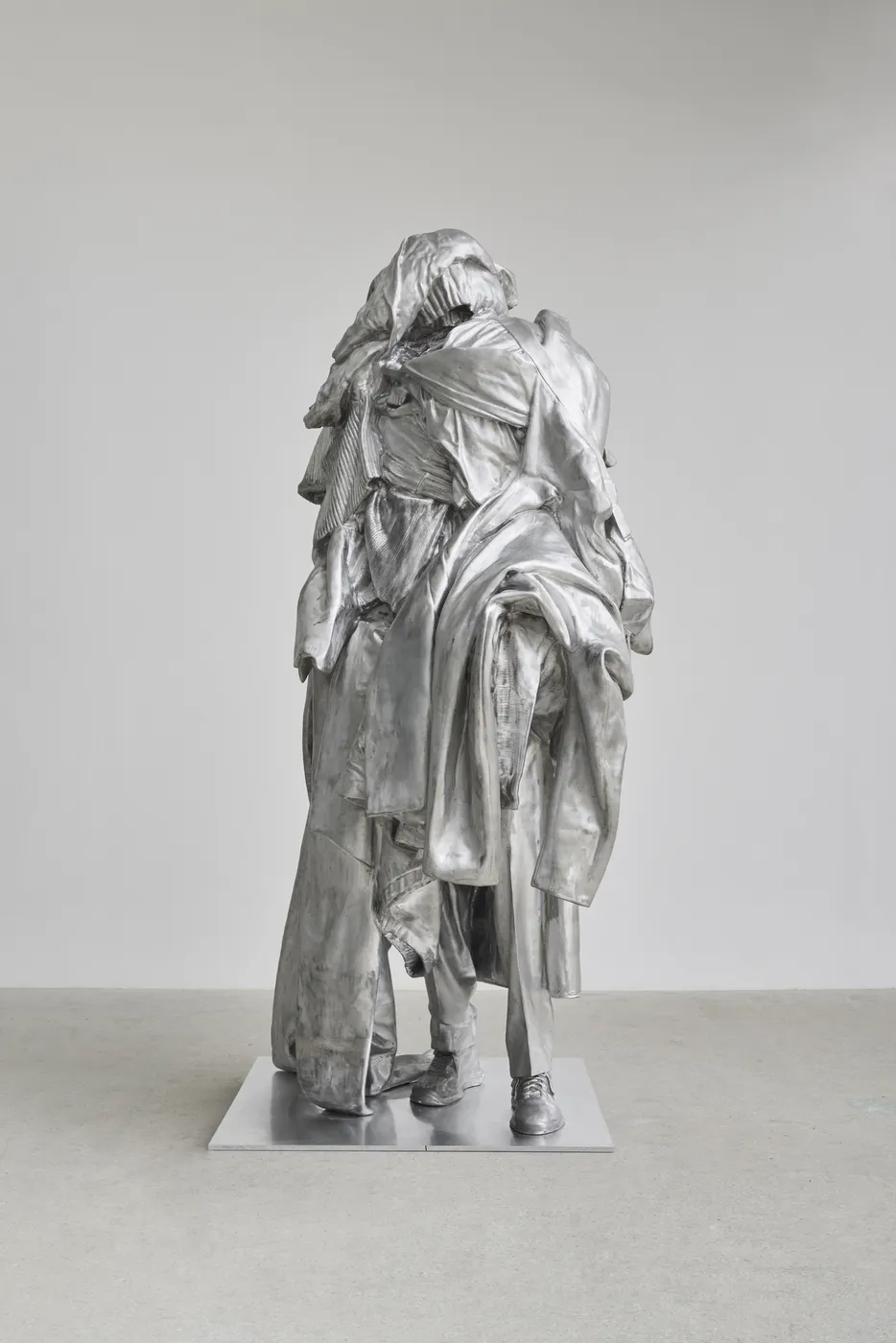
Erwin Wurm Balzac, 2023 Aluminium 320 × 163 × 133 cm (125.98 × 64.17 × 52.36 in) Standing at over...
Erwin Wurm
Balzac, 2023
Aluminium
320 × 163 × 133 cm (125.98 × 64.17 × 52.36 in)
 
Standing at over three metres in height, the majestic Balzac (2023), meanwhile, responds to Auguste Rodin’s canonical Monument to Balzac (1891–97). An ‘idea of a person’ emerges from a pile of draped clothing, evoking the semi-abstract monolith of Rodin’s homage to the French novelist Honoré de Balzac. Wurm was inspired by the myth that the French sculptor soaked the writer’s dressing gown in plaster to dress his monumental form. The Balzac on view in the exhibition follows a first edition, unveiled as part of Wurm’s 2023–24 exhibition at Yorkshire Sculpture Park, where it is now part of the permanent collection. 
Commenced in 2024, Wurm’s Mind Bubbles place ovular forms atop cartoon-like legs in anthropomorphic reimaginings of the thought bubbles found in comic strips or graphic novels. Oscillating between figuration and abstraction, the gravity-defying sculptures’ spindly legs are weighed down by the rounded, organic shapes in a play of proportions that reevaluates the balance between body and mind in making us who we are. As Wurm says: ‘Everything is perception’.
The exhibition will also feature a selection of Wurm’s One Minute Sculptures, whose time-based, participatory angle epitomises the artist’s provocative,...
The exhibition will also feature a selection of Wurm’s One Minute Sculptures, whose time-based, participatory angle epitomises the artist’s provocative, questioning approach to sculpture. Begun in 1996, they incorporate everyday objects, which they invite the visitor into brief but thought-provoking interactions with.

The One Minute Sculptures on view include elements such as a pile of two hats to be worn, a bottle of whisky to be drunk from a glass, and even Issey Miyake garments that visitors can put on to activate, following the One Minute Sculptures that featured on the runway in the presentation of Miyake’s Wurm-inspired Autumn/Winter 2025–26 collection at the Carrousel du Louvre, Paris in March 2025.

Inheriting from Joseph Beuys’s concept of social sculpture, this series transforms the visitor from spectator into participant, destabilising traditional modes of engaging with art. In these ephemeral living sculptures, the visitor completes the work, becoming a temporary site for Wurm’s exploration of form, thought and belief in mutation.

Coinciding with the 61st Venice Biennale

6 May—22 November 2026 Museo Fortuny, Venice The Museo Fortuny will present an exhibition of works by Austrian artist Erwin...

6 May—22 November 2026
Museo Fortuny, Venice


The Museo Fortuny will present an exhibition of works by Austrian artist Erwin Wurm, featuring both new sculptures shown for the first time and works retracing some of his most celebrated series. The exhibition unfolds across three floors of the Palazzo Fortuny in Venice, which, for the first half of the 20th century, was the home and atelier of Spanish fashion designer Mariano Fortuny. The ground floor will be dedicated to a solo presentation of Wurm’s sculptures, while, on the first and second floors, his work will be brought into dialogue with Fortuny’s, the light-toned, ductile aspect of Wurm’s works conveying a sculptural plasticity as they emerge from the shadows of the museum’s rich collection. ‘I find that very exciting’, says Wurm, ‘placing contemporary sculpture in such a layered, historical environment’.


Wurm achieves a transformation in the opposite direction when objects or forms in his work assume distinctly human attributes. In...

Wurm achieves a transformation in the opposite direction when objects or forms in his work assume distinctly human attributes. In his Stone Sculptures and Tall Bags, these anthropomorphised objects are perched on legs with characteristics or postures that evoke distinct personalities. He has also explored clothing as a sculptural theme – as a second skin, protective shell, outline, or the filling out of volume – in large-scale installations where architectural features are dressed in knitted pullovers. The artist views the bodily process of gaining or losing weight in sculptural terms as the addition or subtraction of material, and often creates illusions of growth or shrinkage, as in his Fat Cars or Narrow House. In recent ceramic works, Wurm has abstracted and isolated body parts such as ears, noses, hands or nipples to create surreal and suggestive forms.

Wurm lives and works in Vienna and Limberg, Austria. The artist has twice participated in the Venice Biennale: with his installation Narrow House at the Palazzo Cavalli-Franchetti in 2011 and when he represented Austria in 2017. Recent solo museum exhibitions have been held at the Taipei Fine Arts Museum (2020); Musée Cantini, Marseille (2019); K11 MUSEA, Hong Kong (2019); Vancouver Art Gallery (2019); Albertina Museum, Vienna (2018); 21er Haus at the Belvedere, Vienna (2017); Leopold Museum, Vienna (2017); Centro Cultural Banco do Brasil, São Paulo (2017); and Berlinische Galerie, Berlin (2016).
 
    Atmospheric image Atmospheric image
    Atmospheric image Atmospheric image
    Atmospheric image Atmospheric image