Lee Kang So’s Survey Captures Change Itself
By Hokhang Cheung
For his 1973 exhibition at Seoul's Myeongdong Gallery, Lee Kang So transformed the gallery into a pub where visitors could sit and converse freely while sharing food and makgeolli (Korean rice wine). Titled Disappearance – Bar in the Gallery (1973), the performance created communal space during a period of severe censorship, shortly after Park Chung Hee’s declaration of martial law. Until recently, an installation recreating the landmark performance was on view in the survey exhibition ‘Emergence and Dissolution’ at Seoul’s LOTTE Museum of Art.
Six decades later, the octogenarian artist is perhaps more closely associated with his abstract paintings than with his cutting-edge performances. Yet, as the exhibition underscores, he was a central figure in 1970s-era Korean experimental arts, with a wide-ranging, medium-defying body of work. His 1975 Untitled-75031 consisted of a live chicken tethered to a feeding trough with a rope; as it roamed so far as it could within the given parameters, the bird moved a powdery coating on the floor, creating the appearance of a drawing. The exhibition features photographic documentation of the chicken’s movements. Situated at the intersection of performance and mark-making, Untitled-75031 evinces Lee’s growing interest in the way actions across time – and the traces they leave – can constitute a work of art.
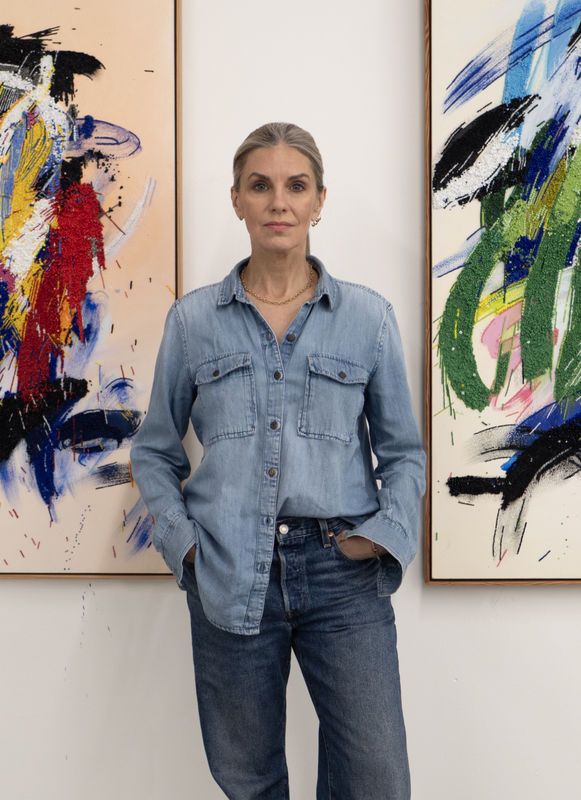
‘Emergence and Dissolution’ opens not with these earlier projects but with Serenity-21929 (2021/2026), a digital installation reconfigured for this venue. Visitors enter through a long, darkened corridor, with continuous LED panels on one side showing Lee’s signature gestural brushstrokes sweeping across the screens. The immersive passage creates a sense of traveling back through time, preparing viewers to examine the culmination of a decades-long practice. Subsequent galleries present Lee’s large-scale paintings made from the late 1980s to 2026. While these canvases might seem a far cry from earlier, more experimental works, they share the same underlying drive: the desire to minimize the artist’s intervention and capture something more processual, perhaps change itself.