Ali Banisadr: Temple of the Mind Exhibition review
By Cal McKeever
The study of art history can lead to the perception that the subject of all painting is, in some form or another, an internal discourse on the lineage of painting that precedes it. This thinking is more in line with Hegel than how painters think about their work, which calls into question its efficacy. Sometimes however, as in the case of the exhibition Ali Banisadr: Temple of the Mind at the Buffalo AKG Art Museum, the framework is revelatory. This exhibition, co-curated by the artist and the museum’s collectors curator Holly E. Hughes, boldly and astutely situates Banisadr’s art history reference-laden oil paintings and bronze sculptures in the curatorial context of the AKG’s exceptional permanent collection.
[...] Banisadr’s intervention is staged in the 1905 neoclassical Robert and Elisabeth Wilmers Building, which houses the collection of work from roughly the 1750s to the late 1950s, not traditionally home to contemporary exhibitions. The collection in this building includes canonical works of artists such as Paul Gauguin, Arshile Gorky, and Willem de Kooning, as well as significant works by James Ensor, Amedeo Modigliani, Ernst Ludwig Kirchner, Alexander Rodchenko, and Jackson Pollock, to name a few.
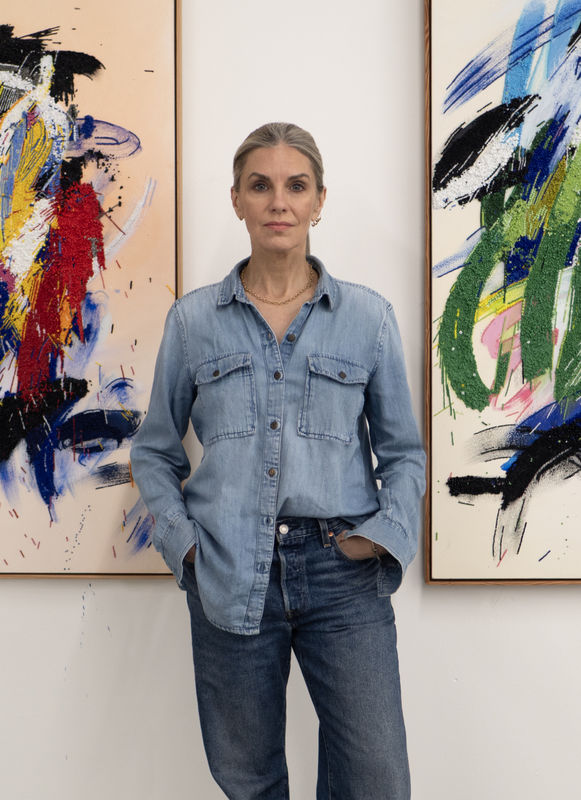
To juxtapose such paintings with very contemporary work is no small or simple task, but there are few more suited than Ali Banisadr. His dense paintings dance between abstraction and figuration in swirling compositions that create a gripping sensation of perpetual motion in the viewer’s eye, rewarding lengthy viewing. This kinesthetic feat is a signature of the artist’s distinct facture—his studied automatism and sense of spatial fluidity result from a unique deployment of speed and touch. Their subject matter seems to evocatively draw from a deep well of heterogeneous and non-hierarchized art historical imagery, but rarely feel disconnected from our contemporary moment.
The title of the exhibition is taken from Albert Pinkham Ryder’s modestly scaled 1880s painting Temple of the Mind (itself a reference of Edgar Allen Poe’s 1839 poem ‘The Haunted Palace’), hung on the salon wall that opens the first gallery. The works, all made in the last four years, are dispersed throughout the museum, with a single work placed in a number of galleries. No works were made specifically for the exhibition or explicitly in response to the collection, but there is an omnipresent sense of curiosity and playfulness in how Banisadr and Hughes created the fruitful conditions for dialogues of pairings, mirrorings, and reverberations—the juxtapositions contain both harmony and at times a generative dissonance. [...]