Adrian Ghenie Capricci romani
Capricci romani
24 September – 15 November 2026
Istituto Centrale per la Grafica, Palazzo Poli, Via Poli 54, Rome
Capricci romani, an exhibition of previously unseen works on paper by Adrian Ghenie (b. 1977, Baia Mare, Romania), is conceived by Alessandra Borghese and promoted by the Fondazione Ghenie Chapels – Mecenatismo per l'Arte and the Istituto Centrale per la Grafica of Rome, curated by Fabio De Chirico and Pier Paolo Pancotto, and supported by Thaddaeus Ropac gallery. Staged at Palazzo Poli in Rome from 24 September to 15 November 2026, it brings together works on paper and cardboard specifically made for the exhibition.
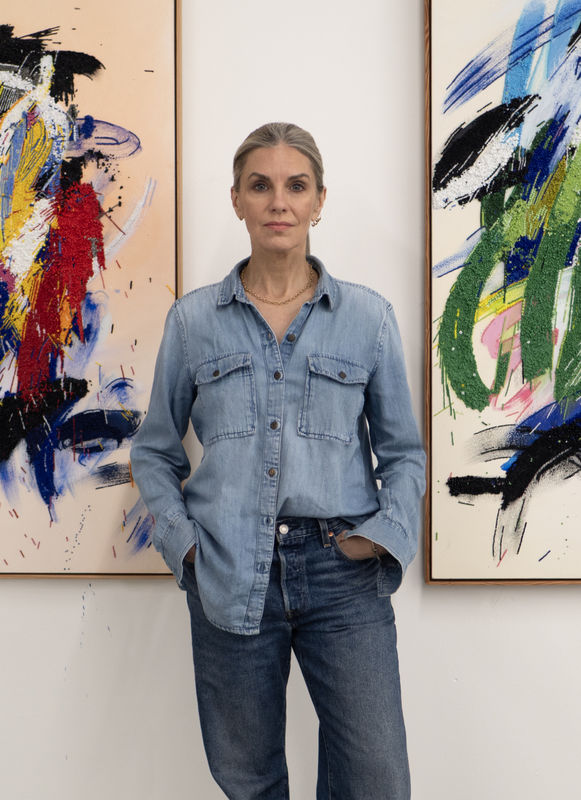
Widely regarded as one of the most significant painters of his generation, Adrian Ghenie has lived and worked in Rome for several years. His studio, on Via Appia, is surrounded by Roman aqueducts, ancient ruins and their countryside, and a constant stream of tourists and pilgrims enamoured of the world's most ancient road. After his move, the artist's pictorial research has come to focus on the theme of the Roman countryside and the 'invented' landscape, a genre that has been central for centuries and developed by great masters before him. His influences span from the Classicism of Nicolas Poussin and Claude Lorrain, through to the picturesque, melancholic Romanticism of Jean-Baptiste Camille Corot, whose atmospheric renderings of this region helped establish landscape as an autonomous genre.
Retracing this lineage, and following in the celebrated footsteps of Giovanni Battista Piranesi, the artist explores the tradition of the capriccio, a genre popular from the seventeenth century onward, in which real and imagined elements are brought together to create scenes that feel at once composed and mnemonic. He constructs landscapes that are, in his words, “recognisable, but not descriptive”: images that evoke a shared visual memory shaped by art history, yet subtly undone through his deconstructed pictorial language, capable of fusing figuration and abstraction.
Favouring charcoal for its responsiveness, Ghenie builds these works through incessant erasing and reworking, until the sheet becomes so densely worked and inhabited by its own line that it comes to resemble a painting — reaffirming his talent for drawing as well as his profound knowledge of and love for the place where he lives.
Today, to paint or draw classical beauty and “Romanness” is a fascinating short circuit. The dilemma lies between nostalgic celebration and contemporary reinterpretation: how can the classical canon be transformed into a living, current language? This is the artist's challenge, and one that Capricci romani sets out to meet.
The series springs from a desire to bring this genre back to life through a new and ironic vision. The artist affirms he was drawn to ancient ruins by the excess of technology that has taken hold of our lives; the ruins have become, for him, a kind of memento mori.
In his drawings, populated by invented landscapes and fantastical imagery, the artist is often both protagonist and guide of an imaginary journey along the Via Appia. A defining tension arises from the encounter between the ancient ruins and contemporary figures equipped with trainers, backpacks, umbrellas or hiking poles.
“When I walk along the Via Appia, I see the details of a stone bearing an ancient inscription; I study it and think about how I might represent it. I often look at it with a sense of bewilderment, and with the desire to understand how to bring it into a contemporary work of art, far from any notion of a classical, hedonistic, museum-bound Romanness. To me, it's a mystery.”
—Adrian Ghenie
The exhibition is consistent with the research, conservation and outreach activities of the Istituto Centrale per la Grafica, which preserves and studies graphic heritage with particular attention to the iconography of Rome and its surrounding territory. The Istituto's collections — which include the world's most important holdings of printing plates, nearly 24,000 metal and wood plates, around 45,000 historic prints, and celebrated holdings such as the Fondo Piranesi and the Fondo Barberini — document the construction of the city's image across the centuries. In recent years, the Istituto has devoted major exhibition projects to this theme, ranging across shows that explore Rome's identity from the sixteenth century to the present day. In this light, Capricci romani is part of an established scholarly reflection on the transformations of Rome's image and on the ways the city continues to be observed and reinterpreted by contemporary artists.
Capricci romani follows Adrian Ghenie's artist residency in the Istituto's historic Calcografia, where the artist worked alongside master printmakers Fabio Ascenzi and Matteo Maria Borsoi to create two soft-ground etchings, inspired by images from the chapels of the Chiesa della Madonna della Mazza in Palermo, where two of the artist's paintings were permanently installed in 2022. The two prints will be on view in the exhibition and will subsequently become part of the Istituto's permanent collection.