Oliver Beer at Thaddaeus Ropac Listening to 17,000-year-old architecture
By Will Jennings
Once the Mayfair residence of the Archbishop of Ely, the Grade 1 listed London HQ of international gallery Thaddaeus Ropac is five stories of grand Georgian pomp, smartened up by Selldorf Architects and Cowie Montgomery Architects in 2017. It features a grand split staircase that spirals up from ground to first floor, one of the handsomest reworkings of stone in any modern art gallery and worth the visit regardless of who is on show.
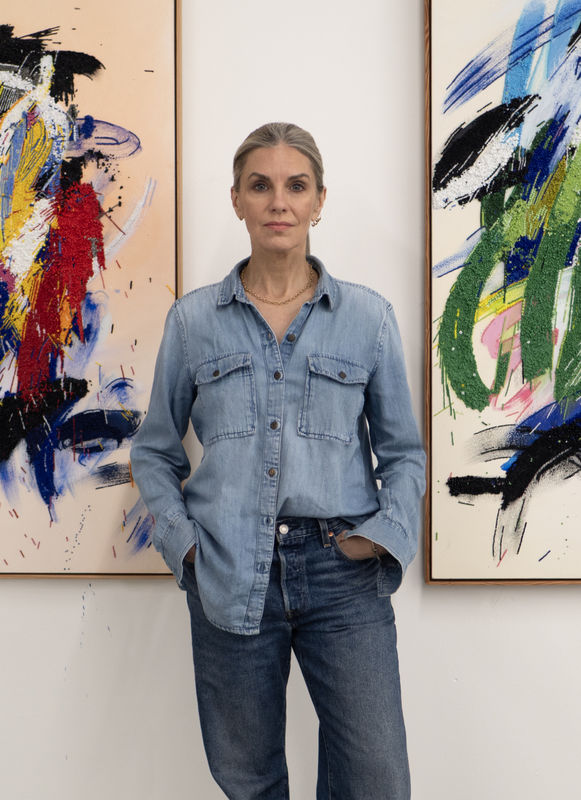
The next series of works to hang on Ely House’s walls are canvases by Oliver Beer, and as abstract shimmers of colour do not at first glance seem to have much to do with the uniformly white, architectural neatness and immaculate decorative detailing surrounding it. But there is linearity, if a long one. The large paintings are profoundly about an architectural space, albeit one resided in many years before the Archbishop contracted Arts and Craft architect Sir Robert Taylor to craft his Palladian home from Portland Stone.
The Sky in the Cave, a series of new works by Beer, is a multi-media installation, comprising a sound installation and series of large canvases that speak to the earliest architectural history. Beer was invited to visit the Palaeolithic La Grotte de Font-de-Gaum caves in the Dordogne region of France, places he has now revisited many times to understand the aesthetic, acoustic, and atmosphere, sometimes alone and sometimes with some specially invited guests. These paintings are a direct result of the experience and qualities of the architecture of these ancient caves.
Beer has long been interested in the unique acoustic quality of any space – whether that be a grand concert hall, prehistoric cave, or even the inside of a Victorian Toby Jug. Every space of every scale has within its own perfect acoustic note, a product of its material, shapes, surfaces, and vibration. Beer can feel it intuitively, so knows where to start a process of working the specific acoustic frequency out through singing, listening, reading the environment, and in a way reaching back from the present towards the time each place was created.