Robert Rauschenberg: Five Friends Review of the group exhibition at Museum Brandhorst and Museum Ludwig
By James Meyer
DEAR BOB RAUSCHENBERG is a gorgeous valentine. A work on paper by Cy Twombly dated February 14, 1972, and composed in the artist’s signature scrawl, the drawing is a charming testimonial of a deep connection. Twombly thanks Rauschenberg for his friendship, his love, his “warm house” on Florida’s Captiva Island, and “lime pie.” He also gives thanks for “Peter,” for “Jungel [sic] Road”—an undeveloped area of the island preserved by Rauschenberg—and for “many other reasons.” Twombly mounted the valentine on a larger sheet, where remnants of other words painted over in white pigment are barely legible. A vestige of another drawing, perhaps, the effaced text is a cipher of all that Twombly could not say, the tangle of feelings and memories conjured by the visit. Dear Bob Rauschenberg captures an intimacy between two artists—two men—that resisted definition.
There are people we meet when we are young—irreplaceable people. Encountered in pedagogical settings or by chance, these individuals, these rare friends, are fellow travelers on the path of becoming, with whom we share moments of intensity. They nurture our passions, our interests. They help us define who we imagine ourselves to be.
So it was with Twombly and Rauschenberg, who met as classmates at the Art Students League in New York in 1951 and soon began a love affair, embarking on a journey to Europe and North Africa that would have a profound effect on their practices. Returning to New York, they lived together until Twombly relocated to Washington, DC, to serve in the army, where he was employed as a cryptologist. Their friends John Cage and Merce Cunningham had met in 1938 at the Cornish College of the Arts in Seattle, where Cage worked as an accompanist in Cunningham’s dance class. Reuniting in New York, Cage and Cunningham staged their first collaborative work in 1942, formalizing a personal and professional relationship that would endure a half century. Another celebrated pair, Rauschenberg and Jasper Johns, became acquainted at the Manhattan studio of artist Sari Dienes in 1954. Within months Rauschenberg left the downtown space he’d shared with Twombly for a loft on Pearl Street a floor above Johns’s studio. He had completed his first Combines, including Bed, 1955. Johns had finished painting Flag, 1954–55. “It would be difficult to imagine my work at that time,” Rauschenberg recalls in the spiral narrative of his lithograph Autobiography, 1968, “without [Johns’s] encouragement.”
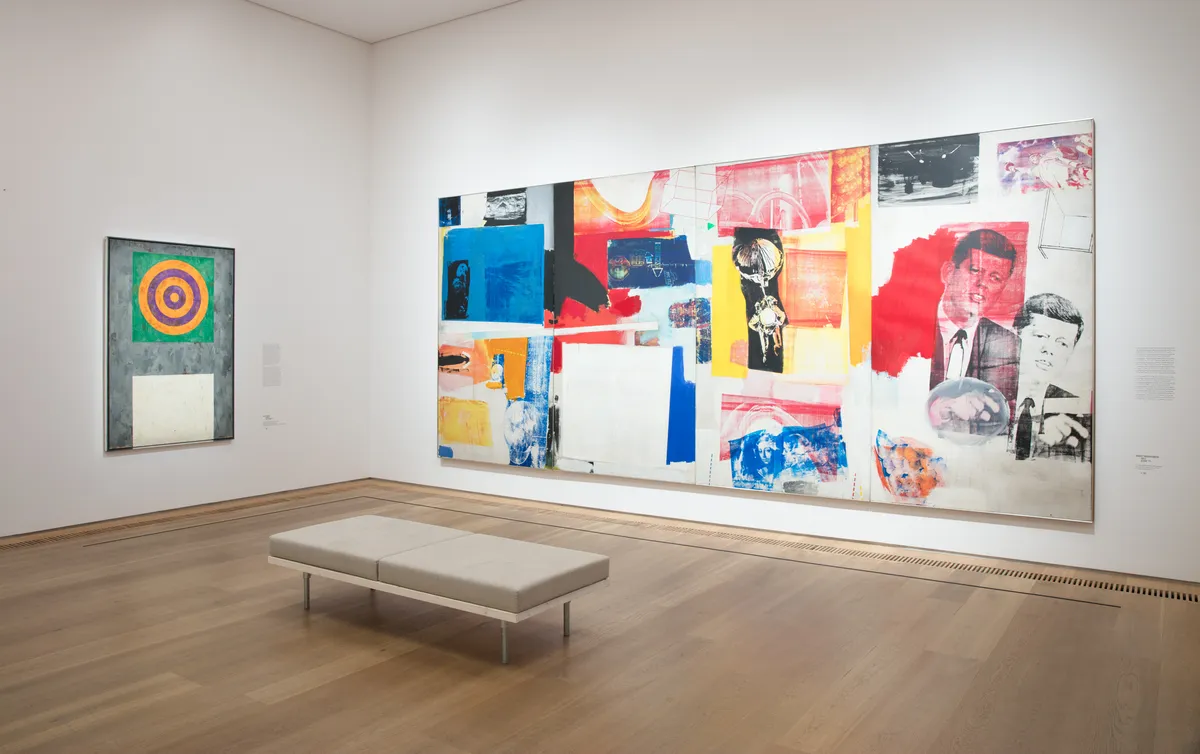
Bed and Autobiography were among the more than two hundred works and documentary materials included in Museum Ludwig’s “Five Friends: John Cage, Merce Cunningham, Jasper Johns, Robert Rauschenberg, Cy Twombly,” an ambitious, deeply satisfying examination of a major episode of queer and postwar art history cocurated by Yilmaz Dziewior and Achim Hochdörfer.