On the road with Robert Rauschenberg Two exhibitions are exploring the artist’s groundbreaking art of the real
By Jessica Lack
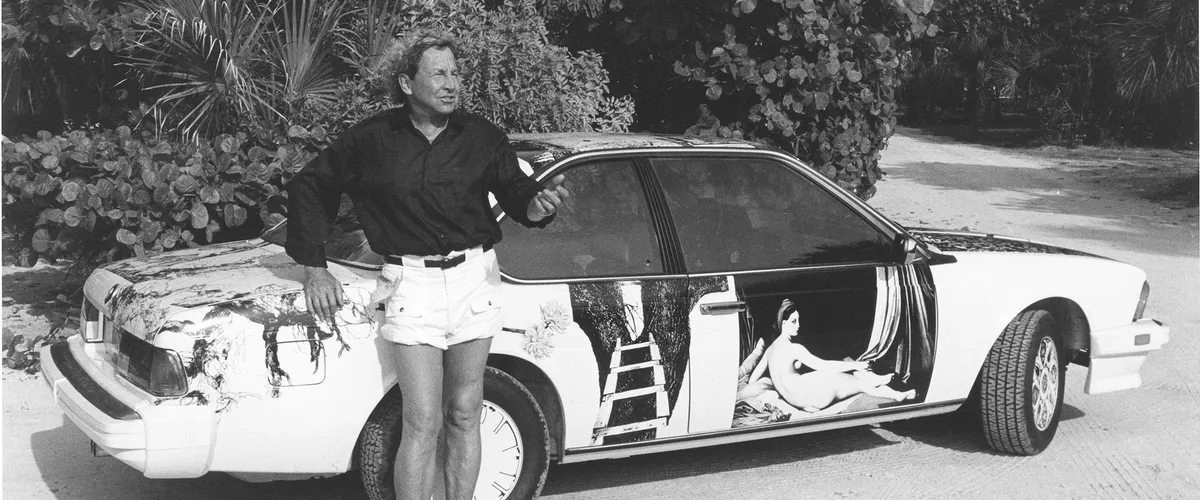
It rained the day Robert Rauschenberg reduced painting to a car tire track. In 1953, the artist was broke and renting an unheated studio on Fulton Street in Lower Manhattan, New York. Unable to afford materials, he scavenged typewriter paper and pasted it together to create an almost 7-meter roll, which he laid on the street outside. The composer John Cage then drove his Ford Model A through black paint and along the paper’s length. It took the pair some time to peel the wet paper off the pavement, but when it had dried, Rauschenberg hung it on the wall in the form of a Chinese scroll and titled it Automobile Tire Print (1953). ‘Nobody ever got more out of a Model A than that,’ he said of the gesture, which, with its tacky residue, mapped the vehicle’s passage through space and time and offered a pitch-level view of the urban landscape.
‘I think a painting is more like the real world when it’s made out of the real world,’ he later famously said. This sense of ‘real world’ art was rooted in the artist’s childhood, spent on the Texas coast. Born in 1925 in the oil refinery town of Port Arthur, Rauschenberg grew up in the shadow of fossil fuel distillation and learnt to appreciate the raw beauty of this corrosive landscape, later incorporating its grime and rust into his ‘Combines’ (1954–64) – seemingly chaotic structures created from newspaper print, paint, and scavenged items that echoed the detritus of the urban and industrial environment.
The trip initiated a lifelong fascination with the region, currently the subject of ‘Rauschenberg and Asia’ at M+ in Hong Kong, staged to mark the centenary of the artist’s birth. The museum’s senior curator and associate director of curatorial affairs, Russell Storer, notes that ‘it holds special meaning for us to map Robert Rauschenberg’s travels across Asia through this exhibition. His encounters with Asian artisanal traditions and cultural contexts left a lasting imprint on his own practice while opening up new possibilities for contemporary art.’
The trip initiated a lifelong fascination with the region, currently the subject of ‘Rauschenberg and Asia’ at M+ in Hong Kong, staged to mark the centenary of the artist’s birth. The museum’s senior curator and associate director of curatorial affairs, Russell Storer, notes that ‘it holds special meaning for us to map Robert Rauschenberg’s travels across Asia through this exhibition. His encounters with Asian artisanal traditions and cultural contexts left a lasting imprint on his own practice while opening up new possibilities for contemporary art.’