Observing from a Distance, or Perhaps Dissolving into It Review of Distancing, navigating the gaps between materiality, the human form, and historical narratives
By Misun Huh
[An English digest of the article]
This exhibition, Distancing, at Thaddaeus Ropac Seoul expands the dialogue between Korean contemporary art and the wider Asian discourse, presenting 19 new paintings and one sculpture by Kei Imazu, Juree Kim, Nosik Lim and Maria Taniguchi.
Upon entering the gallery, one encounters three paintings by Maria Taniguchi. These works are part of her Brick Paintings, so named because of her method of layering the composition like bricks. While they may appear to represent a meditative or self-reflective process, the artist describes them as an expression of "the flow of time and the accumulation of the physical body." Taniguchi highlights two essential elements in these works: "Conceptual Relationships," established within the internal conditions of the painting itself, and "Familiar Relationships," meaning the way her works from the past 15 years meet and form a single group. Connecting over 200 of her works are her pencil sketches, the act of drawing bricks, and the use of small brushes for colouring. Regarding the decision to lean these three new works against the wall rather than hanging them, she noted that they felt like "portals or doors transitioning to another dimension."
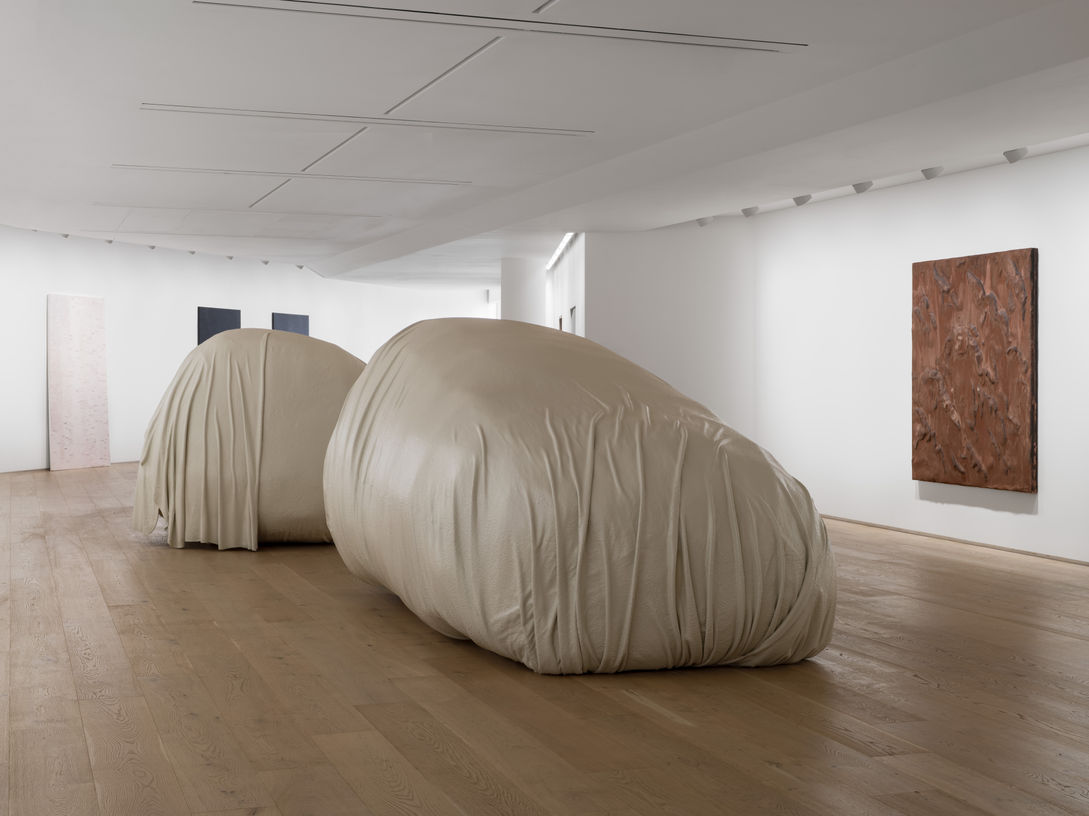
Juree Kim, who expresses changes in matter, environment, and ecology through installation, sculpture, and painting, presents her desert series—which condenses traces of cracking and sedimentation—alongside her sculpture Wet Matter (某濕), which is maintained through interaction with its surroundings. The desert paintings capture a cyclical scene by unfolding different states and timelines experienced by a single material all at once. Having witnessed the moment a clod of earth dissolves in a water tank, Kim was reminded of the cycle of life and began focusing her work on the material of soil. Utilising remnants such as earth, waste bricks, rocks, and ceramics, she portrays creation and dissolution not as opposing or independent structures, but as a single, continuous, and cyclical scene.
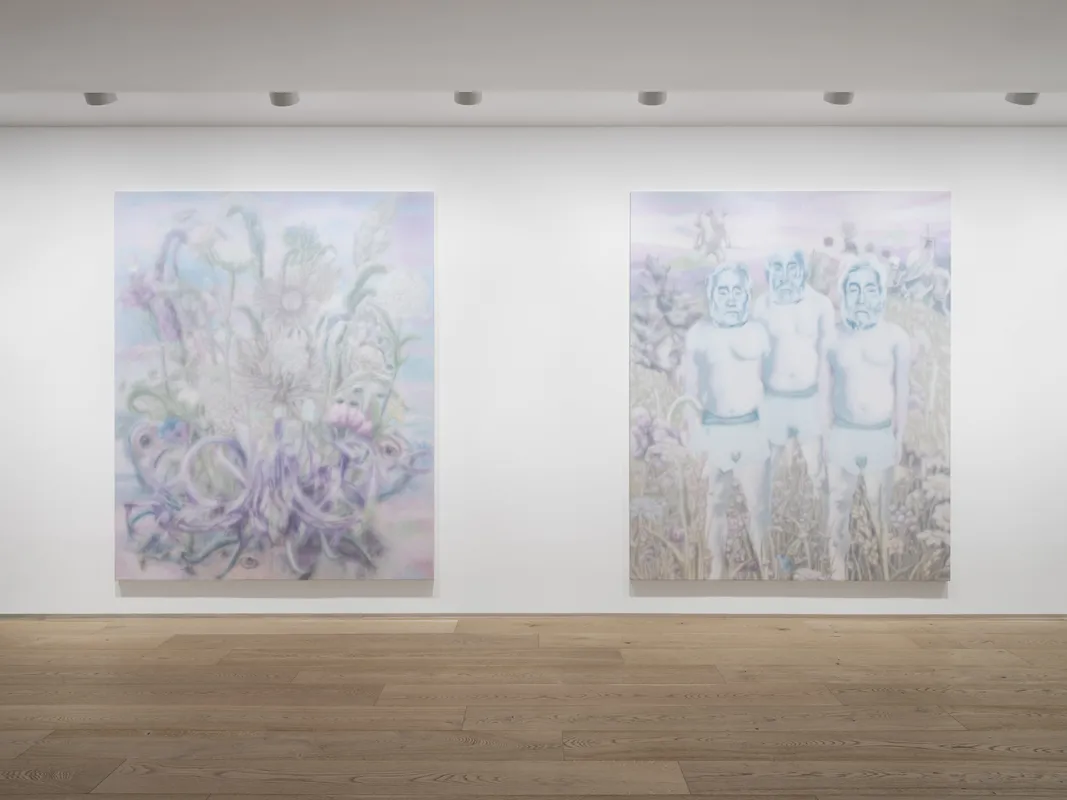
Interspersed among Kim’s works are the paintings of Nosik Lim, whose placement creates a rhythmic presence. Starting from his own surroundings and stories, Lim expresses the relationships functioning between objects, as well as the invisible currents and air surrounding them. Objects with soft focus overlap or permeate one another, forming their own unique relationships. His Landscape series explores the numerous points of view within the frame, the position of the viewer, and the position of the canvas looking back at the viewer. These works, including Yeoju, LIM, Father, and Wildflower, depict the scenery of his hometown in Gyeonggi Province. They take inspiration from rural landscapes, such as sand mountains created by national industry, foreign friends moving to farming villages, scenes of extinct flowers returning to life, and funeral traditions. Lim explained that while he initially collected images from his ancestral burial grounds, he now gathers views from paddy fields, riverbeds, and the ground itself, seeking out both visible elements—like walls and earth—and invisible things felt through the body.
The Japanese artist Kei Imazu, who is based in Bandung, Indonesia, uses images from myths and folktales to condense different narratives and timelines into a single frame. Regarding the theme of Distancing, she noted that even after the war, Japan experienced many ambiguous periods where time seemed to flow without a set direction, referencing Douglas MacArthur’s famous description of the nation's self-reliance at the time. Having moved to Indonesia eight years ago to rediscover her purpose in painting, she found a contrasting perspective in a country that gained independence after the war, and now incorporates their myths and folklore into her work. Imazu presents Hearth and Wreck, Violet Trade, and She Who Treads, where multiple eras and stories coexist. In Hearth and Wreck, everyday life inspired by Indonesian ruins exists alongside a Japanese warship submerged in the Philippine sea. She expressed a desire to show that while the past of the war remains beneath the sea, daily life has continued gracefully to the present day.