Robert Rauschenberg: Life Can't be Stopped Review of Rauschenberg's solo exhibition at the Guggenheim, New York
By Maddy Santorelli
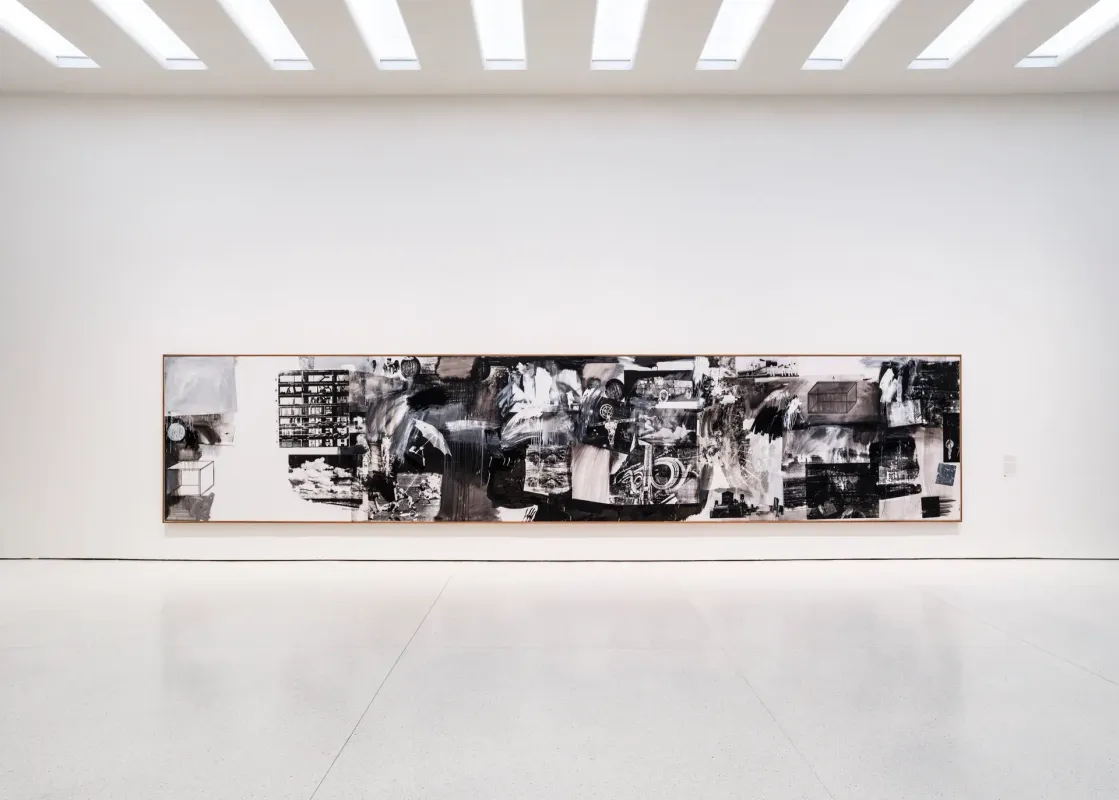
Robert Rauschenberg has returned to the Guggenheim in honor of his centennial year. Part of the museum’s Collection in Focus series, Life Can’t Be Stopped presents a sort of miniature retrospective (“over a dozen” works, but not more than fifteen) cuddled in the corners of the sixth floor of the Guggenheim’s tower. The exhibition, smartly organized by Joan Young, walks its visitor through and between time, encompassing notable mediums of paint and paper, transfers and silkscreens—all some means of collage. It is a fine job at a survey, a place for one to get familiar, undressed, though not quite known.
The show opens with one of Rauschenberg’s signature moves. Recalling the “Combines,” a 1963 untitled work is topped with a toaster, the middle of the canvas marked by a black-and-white horizontal picture of his friend and colleague the choreographer Merce Cunningham turned vertically, making it seem as though his silhouetted body is falling. Maybe he is. Objects become images and images become objects, neither ever totally either. Using the image-as-material, where sign and symbol are one in a word, our imagination is free to run wild with Rauschenberg’s. What else here is a body? A bike, a plane, a bug, a fetus in a womb—stars being born and dying but never dead. There is no beginning or end.
The pieces weave themselves in and out of invention and destruction. One is satisfied for a breath by the faint touching of two thin strips fashioned from cheese cloth caulked in print in an untitled 1974 work, where the artist lets four papier-mâché strands hang, attached to the wall only by a board, as the wall text puts it, “enabling the fabric tails to catch a passing breeze.” I think of sailing catamarans in the bays of my youth and all that brought to my being, similarly and so different from the artist who grew up informed by the Gulf Coast of Port Arthur, and who later spent so much time making work on Captiva Island. I take another lap around the show, and the pair once joined at the edges is already no longer.