In Rotterdam, Mandy El-Sayegh Offers Up an Assault on the Senses Exhibition review
By Henry Roberts
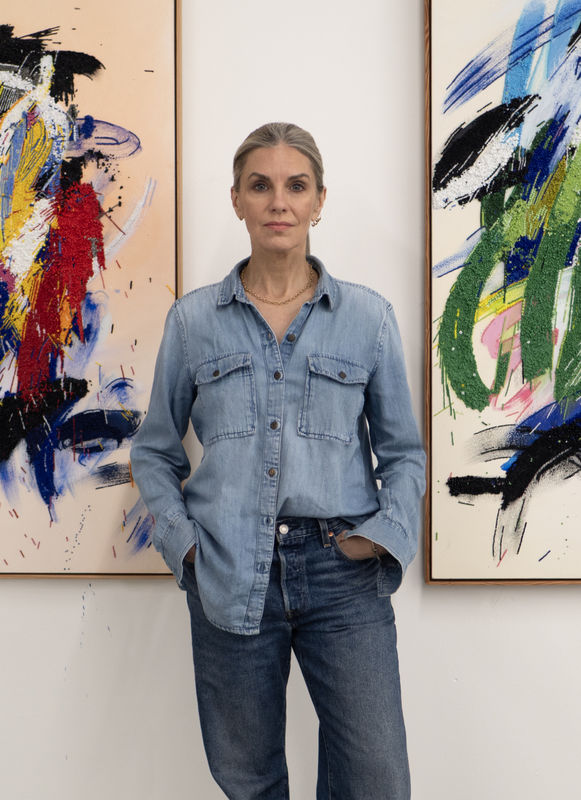
I could smell Mandy El-Sayegh’s exhibition before I could see it. Ahead of entering “Figure, Field, Grid” at Depot Boijmans Van Beuningen, I watched a video of Mandy El-Sayegh, in which she discusses her love of latex. “It’s a gnarly material,” she tells the camera. “It has this dual quality of congealing and holding, but it’s also dying and falling apart. It’s an impossibility of having any beauty without its terror.” That coupling of beauty and terror aptly describes El-Sayegh’s practice; in all of her work, a dark undercurrent lies beneath initial appearances. For all its gnarly material quality, the latex throughout “Figure, Field, Grid” foregrounds its history of extraction and colonial violence. The smell of that congealed latex was palpable from down the Depot corridor in Rotterdam. When I pointed it out to a member of the gallery staff who had been installing the show for over a week, she laughed. “We’re used to it,” they responded.
Immediately on entering, it’s clear that “Figure, Field, Grid” is a multisensory show. The floor was coated in hardened latex, paint and rust, making it slightly uneven underfoot. Look up from the floor, and one sees a Frankenstein mashup of materials and histories. Huge sheets of newsprint, silkscreens, her father’s calligraphy, a copy of Robert Burton’s The Anatomy of Melancholy sitting under a glass display, hand-painted grids, more latex. But “Figure, Field, Grid” isn’t just about what we can see. The smell was part of the experience (even if Boijmans staff were desensitized), as was the sound, a screaming blues track playing from speakers above our heads. It was discomfiting, but for a show that tackles, among other themes, the war in Gaza and our numbed response to genocide, we can hardly expect to feel comfortable.
The name of the exhibition comes from Rosalind Krauss’s seminal essay. Published in 1979, “Grids” positioned the grid as central to modern art. It has been a tool for artists since the Renaissance, but in the 20th century, the grid became a prominent feature in works by Piet Mondrian and Agnes Martin. In a different essay, Krauss articulates the “expanded field” as a way for art to transcend the traditional boundaries of painting and sculpture. El-Sayegh takes this idea and runs with it, creating “Figure, Field, Grid” as a multisensory show, something that is physically experienced rather than passively received.