The ascent of Danish artist Eva Helene Pade “Painting is a magical process of letting go”
By Lydia R. Figes
A golden haze, sweat and smoke, the vibrations of pulsating music, and the flickering of a distant strobe light—the sensuous paintings of Eva Helene Pade allude to the heady atmosphere of a nightclub. Relishing in primal, earthly pleasures, her large-scale paintings also point to something mythical; unfolding human narratives existing at the liminal threshold of fantasy and reality. These works are intoxicating dreamscapes that defy categorisation.
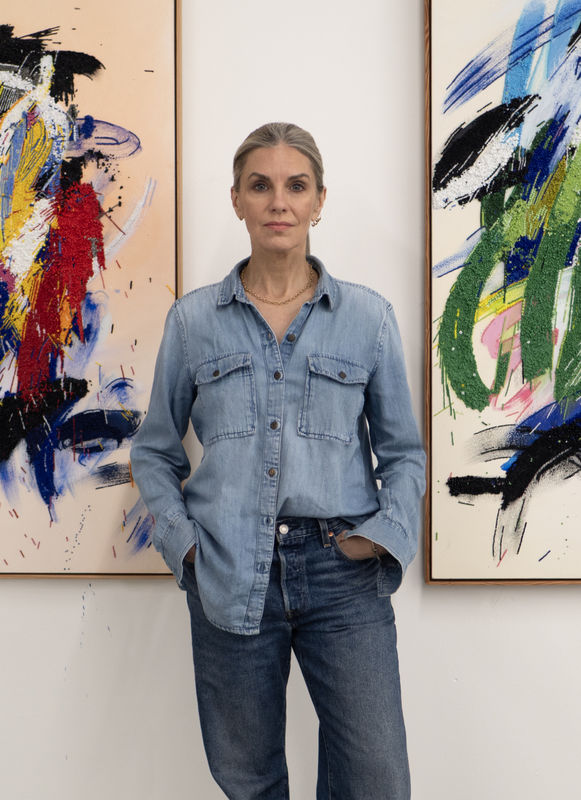
When I meet Pade in person, a 28-year-old Danish painter who now resides in Paris, I start to comprehend how such an early career artist has created an impressively mature body of work. As we walk through the galleries of Thaddaeus Ropac, where she is debuting her first UK solo show, Eva Helene Pade: Søgelys, she is calmly confident and, wearing leather trousers with tousled blonde hair, gives off an air of understated cool. Training at the The Danish Royal Academy of Fine Arts and graduating from her MFA in 2024, Pade is now one of the youngest artists to be represented by Thaddaeus Ropac. But don’t be fooled by her short CV. The reason I say Pade is mature for her age is because she doesn’t overcompensate when explaining her practice. She also reveals a humility you often (ironically) only find in more seasoned artists; she acknowledges that she is both creator and vessel for the final work. “I start with an idea, then I have to give it space to take its own life” Pade tells me. “You can’t really predict how the work will turn out. You can’t expect too much of your idea. At some point the painting takes over—you have to continue without knowing exactly how it will unfold. Painting is a magical process of letting go.”
Pade’s works have captured the art world’s attention since her institutional solo show earlier this year: ‘Forårsofret (The Rite of Spring)’ at ARKEN Museum of Contemporary Art, outside of Copenhagen, which took as its inspiration Igor Stravinsky’s 1913 The Rite of Spring and famous dance reinterpretion by the German choreographer Pina Bausch in 1975. Continuing the visual motifs of those primordial paintings, this new body of work similarly conjures a sense of dance and dynamism in bacchanalian spirit.