Gilbert & George: 21st Century Pictures A review of the artists' exhibition at the Hayward Gallery
By Joe Lloyd
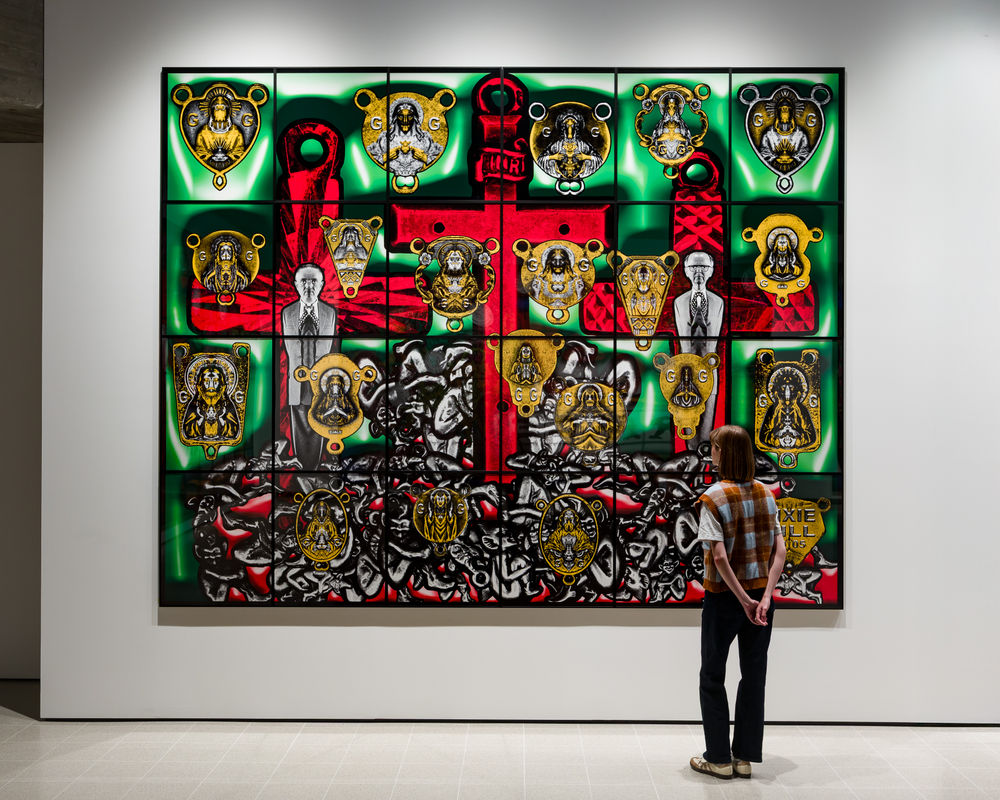
Gilbert & George hate music. They once described it as “the enemy”. They even changed their nightly dining spot after they noticed the cables for a speaker that was being set up. Yet their new exhibition at the Hayward Gallery, which gathers their major works since the turn of the millennium, is one of the most cacophonous exhibitions in recent memory. There is no sound, but the wildly clashing colours, coruscating patterns and lurid imagery of the venerable duo’s vast compositions seem to blip and blare like machines in a seaside arcade. In shopping malls, architects use multiple light sources to force visitors’ eyes to shift around from window display to window display. Ensconced in Gilbert & George’s hallucinatory funfair, I sometimes wanted to find a white wall to shield my eyes from the visual overload.
I sense Gilbert & George would want it that way. The pair have been provocateurs since they appeared at the tail end of the 1960s. An early self-portrait was entitled George the Cunt and Gilbert the Shit, the words floating over their toffish outfits. At about the same time, they took to covering their skin in colourful powders, standing on a table and singing the popular 1930s song Underneath the Arches for hours at a time. The very fact that these two men, one from Devon and the other from South Tyrol, Italy, spent every waking hour together, always dressed in the suits of a bank clerk, was in itself a provocation. Some of their early works, such as the charcoal drawing series The General Jungle or Carrying on Sculpting (1971), remain milestone works of contemporary art, fusing expressive draughtsmanship with lightly philosophical texts. Emerging at the high point of dry conceptualism, the whimsy and Romanticism of these works helped show that a different – and more publicly accessible – path was possible.
Around the same time, they commenced The Pictures, the series that has dominated their output in the decades since. All feature self-portraits of the artists, usually in their suits. Working in their kitchen in Spitalfields, east London, they created a process whereby they would arrange negatives and expose them on to photographic paper, which was then developed. Many such panels are then placed together into a sort of collage, with the black framing of each unit making them resemble vast windows. The initial works were black and white, before they started hand-colouring them, giving them jewel-like colours redolent of backlit stained glass. While the earliest Pictures reveal their origins in photography, with the assemblage of panels clear, they quickly became more complicated. They also became more subversive, and sometimes more vulgar. Take Naked (1994): here, the pair bear their buttocks and genitalia while their detached floating heads stick out their tongues, all arranged around a turd-coloured totem pole of penises.