Baselitz/Fontana Possible dialogues
By Stefano Bucci
Translated from Italian
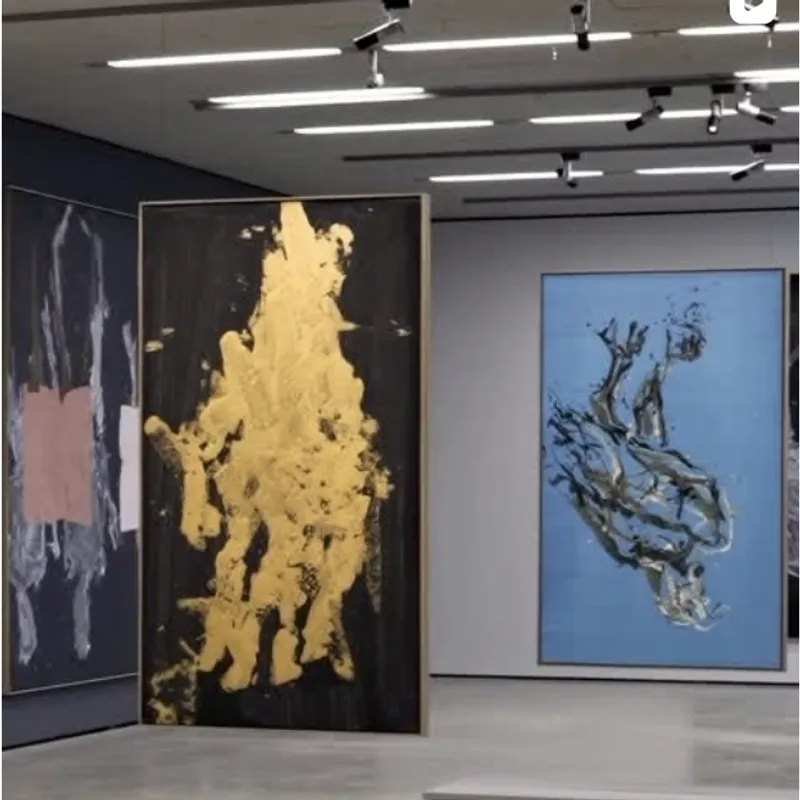
‘I deeply admire the kind of charm and intelligence that I have encountered, but I cannot make them my own.' From his home-studio (designed by Herzrog & De Meuron) overlooking the Ammersee in Upper Bavaria, Georg Baselitz describes the essence of the exhibition that, from 20 September, will literally bring him face to face with Lucio Fontana. An equal comparison, not a clash. But neither is it the homage due from one master (of the contemporary) to another master (of the modern). The exhibition, which inaugurates the new space of Thaddaeus Ropac gallery in Milan (which has already announced its next event featuring the female duo VALIE EXPORT & Ketty La Rocca, from 26 November), stages an imaginary dialogue between Hans-Georg Kern, born in 1938 in Deutschbaselitz, in Saxony, universally known as Georg Baselitz (a pseudonym that appears to be an obvious tribute to his roots), one of the most famous and prolific German artists, described as “aggressive and disturbing” and always a “scandalous” master, and Lucio Fontana (1899-1968), one of the most important protagonists of the international art scene in the 20th century.
‘I studied Fontana in Berlin, where he was very present: I always considered him the anti-image under Duchamp's whip.’ With his usual dry style, Baselitz recounts the beginning of his relationship with Fontana, a relationship that still continues today in some way under the sign of Duchamp: ‘Through the inversion of my subjects, I thought I had freed them from the shackles of traditional painting, as Duchamp had done with his Pharmacie,’ the first ready-made in history. The reference to Marcel Duchamp, a key figure in conceptual art, the rejection of traditional images and the move towards anti-images, confirms the link between these two revolutionary visions, since Fontana, with his slashes, had detached himself from classical painting, opening up a new space, symbolising an infinity yet to be explored.
Italy has always played an important role in Baselitz's work (he is a passionate collector of Mannerist prints and has a work by Emilio Vedova hanging in his kitchen): until 1987, he had a studio in Castiglione Fiorentino, near Arezzo, while he currently has one in Imperia. In 2019, Baselitz was also the first living artist to exhibit at the Gallerie dell'Accademia in Venice with the exhibition Baselitz-Academy, focusing on the evolution of his artistic practice and his interest in academies [...]