Ali Banisadr: The Alchemist Exhibition review
By Susan Harris
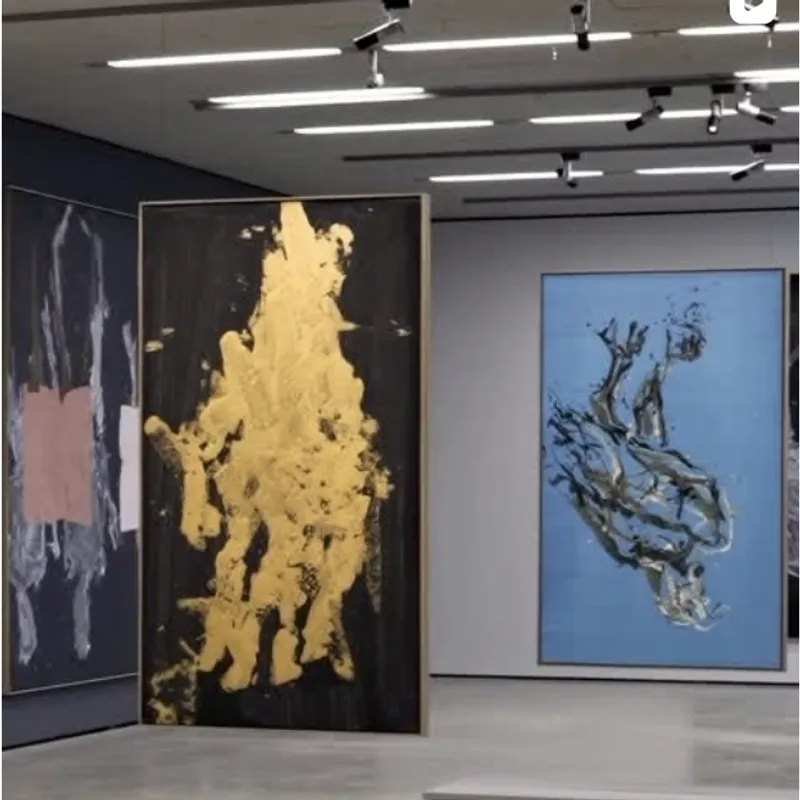
Ali Banisadr: The Alchemist is a sweeping survey of the artist’s last twenty years of work in which visitors bear witness to dazzling personal and collective worlds and embedded gestures that explode across and beyond the confines of the canvases. Alchemy, indeed, lies at the core of the enigmatic topographies and difficult-to-discern figures in paintings that are distinctively grounded in a fusion of abstraction and figuration—not as painterly strategy but as an outcome of an intuitive, empathic process involving synesthesia, a phenomenon unique to certain individuals in which one sense triggers a response in another sense. Born in Tehran in 1976—two years old when the 1979 Revolution occurred and four at the start of the eight-year Iran-Iraq War—Banisadr transmuted the vibrations and sounds of air raids, bombs, and blasts into drawings as a means for coping with and processing the violence. In 1988, he and his family emigrated to California via Turkey and his memories of the atrocities receded until 2006 when he experienced a personal and artistic epiphany.
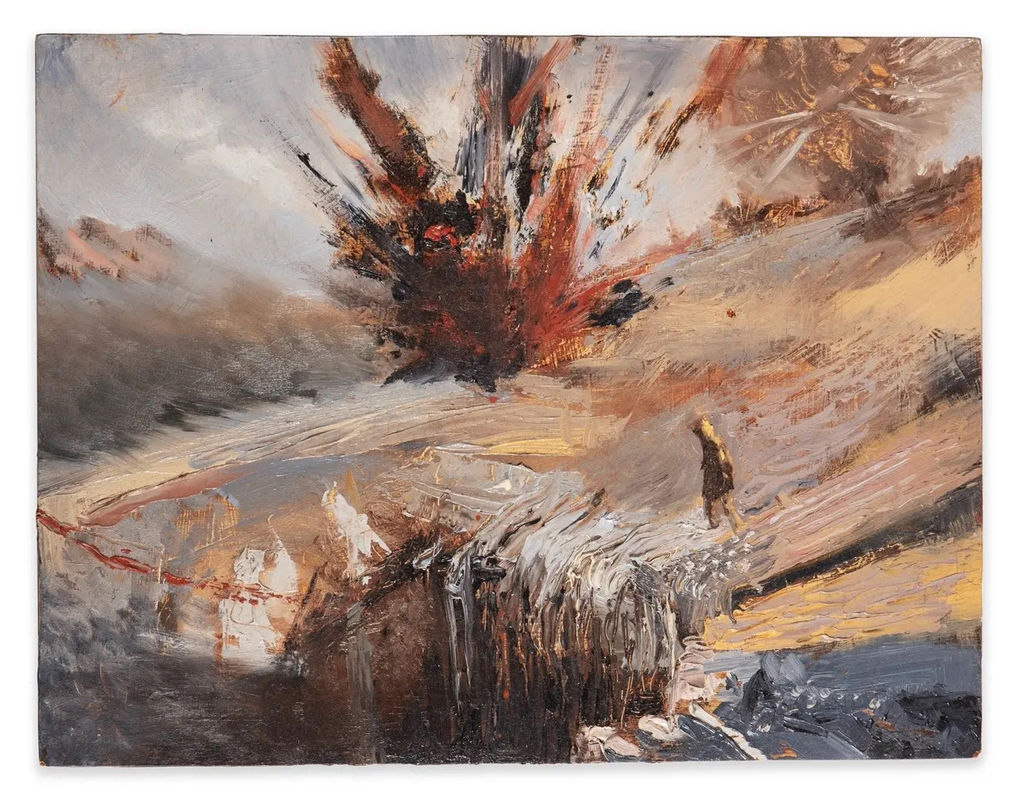
The exhibition opens with small ink and charcoal drawings of explosions that Banisadr made after a visit to the sites of Allied invasions in Normandy which triggered his foundational memories of the Iran-Iraq War. One can almost hear and feel the power of the blasts in the vigorous handling of lines and smudged, smeared, and blotted medium. So, too, in The Waste Land (2006), a small oil painting from the same time of a churning, molten landscape with an indistinct figure walking toward an open, liquifying crater and an explosion of paint in the distance. Taking the title of T. S. Eliot’s “The Waste Land,” the poet’s response to the violence of World War I, Banisadr has described how the crater just appeared in the foreground, surfacing and connecting to memories of hearing explosions and seeing craters in Tehran. He observed the painting pouring out of him so rapidly that he simply gave in to it, grabbing rags, palette knives, twigs—anything close by to make it happen. Ever since, internal sounds and vibrations along with a devotion to research are his personal North Star for building the mutable, encyclopedic, and nonhierarchical worlds that define his art.