Markus Schinwald Interiors Inc. Markus Schinwald Interiors Inc.

Markus Schinwald Interiors Inc.

Until 17 January 2026
Salzburg Villa Kast

Scroll down to learn more
/
I never really start with a blank page or a white canvas, there's always something there to build on and always something that I have a dialogue with. A painting from the 19th century is, in the contemporary sense, an artefact and using it again is almost like giving it a bypass, a second life.

— Markus Schinwald

Watch a video of the artist talking about the exhibition

Play
Pause
Watch a video of the artist talking about the exhibition
Thaddaeus Ropac Salzburg presents an exhibition of new works by Austrian artist Markus Schinwald. Large-scale tapestries and an immersive soundscape,...
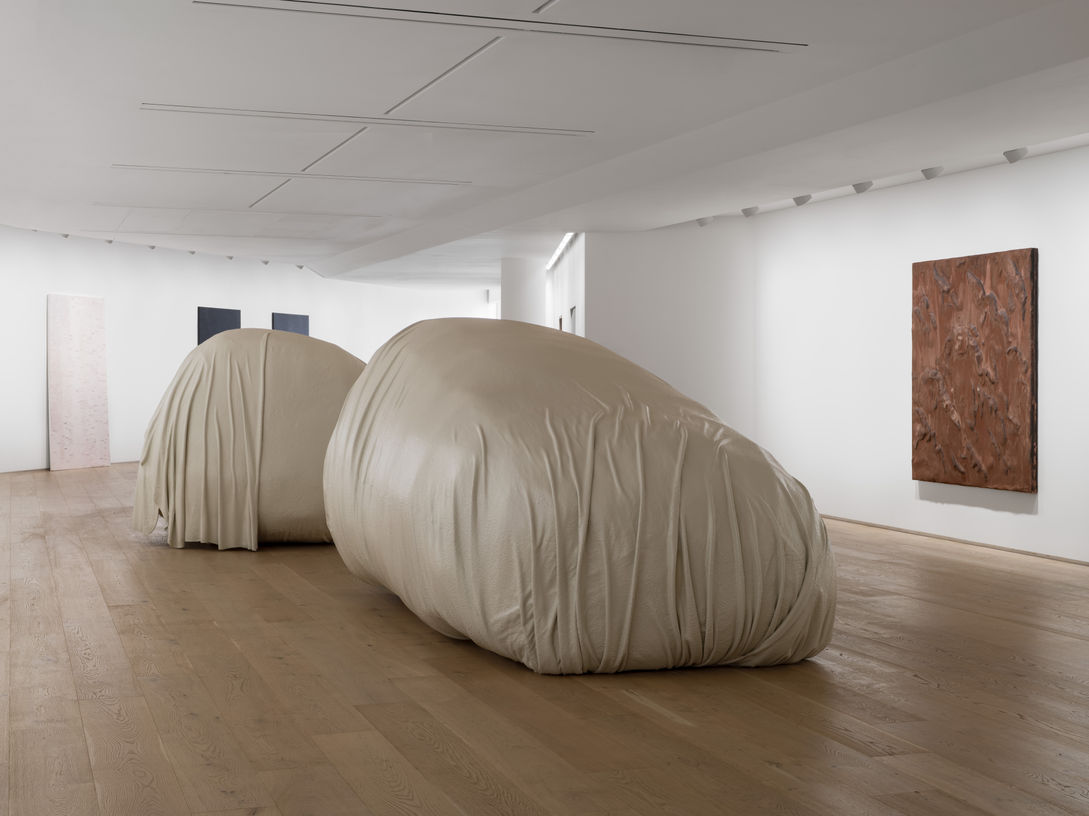
Thaddaeus Ropac Salzburg presents an exhibition of new works by Austrian artist Markus Schinwald. Large-scale tapestries and an immersive soundscape, that hovers on the limits of perception, envelop the gallery space, transforming the rooms of Villa Kast into a uniquely experiential setting for Schinwald’s recent series of paintings. The works suggest a conversation between the past and the future, sparked by an analogue method that bridges centuries of artistic and conceptual thinking. Having explored the complexities of inhabiting and perceiving the body for many years, Schinwald’s recent work investigates the deformation and decline of ‘memory culture’. For the artist, this not only includes retrospective constructions of the past, but also speculative imaginings of the future – as seen, for instance, in science fiction films – which are inevitably built from fragments of our past. Schinwald is particularly interested in the ‘flattening’ and self-referentiality of images and sound fostered by artificial intelligence and algorithm-driven media. For this exhibition, the artist seeks to ‘create a specific sense of space or interior,’ while employing ‘various methods of resurrection, ranging from restoration to generative technology.’ 

Markus Schinwald

Untitled (Extensions), 2024
Oil on canvas
200 × 200 cm (78.74 × 78.74 in)

Schinwald’s most recent series of paintings, titled Extensions, is presented against the tapestried backdrop. First featured in his celebrated installation...
Schinwald’s most recent series of paintings, titled Extensions, is presented against the tapestried backdrop. First featured in his celebrated installation Panorama (2022), shown at the 16th edition of the Lyon Biennale, these works are distinguished by the artist’s preoccupation with the digital world. As is characteristic of his previous paintings, the restoration of historical material is an integral aspect of his artistic process. Schinwald acquires undistinguished historic paintings in antique stores or at auctions and glues or weaves them into a larger, blank canvas. Once the old image is seamlessly merged into the new base, the artist starts painting around the historic details, treating them as a mere fragment of the new composition. While the original painting determines the colour palette, brush size and impasto, Schinwald expands upon the underlying historical idea or myth, interlacing it with other narratives and contemporary aesthetics. This actively disrupts the conventional way the viewer perceives historical paintings, thereby intervening in both their constructed historical lineage and their reception. ‘I try to get as close as possible to the character of the original painting, but I use an abstract, 21st-century pictorial language,’ the artist explains.

Markus Schinwald

Untitled (Extensions), 2024
Oil on canvas
200 × 200 cm (78.74 × 78.74 in)

Fascinated with the concept of the ‘holodeck’, a fictional device from the television series Star Trek, which offers the user...
Fascinated with the concept of the ‘holodeck’, a fictional device from the television series Star Trek, which offers the user interactive simulations of specific rooms or locations at the touch of a button, the artist sought to create the sense of a constructed universe within the gallery space. This impression of entering a virtual space, similar to that of a video game, is further enhanced by the hardly audible layer of sound, that brings about the feeling of a distant space without any determinable origin.

Markus Schinwald

Untitled (Extensions), 2025
Oil on canvas
200 × 200 cm (78.74 × 78.74 in)

For Untitled (2025), Schinwald incorporated the historical image of a group of Bedouins into the lower right corner of the...
For Untitled (2025), Schinwald incorporated the historical image of a group of Bedouins into the lower right corner of the composition, where it serves both as a starting point and a marker of time. The image is dwarfed by a sandstorm in sepia tones that engulfs the entire canvas in oversized proportions. The dark edge framing the composition is faintly reminiscent of the borders of illuminated manuscripts or the dramatic peripheries of Baroque ceiling frescoes, while also recalling Mark Rothko’s irregular fields of colour. The scene further evokes science-fiction blockbusters such as Mad Max or Dune. Formally, the work is strongly informed by graphic elements: the delicate pink border on the left half of the picture emphasises the offset character of the composition. Inspired by the design magazine Emigre from the 1990s and works by Wade Guyton, Schinwald’s canvas likewise gives the impression of being composed of two parts.

Markus Schinwald

Untitled (Extensions), 2025
Oil on canvas
200 × 200 cm (78.74 × 78.74 in)

For Untitled (Extensions) (2024), Schinwald incorporates the historical image of a sleeping woman into the lower right part of the...
For Untitled (Extensions) (2024), Schinwald incorporates the historical image of a sleeping woman into the lower right part of the composition. Earth tones mixed with intense dark shades seem to form a cloud over the sleeping woman, while the United Artists (UA) logo features at the centre of the work. The American film production company was founded in 1919 by Douglas Fairbanks, Mary Pickford, Charlie Chaplin and D. W. Griffith, aiming to give artists greater control over their work. Fusing art-historical traditions with the visual grammar of digital technologies allows Schinwald to alter the conventions of painting that ‘do not fit the climate of our time’ in such a way ‘that they can exist under contemporary conditions.’

Markus Schinwald

Untitled (Extensions), 2024
Oil on canvas
200 × 200 cm (78.74 × 78.74 in)

These paintings aren’t meant to be questionnaires for history buffs or to anticipate AI prompts: rather, they are images of...
These paintings aren’t meant to be questionnaires for history buffs or to anticipate AI prompts: rather, they are images of mourning, of contextual loss. […] The mourning my paintings should evoke is not grieving the heroes of yesterday but the memory of the world around a work. A world that loses touch with diverse biographies and their historical context is destined for either endless consumption or utter oblivion. If we flatten everything, it all becomes uniform, and painting an image becomes a mere fetish.

— Markus Schinwald


Markus Schinwald

Untitled (Extensions), 2025
Oil on canvas
200 × 200 cm (78.74 × 78.74 in)

The tapestries created for this exhibition reflect the composite nature of the artworks. While some were generated using AI and...
The tapestries created for this exhibition reflect the composite nature of the artworks. While some were generated using AI and depict ravaged interiors reminiscent of disaster scenes in Hollywood films, others are based on a fresco by Renaissance painter Giotto di Bondone, which Schinwald altered digitally. The architectural elements in Giotto’s cityscape never existed in real life but rather show a constructed reality – now arranged in a seemingly endlessly expandable row in Schinwald’s tapestries. The edited image still appears somewhat historical to the viewer, but can no longer be precisely placed or dated, creating a kind of time warp. With looms being the first programmable machines controlled by punch cards containing the information of a pattern in the form of binary code, the medium of tapestry carries multi-layered historical meaning as a precursor to today’s digital language. The concern that human labour might become obsolete – a question that resonates strongly today – was central to the introduction of mechanical looms in the early 18th century. The machines reduced the need for skilled handweavers, driving down wages, causing unemployment and sparking unrest.

Markus Schinwald

Untitled (Extensions), 2025
Oil on canvas
200 × 200 cm (78.74 × 78.74 in)

This painting is based on a street scene depicting joyful young women. Something we would know as a snapshot in...

This painting is based on a street scene depicting joyful young women. Something we would know as a snapshot in today’s visual culture. This image sits pretty much in the centre of the composition and is juxtaposed with a motif inspired by New Objectivity. That’s a small temporal bridge – basically just 50 years. The contrast lies in the very optimistic or pessimistic view. The street scene is still very naive, very joyful, in comparison to the industrial architecture of New Objectivity, which has an entirely different rationality in mind. I connect them with the rather sepia-like, very pleasant colour scheme of the initial 19th-century image. To this, I added elements from Asian and Japanese culture, a frame of golden clouds. They sit atop these two European motifs, creating an incredible flattening effect. These images seem almost comic-like, and, of course, comics also originated in Japanese culture, in woodcuts, and only 150 years later did they find their way into European or Western art history.

— Markus Schinwald


Markus Schinwald

Untitled (Extensions), 2025
Oil on canvas
200 × 200 cm (78.74 × 78.74 in)

    Atmospheric image Atmospheric image
    Atmospheric image Atmospheric image
    Atmospheric image Atmospheric image