Ali Banisadr: The Symphony of Metamorphosis Interview
Interview by Margherita Artoni
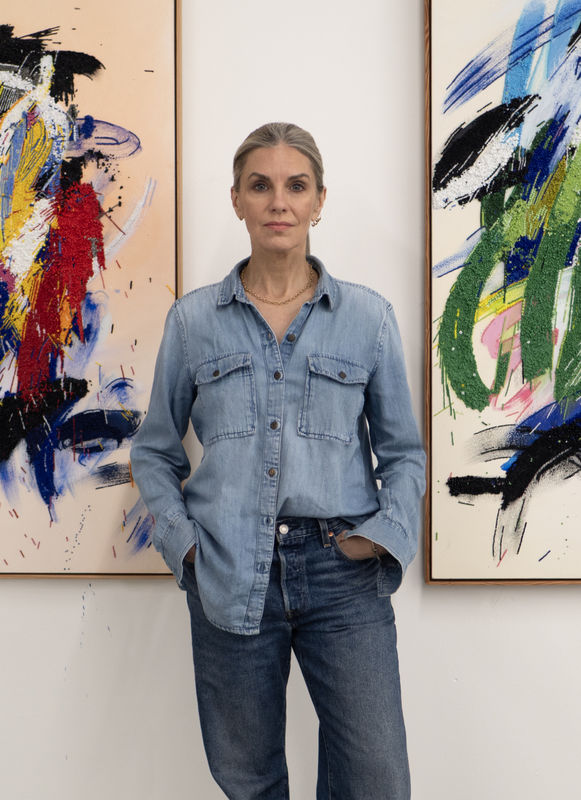
Through a complex balance between figuration and abstraction, his practice explores the unstable relationships between personal experience, collective history, and the construction of images.
Born from the intersection of memory and invention, Banisadr’s paintings unfold as intricate visual ecosystems in which forms, colours, and gestures remain in constant movement. His childhood experiences in Tehran during the Iran-Iraq War — which he has often described through fragmented impressions of sounds, images, and sensations — continue to inform a practice in which reality is not reproduced, but reimagined through the processes of perception and transformation.
A central element of Banisadr’s work is his experience of synaesthetic perception, through which sound and colour are perceived as interconnected. This condition becomes a visual language: colour acquires rhythm, brushstrokes suggest movement, and the painted surface becomes a field of simultaneous energies. His compositions emerge through a dialogue between precision and spontaneity, accumulation and erasure, creating images that appear to evolve before the viewer’s eyes.
Margherita Artoni: Your paintings often emerge from the intersection of personal memory and collective history. Your childhood experiences in Tehran during the Iran-Iraq War have been described through fragmented impressions of sounds, images, and sensations — memories suspended between abstraction and recognition. How has this relationship between memory and experience shaped your understanding of painting? How does a past event become transformed into an image belonging to the present?
Ali Banisadr: Since I was a child, I have used images to build an internal world in order to understand the external one. My experience of the Iran-Iraq War was fragmented—sound, vibration, flashes of images, things half-seen or half-understood. I think this taught me very early that experience does not enter memory as a complete narrative. It becomes fragments, sensations, images, and sometimes abstractions.
That is still how I think about painting. I am not interested in illustrating a memory or reconstructing an event. I am interested in what happens to an experience once it has passed through memory, time, history, and imagination. By the time it arrives in a painting, it has already become something else. This also connects to my interest in the history and power of images. Images have their own memory. They travel through civilizations, disappear, return, and change meaning.
The past, for me, is never really past. It keeps circulating through the present. I sometimes think of time less as a straight arrow than as something circular or spiral-like. Things return, but they return transformed.
This is very present in my exhibitions Talisman at Thaddaeus Ropac and at the Musée Gustave Moreau. A talisman is itself an image or object carrying memory, belief, protection, and psychic energy across time. The paintings are not trying to revive the past nostalgically. They are asking how certain images continue to live inside us now. [...]