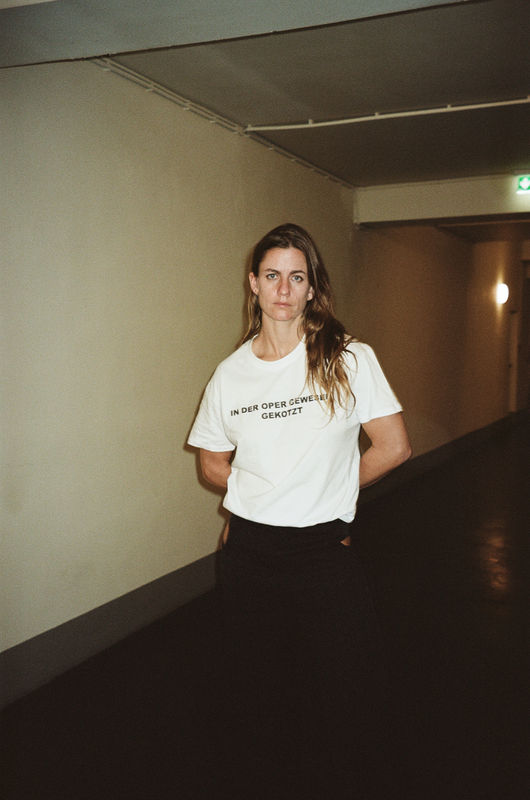
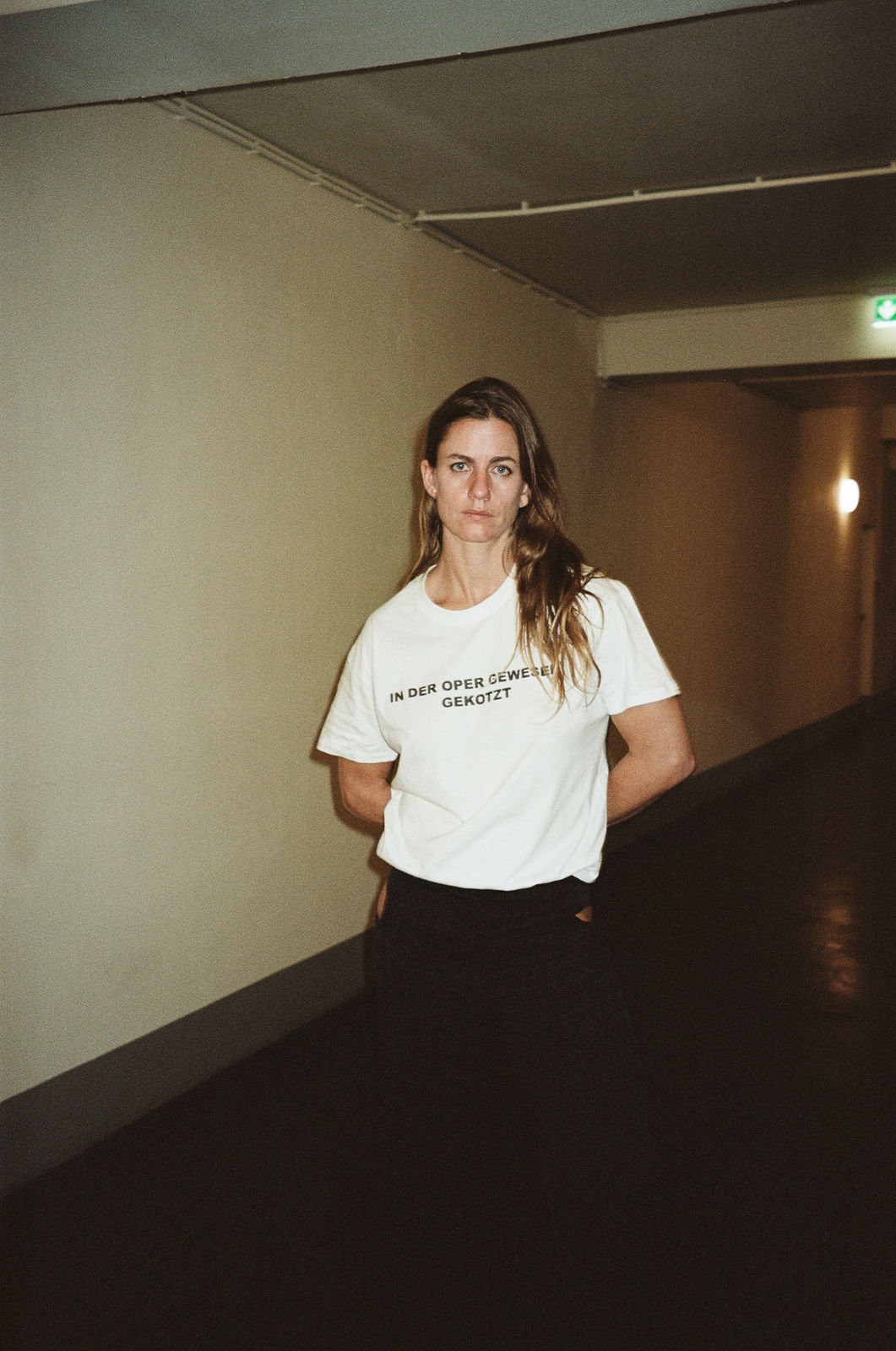
In the Waste of Others. Florentina Holzinger
By Jeanette Bisschops
It’s the first official pre-opening day of the 61st Venice Biennale and we, a group of eager art tourists, are huddling together on a pier. While the rain slowly falls down on us, we pile into several boats. We’re on our way to the much anticipated and highly exclusive Opening Étude of Florentina Holzinger’s SEAWORLD VENICE (2026). For those in the know, the choreographer and performance artist Holzinger started staging one-offs under the title of Études in 2020 as a way to experiment outside the black box theaters where she’s been staging her works since 2012. Taking her choreographies into public space has offered the artist a chance to create much more complex compositions in dialogue with architecture and natural elements.
Our boats are driven to an undisclosed location out on the water, dropping us off on floating bleachers. We rush to find a wet seat with the best view of the water while hiding under our umbrellas. While we wait, several unclothed women hang out on another platform. One group blatantly stares at us across the water, another forms a band, playing peaceful string drone music out onto the lagoon. A large industrial crane looms above them. A conductor, whom I recognize from an earlier Étude in Bergen, walks out between the musicians and the music picks up in intensity, transforming into noise metal. A guitarist starts climbing all the way up to the top of the crane, followed by a singer belting out screams across the water, a long-haired siren luring us in. They’re both safely secured, yet the stark contrast between their flesh and the cold imposing metal of the crane feels visceral, reinforced by the gray clouds and the pounding rain. Then, slowly, the crane dredges something heavy from the water, revealing a metal bell, from which a dripping wet Holzinger emerges, hanging upside down. How long had she been down there? Slowly she starts moving her body from side to side, banging her lower body against the metal, turning herself into a bell clapper, before being joined by another performer lifted on flesh hooks between her shoulder blades, slowly and serenely dancing in the air below her. This same bell ends up hanging at the Austrian pavilion, where a performer climbs inside and rings it every hour, instantly creating one of the most eidetic images of the Biennale.
That Holzinger was to become the darling of the 61st Venice Biennale was not a given. Since Anne Imhof won the Golden Lion for her work Faust in 2017, and was quickly followed by the “beach opera” Sun & Sea (Marina) by Rugilė Barzdžiukaitė, Vaiva Grainytė, and Lina Lapelytė in 2019, an important shift toward including performance in the traditionally sculpture- and painting-heavy setting of the Venice Biennale had been signaled. Holzinger, however, has mostly been visible in the dance and theater world. Part of a broader wave of theater-makers, from Miet Warlop to Dries Verhoeven, who are increasingly finding their way to Venice, for many in the visual arts this may well be a first encounter with her work. Often lauded as the superstar of contemporary European dance, she only slowly began to venture into the visual art world after her collaboration with German curator Nora-Swantje Almes at Bergen Kunsthall, where she staged Harbour Étude (2024), a high-stakes, open-air choreography commanding dance, stunts, heavy machinery, and natural elements.
Her audience seems polarized as always, but responds overwhelmingly positively toward the newcomer. At the inauguration, Holzinger’s athletic frame is clad in baggy sportswear rather than full designer swag, ready to plunge herself into the flooded pavilion. She speaks about failing systems, the political pressures bearing down on the Biennale, and the tensions causing the prize jury to resign. In the days after, people kept quoting her back to me. Holzinger’s SEAWORLD VENICE feels like an acknowledgement that individualism isn’t working anymore. When the Art Not Genocide Alliance (ANGA), in collaboration with Italian unions, calls a strike during the Biennale, every single one of Holzinger’s performers joins, bringing the pavilion to a standstill. In an art world that too often mistakes critique for action, people are responding to someone who simply shows up and builds something real.
[...]
Over the years, Holzinger has continued to insert her own body into her work while building close ties with her community. What isn’t immediately visible in the work is the depth of care behind it — for the performers, for the infrastructure, for the city of Venice itself. This type of high-stakes exploration is only possible through a high level of care and trust, something she has built and maintained over more than a decade with her group of collaborators. In SEAWORLD VENICE, her work has become more rigorous and more sincere. The 2026 Austrian Pavilion is thus not a stand-alone concept or just a self-described theme park where each performer does their trick, but a continuation of a training camp of sorts, for a life in the trenches. As Holzinger herself described it at the inauguration: “a way of life practiced in the waste of others.”