


Erwin Wurm
Tomorrow: Yes
17 January—11 April 2026
Paris Pantin

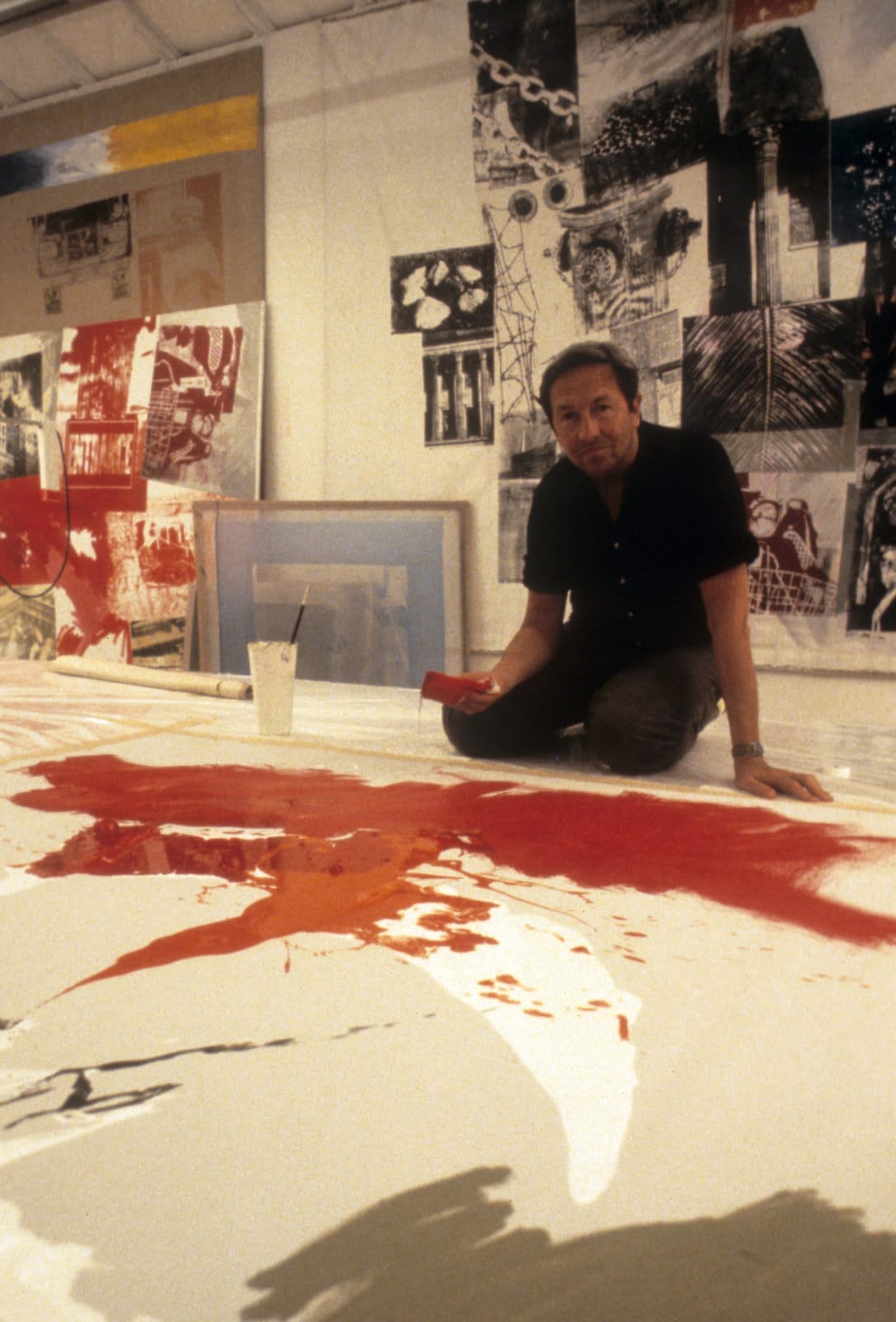
Created in 1990, Treadle / ROCI USA (Wax Fire Works) belongs to a decade-long experimentation with metal paintings commenced by Robert Rauschenberg in the mid-1980s. Taking a characteristically innovative approach to materials and technique, the artist exchanged the canvas for flat sheets of metal upon which he created silkscreened and hand-painted images. Composed of twenty metal paintings, the Wax Fire Works series (1990-91) was executed with the titular 'fire- wax' technique, the term Rauschenberg coined for a form of encaustic where hot wax, mixed with pigment, was screenprinted onto polished aluminium.
The Wax Fire Works series was conceived for the final leg of the artist's international touring project designed to foster peace through artistic collaboration, the Rauschenberg Overseas Culture Interchange (ROCI) project. Pronounced 'Rocky' after the artist's pet turtle, ROCI comprised a series of exhibitions in participating countries in which Rauschenberg presented works that engaged with techniques, materials and imagery particular to each location. The project culminated in an exhibition at the National Gallery of Art, Washington, D.C. in 1991, where Treadle was first shown.
Articulated in a palette of red, white and blue to evoke the flag of the United States, the imagery used in Treadle is taken from the artist's own black-and-white photographs and references distinctly American symbolism, including the bald eagle. Encapsulating Rauschenberg's penchant for wordplay, the title names the foot pedal used to manually operate machinery using a circular motion, thematically imbuing the work with ideas of cyclical movement. The image of the tyres evokes mobility or freedom, while citing the importance of the motif in the artist's wider oeuvre, for instance the tyre that encircles the body of a taxidermied goat in his iconic Combine Monogram (1955-59), now housed in the collection of the Moderna Museet, Stockholm.
In turn, the image of an arrow has been printed, rotated and reprinted to create a sense of circular directionality. Anticipating his subsequent series of metal paintings on mirrored aluminium, Phantom and Night Shades (both 1991), the arrows instruct the viewer to look again, as they consider the relationship of their own body to the work. The reflective quality of Treadle, combined with the layering of screenprinted imagery, is undertaken in service to Rauschenberg's declared goal 'to make a surface which invited a constant change of focus and an examination of detail.'