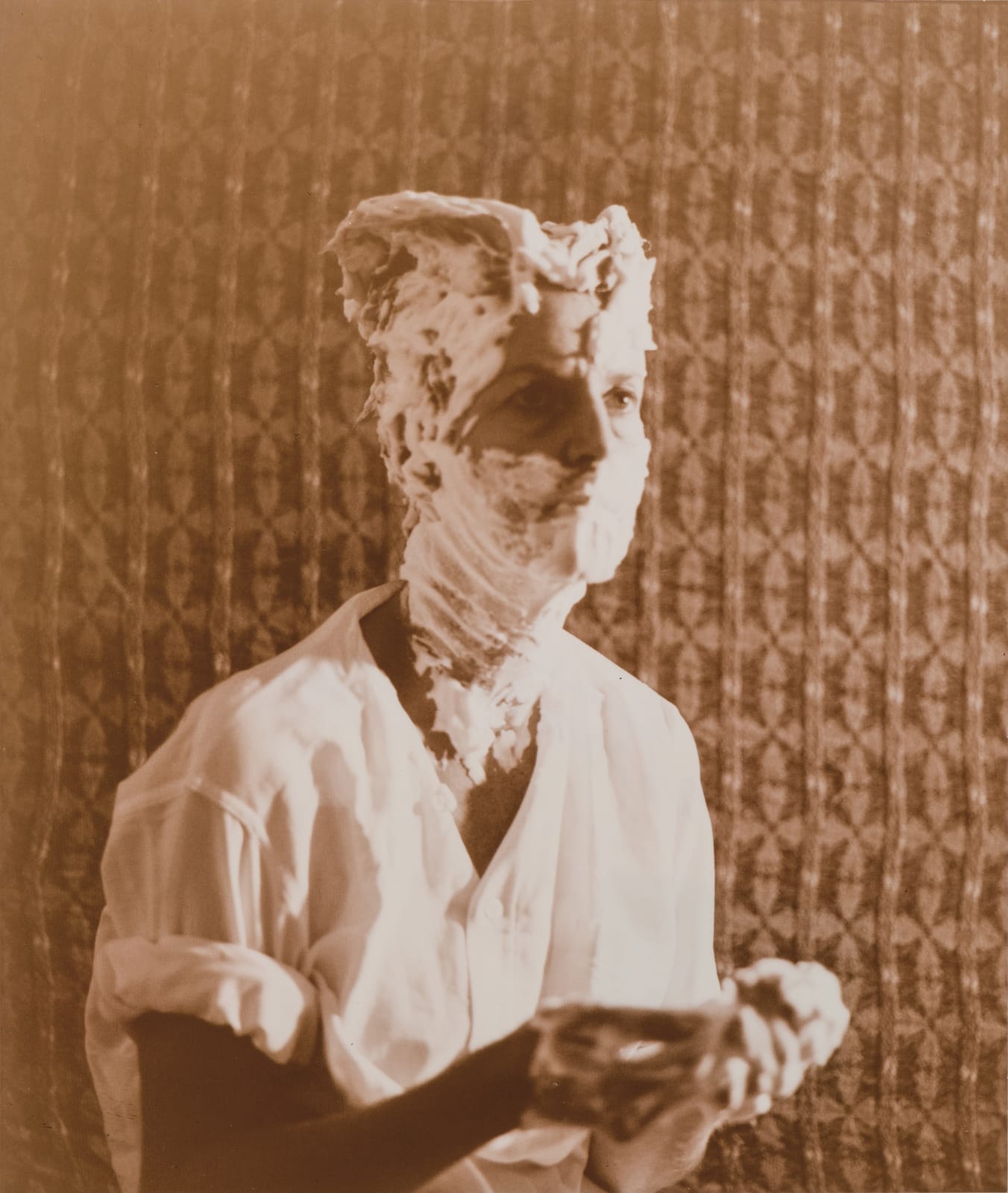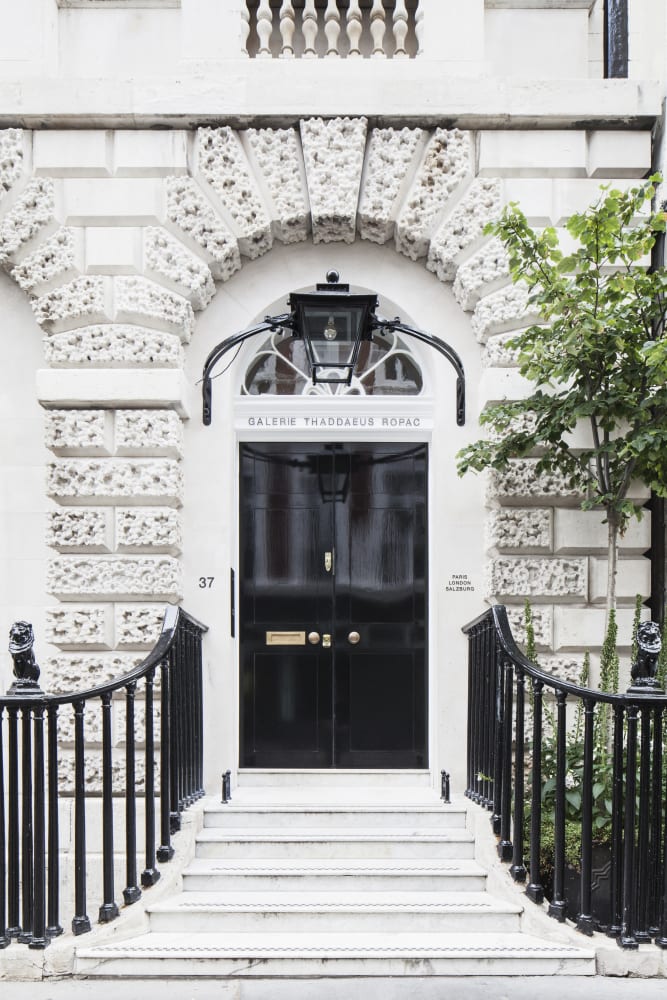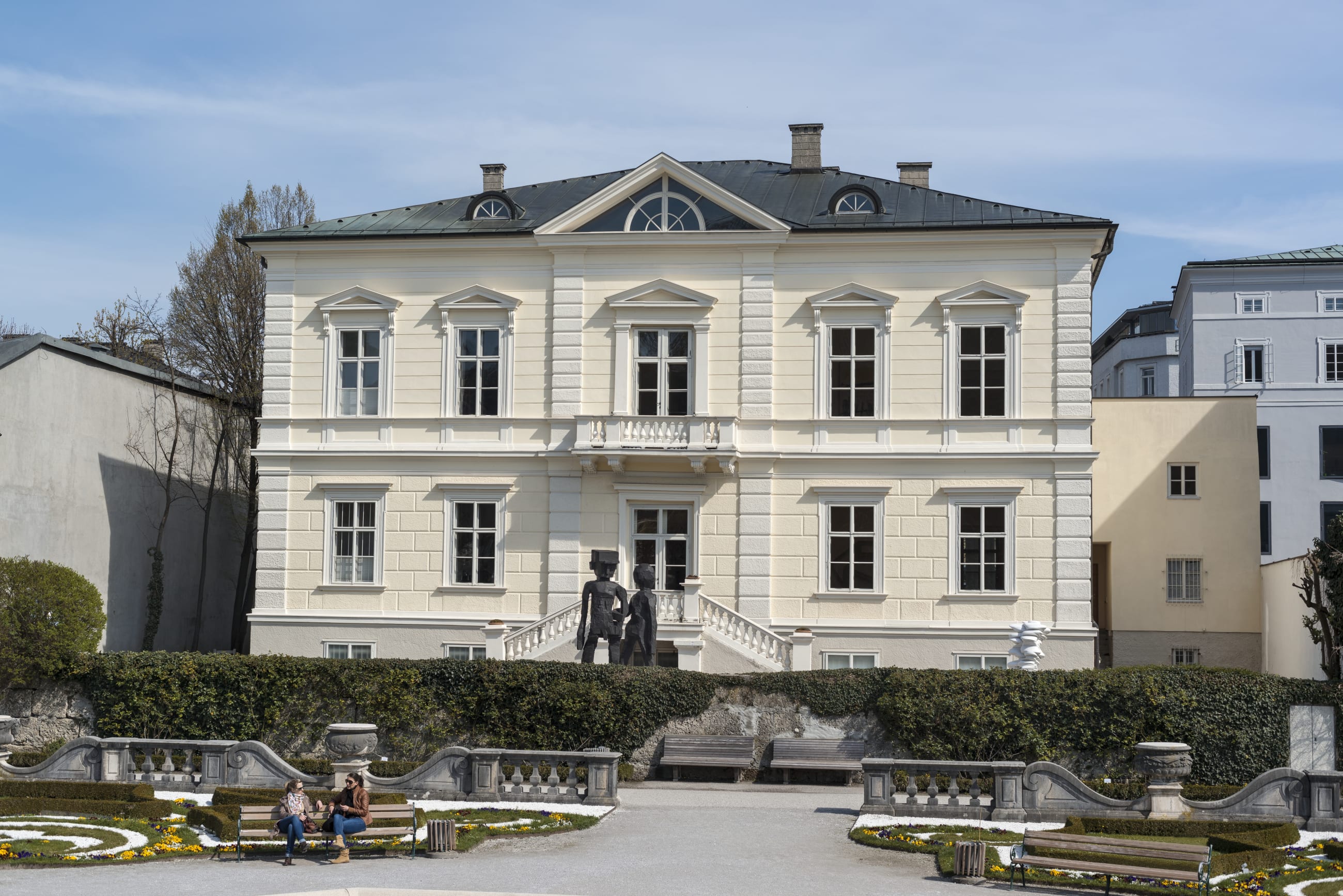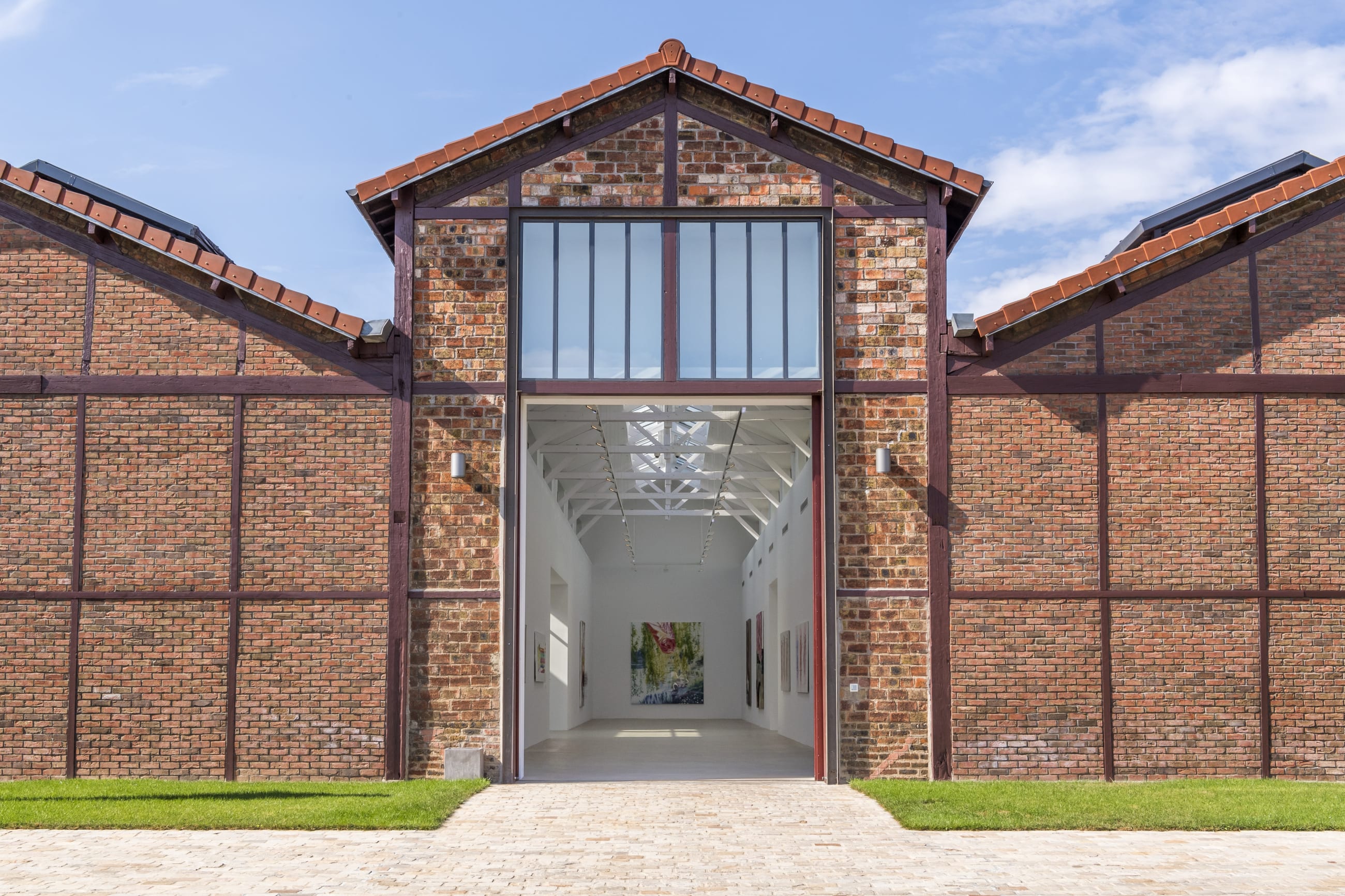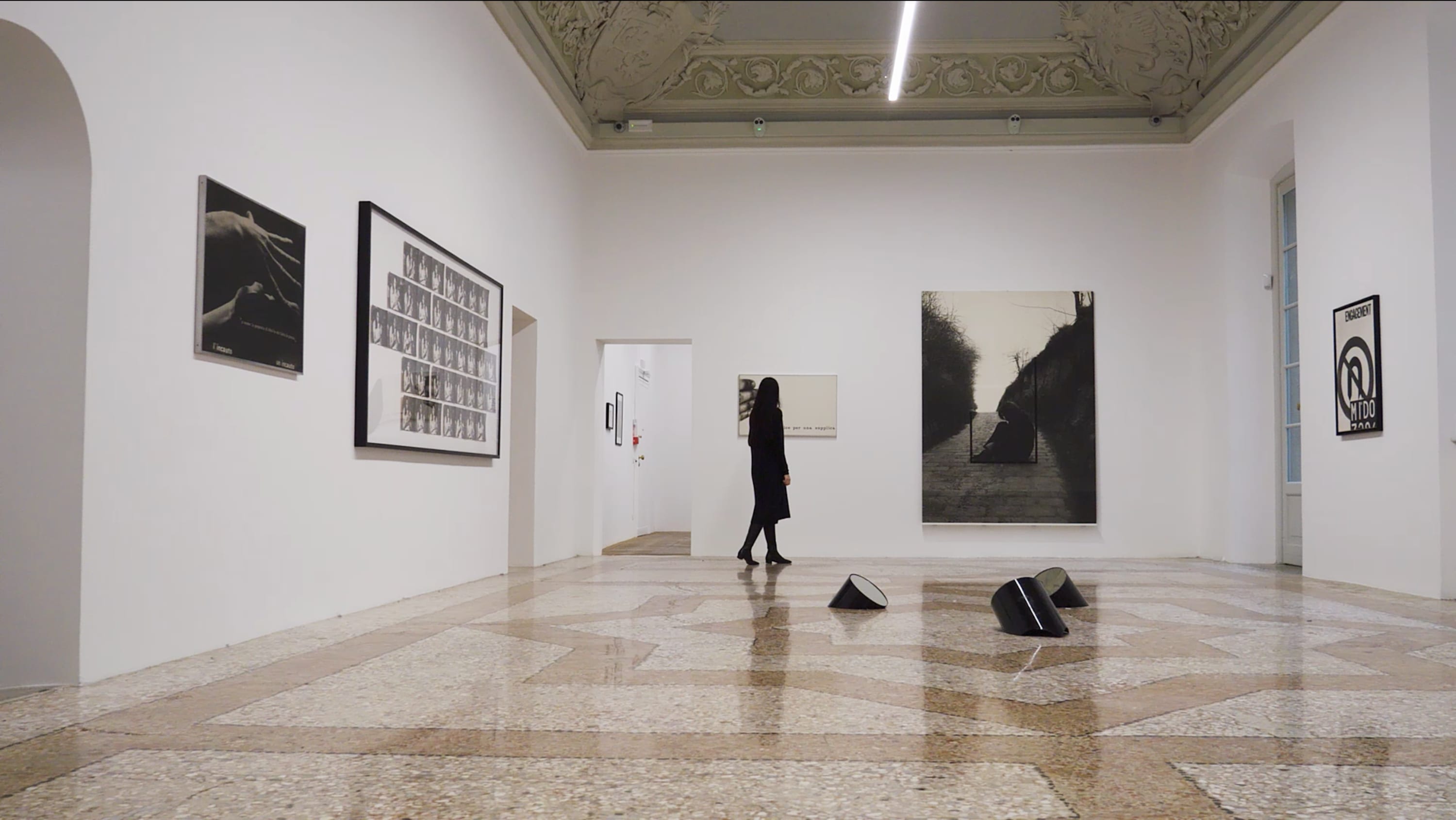
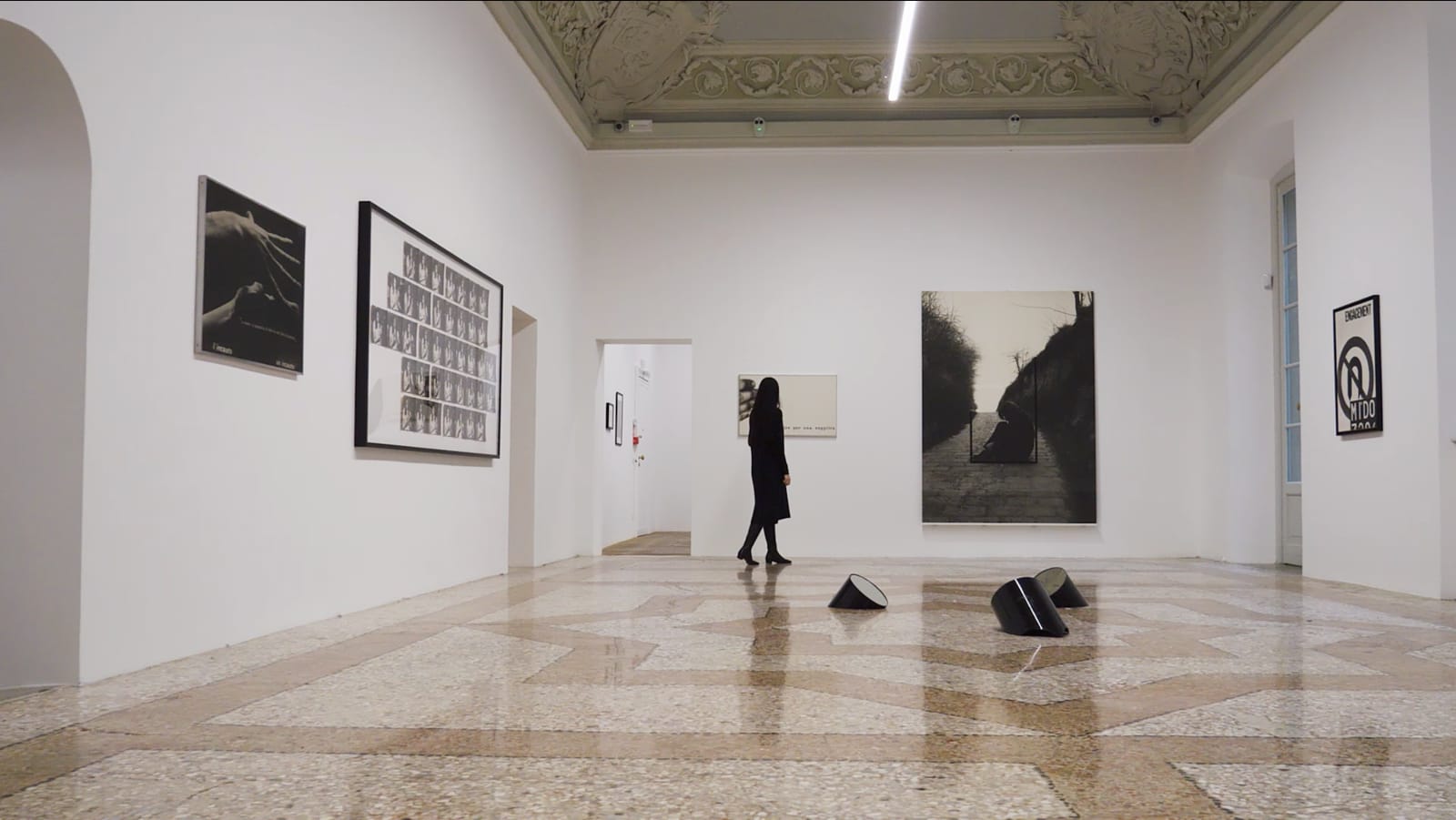
Curated by Andrea Maurer and Alberto Salvadori in collaboration with Studio VALIE EXPORT and the KETTY LA ROCCA Estate, the show stages an unprecedented dialogue between two of the most visionary feminist conceptual artists to emerge in Europe during the 1960s. Both artists placed their own bodies at the centre of their experiments across photography, video, performance and sculpture, to challenge language’s patriarchal function, and expose how it operates in public and private space.
Watch a video of VALIE EXPORT discussing the exhibition.


VALIE EXPORT
BODY SIGN B, 1970
Black and white photograph
44.6 × 30.4 cm (17.56 × 11.97 in)
BODY SIGN B (1970) is part of the photographic series BODY SIGN, which lends the exhibition its title. In this work, EXPORT engages with the visual language of sexuality. The artist is depicted hoisting her dress and defiantly meeting the viewer’s gaze as she reveals a tattoo of a garter on her thigh. The pose is deliberate and confrontational: EXPORT exposes both the tattoo and the mechanisms of looking that have historically defined the female body as an object of desire. She understood tattooing as a form of inscription that reveals how cultural rituals, power structures and gender norms are written onto the body. As she wrote: ‘In the tattoo the garter appears as a sign of a past enslavement, clothing as the suppression of sexuality, the garter as an attribute of a femininity not determined by ourselves.’
Women have no time for declarations:
they have too much to do, and moreover they would then have to use
language that is not their own, language that is both alien and hostile to them.
— KETTY LA ROCCA

Ketty La Rocca
J with dot (3 dimensions), 1970
Pvc plastic
117 × 50 × 11 cm (46.06 × 19.69 × 4.33 in)
Ketty La Rocca's semiotic experimentation is evident in J with dot (three dimensions) (1970), a human-sized, black PVC ‘J’ – a letter that is absent from her native Italian alphabet – that denotes the French Je, or ‘I’. As curator Angelika Stepken writes, La Rocca ‘isolated alphabetical letters and signs not only from the logic of meaning that language gives them, but also from their support, the canvas or surface.’

Ketty La Rocca
Con attenzione, 1971
Photo and ink
12.5 × 17.4 cm (4.92 × 6.85 in)
In the subsequent photograph Con attenzione (1971), La Rocca takes the linguistic character to bed, creating a scene of both identification and estrangement between language and self. Locking eye contact with the viewer from beneath the sheets, La Rocca makes a wry commentary on the shortcomings of language as a means of communication.
In the 1960s, our attempts to cultivate a direct and uncontrolled language in art were based upon the idea that the dominant language was a form of manipulation.
The plan was to circumvent these forms of social control. [...]
This was the strength of the female body: to be able to express directly and without mediation.

VALIE EXPORT
Aufhockung, 1972/1980
Black and white silver gelatin print on baryta paper laid on chip board, overpainted
230.5 × 170 cm (90.75 × 66.93 in)
Aukhockung (Perching On, 1972/1980) is one of the earliest examples from Body Configurations (1972–82), the most significant series of photographic experiments by VALIE EXPORT in which she uses her own body to visualise the internal accommodations we make in response to nature, architecture and culture. In Aukhockung (Perching On, 1972/1980) EXPORT positions herself in the middle of a stone pathway, crouching with her knees pulled up to her chest and her head bowed. The path leads beyond the horizon into the open air. Three straight black lines are painted around the body, framing and caging her huddled figure. VALIE EXPORT described the work as an image of self-imposed confinement: even when there are no external obstacles and the path is open, freedom of movement remains impossible as long as internalised structures of constraint persist. The work suggests that liberation cannot be achieved through external conditions alone, but requires a transformation from within.

VALIE EXPORT
Einkreisung, 1976/1980
Black and white silver gelatin print on baryta paper laid on chip board
100 × 170 (39.37 × 66.93 in)
Since the beginning of the 1970s, I have addressed – through actionism, photography and drawing – the subject of representing body posture as an expression of inner states. […] I associate architecture with the female body. In different forms, positions and impressions, I set the architecture of the female body within the architecture of nature or the urban environment. The body becomes the extension of the architecture, extending architectural elements and structures.
— VALIE EXPORT

Ketty La Rocca
Craniologia n. 8, 1973
X-ray film and ink
70 × 50 cm (27.6 × 19.7 in)
The mystifying dimension of language has thus made the face of man, corroded it and for this reason I superimpose the gesture of the hand in all its expressiveness and communicative simplicity inside the skull, where the brain has given birth to the entirety of human thought and human language.
— KETTY LA ROCCA
La Rocca considers language’s origination from within the body with her Craniologie series (1973). Here, an X-ray image of a skull is double-exposed with a photograph of a hand – with an outstretched index finger – and overlaid with the handwritten words ‘you, you, you’. Integrating the external and internal, mind and body, and word and image, La Rocca exposes the insufficiencies of each medium in isolation and simultaneously cultivates her own proto-feminist visual language.
Hands play a central role in both artists’ work, as instruments of perception and as vehicles for conveying meaning beyond words. This emphasis on the tactile countered Conceptual art’s dematerialisation of the art object, expanding its very framework by declaring the body itself as an accomplice of the conceptual.

Ketty La Rocca
Appendice per una supplica, 1972 (excerpt)
Two colour video, silent
In Appendice per una supplica (1972) by Ketty La Rocca, female and male hands perform a sequence of movements, evoking sign language but with no key in sight. As Dr Amy Tobin writes, ‘these are not works to be decoded, but invitations to short-circuit and dwell in other potential modes of communication.’
The gesture as opposed to the word, the gesture as a universal language.

Ketty La Rocca
Appendice per una supplica, 1972
Photograph with hand-painted intervention
Each 17.5 × 23.8 cm (6.89 × 9.37 in)

VALIE EXPORT
SYNTAGMA, 1983 (excerpt)
16 mm, 18 min, colour
Ed. 9 of 10
I had once written in a text, ‘My hands are my identity.’ And I really felt that way. That my hands are my identity. They show age, they show gestures, they show movement, they show feelings. Hands are very expressive because they are so mobile. You can paint, you can strike. You can be tender, you can work with them. You can do all kinds of work with your hands. That's the most important thing.
— VALIE EXPORT

VALIE EXPORT lives and works in Vienna. A pioneer in conceptual photography, video and performance art, she has produced one of the most significant bodies of feminist art since the 1960s. In 1967, she adopted the name VALIE EXPORT, a bold reinvention that marked the beginning of her new artistic identity. In 1968, she co-founded the Austrian Filmmakers Cooperative. She has participated in numerous international exhibitions, including documenta 6 and 12 (1977 and 2007) and the Austrian Pavilion at the 39th Venice Biennale in 1980. In recent years, her work has been exhibited at MAK Center for Art and Architecture at Schindler House, Los Angeles (2024); C/O Berlin Foundation (2024); Albertina, Vienna (2023); Fotomuseum Winterthur (2023); Kunsthaus Bregenz (2023); Staatliche Kunsthalle Baden-Baden (2020); Pavillon Populaire, Montpellier (2019); Lentos Kunstmuseum Linz (2017); Belvedere Museum, Vienna (2010); Israel Museum, Jerusalem (2009); and Centre Pompidou, Paris (2007).
EXPORT has taught at a number of international institutions, including the University of Wisconsin, San Francisco Art Institute and University of the Arts in Berlin. From 1995–2005 she was professor of multimedia and performance at the Academy of Media Arts in Cologne. In 2019, she was awarded the Roswitha Haftmann Prize in recognition of her outstanding contributions to the visual arts. EXPORT received the Max-Beckmann-Prize of the City of Frankfurt 2022. With the purchase of her premature legacy, the VALIE EXPORT Center Linz was founded in 2015, laying the foundations for an international research centre for media and performance art. In 2023, the artist established the VALIE EXPORT FOUNDATION in Vienna, a non-profit that aims to preserve and research the artist’s work.

KETTY LA ROCCA (1938–1976) was one of the most original and influential figures in Italian art between the mid-1960s and mid-1970s, standing at the crossroads of Body Art, Visual Poetry, and Conceptual research. In 1972 she was invited to participate in the 36th Venice Biennale, and henceforth her work gained widespread national and international visibility, featuring in the exhibition Photography Into Art at the Camden Art Centre, London, that same year. She received a retrospective exhibition at the 38th Venice Biennale (1978) and has been featured in numerous significant exhibitions focused on the relationship between art and feminism, including Wack! Art and Feminist Revolution at The Museum of Contemporary Art, Los Angeles (2007) and Woman: feminist avant-garde in the 70s at the Galleria Nazionale d’Arte Moderna e Contemporanea, Rome (2010). Her works have been exhibited at numerous international institutions, including the Museum of Contemporary Photography, Chicago (2025); EMMA - Espoo Museum of Modern Art (2025); MAMbo - Museo d’Arte Moderna di Bologna (2025); Tate Modern, London (2024); Hamburger Kunsthalle (2022); LE BAL/Jeu de Paume, Paris (2022); Kunsthaus Graz (2022); MAMAC - Musée d’Art Moderne et d’Art Contemporain, Nice (2022); Kunsthalle zu Kiel (2021); MUSEION, Bolzano (2019); Kunsthalle Schirn, Frankfurt (2016); Albertina, Vienna (2012); and MoMA PS1, New York (2007).
Today, her works are held in major international collections, including the Centre Pompidou, Paris; The Museum of Modern Art, New York; The Museum of Contemporary Art, Los Angeles; Museum Ostwall, Dortmund; Gallerie degli Uffizi, Florence; Galleria Nazionale d’Arte Moderna e Contemporanea, Rome; and Mart Rovereto. Her work was recently the subject of a major solo museum exhibition, entitled Ketty La Rocca: you you, at the Estorick Collection of Modern Italian Art, London (2025).