Overview
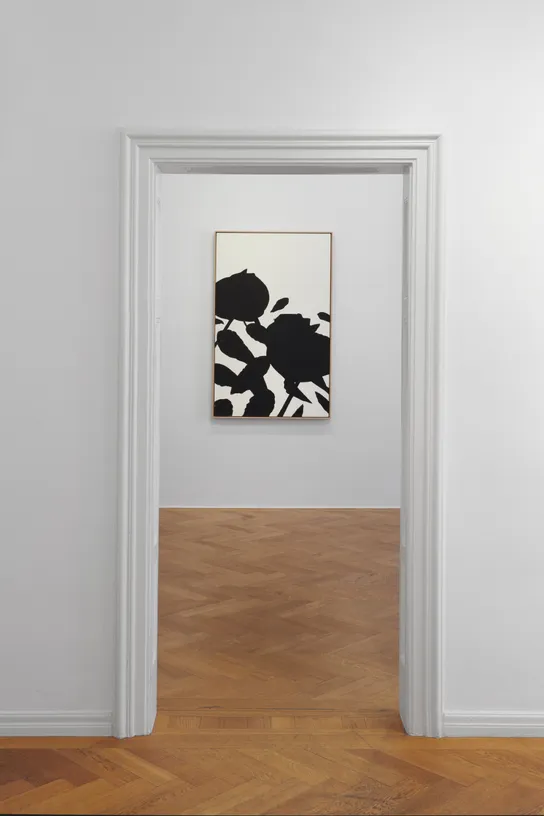
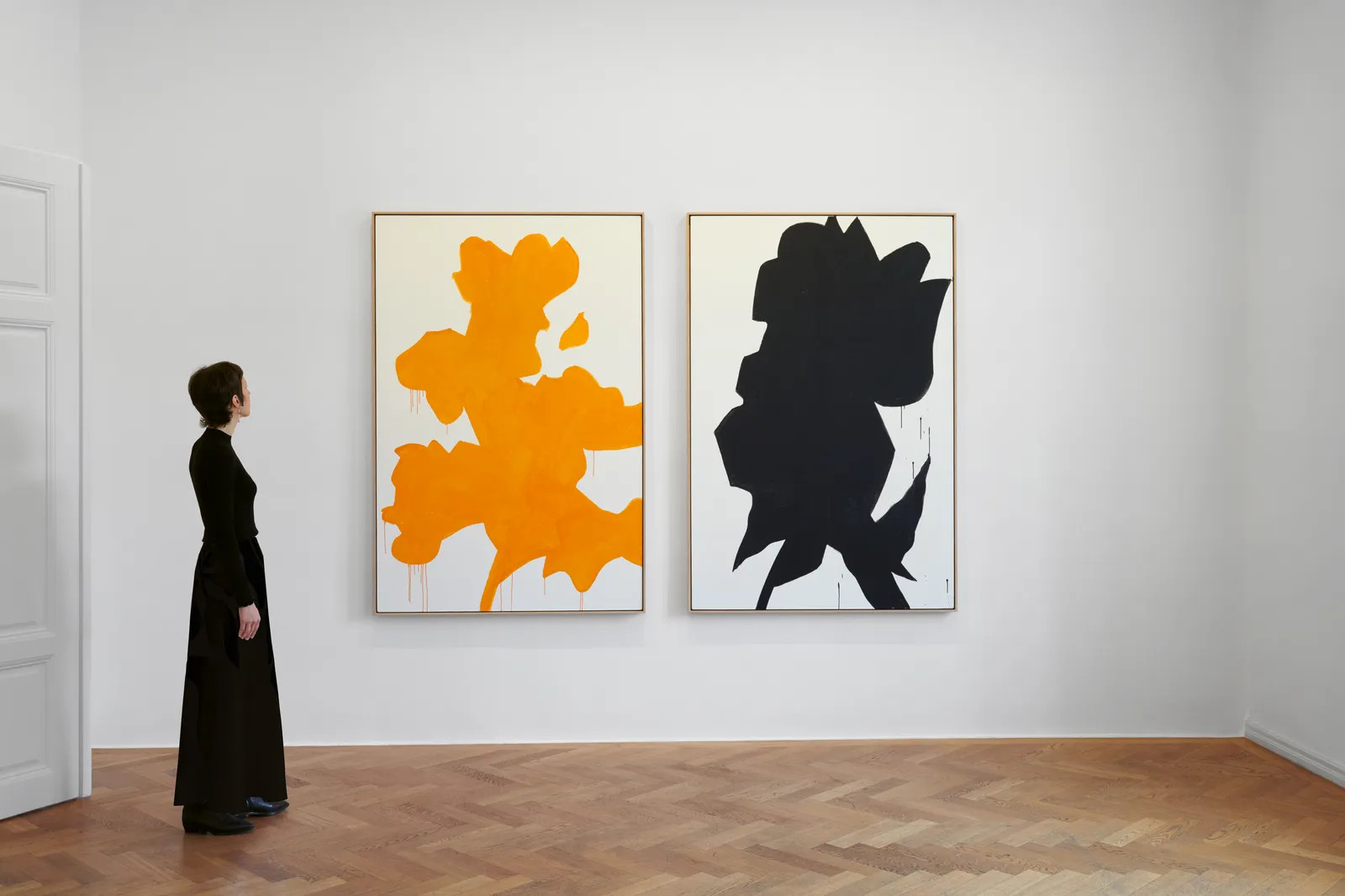
Thaddaeus Ropac Salzburg presents a series of new paintings by Alex Katz, all created within the last year. With these large-scale canvases, the American artist returns to the depiction of flowers, a motif that has featured in his work throughout his career. Subtle and sparing, this most recent group of works testifies to his sustained exploration of abstraction: Katz distils the flowers into rhythmically arranged areas of opaque fields of paint. By eliminating the roses of any form of visual adornment and flattening their complexity in favour of rhythm and space, Katz turns the motif into something almost sculptural. The artist is known for his striking use of colour, and here, he emphasises the basic shapes of petals and buds by restricting his palette to black or orange against white backgrounds, creating dynamic compositions that appear as snapshots of an ongoing movement.
Framed as cinematic close-ups, Katz’s roses convey a striking feeling of immediacy, further enhanced by their sheer scale. The compositions could theoretically be continued indefinitely, transposing the ‘all-over’ treatment of the canvas found among Abstract Expressionists to create paintings that convey a boundless, immeasurable reality. The flowers take on a distinct presence: their two-dimensional shapes, layered against the flat background, are detached from their environment. While Katz has often presented flowers embedded in rich meadows or vast fields, in this series, he does not reveal the surrounding environment in which these seemingly carefully chosen blooms are set. The stark contrast between form and ground is softened only by drips and splatters of paint, which disrupt the controlled surface around the silhouetted blooms.
The roses’ scale and lack of context – neither their setting nor the time of day can be gauged from these depictions – create a sense of remove, while simultaneously highlighting the importance of surface in Katz’s paintings as a site of heightened experience. Neither black nor this shade of bold orange are colours traditionally associated with roses. For this series, Katz pushes the boundaries of his characteristic illusionistic approach, and it remains uncertain here whether we encounter the flowers outdoors or as traditional still lifes, further contributing to the sense of mystery surrounding these pared-back depictions. The sense of colour, composition and economy of means in the works recalls, in particular, Henri Matisse’s cut-outs, at once for their flat planes of contrasting colour, and for their half-vegetal, half-abstract forms.
For me, there’s nothing more mysterious than appearances, I can’t think of anything more exciting than the surface of things. — Alex Katz
Katz began painting wild flowers in the 1960s, finding in them the sense of movement he felt was absent from portraiture. In 1966, for the first time, they became the main subject of a series of monumental paintings. ‘It started in the rain,’ the artist has stated. ‘I cut flowers and put them in a vase, and started painting them. Years later, it’s the same process, but this time around, I was more interested in the flowers rather than the vase.’ While the depiction of flowers in art has historically taken on a variety of meanings, ranging from from Baroque ornamentation to the symbolism of 17th-century Dutch still lifes, Katz’s roses take on a meaning all their own, or as Prudence Peiffer writes in the exhibition catalogue for Katz’s Guggenheim retrospective: ‘there is no more serious flower than Katz’s […] he makes these familiar objects a little unknowable.’